Meise Kristine, Mueller Birte, Zein Beate, Trillmich Fritz
Department of Animal Behaviour, University of Bielefeld, Bielefeld, Germany.
PLoS One. 2014 Jul 2;9(7):e101197. doi: 10.1371/journal.pone.0101197. eCollection 2014.
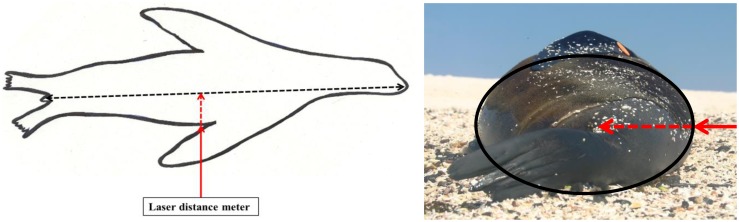
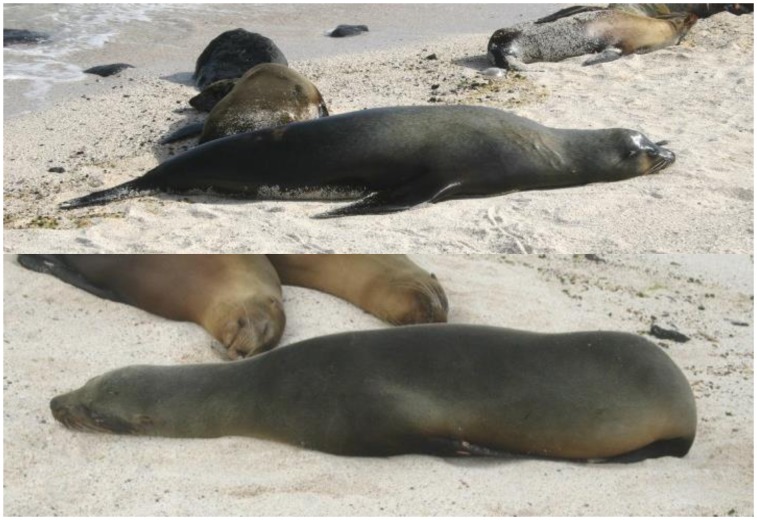
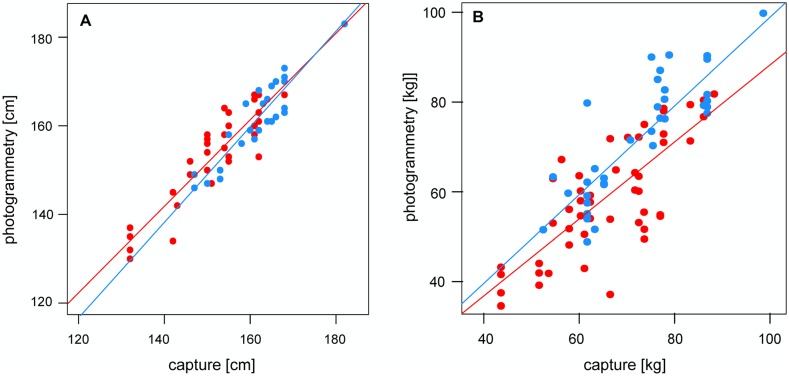
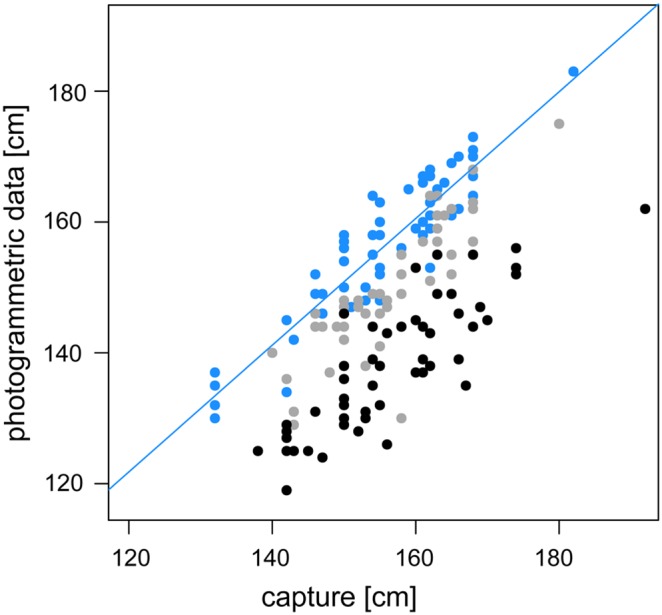
Morphological features correlate with many life history traits and are therefore of high interest to behavioral and evolutionary biologists. Photogrammetry provides a useful tool to collect morphological data from species for which measurements are otherwise difficult to obtain. This method reduces disturbance and avoids capture stress. Using the Galapagos sea lion (Zalophus wollebaeki) as a model system, we tested the applicability of single-camera photogrammetry in combination with laser distance measurement to estimate morphological traits which may vary with an animal's body position. We assessed whether linear morphological traits estimated by photogrammetry can be used to estimate body length and mass. We show that accurate estimates of body length (males: ±2.0%, females: ±2.6%) and reliable estimates of body mass are possible (males: ±6.8%, females: 14.5%). Furthermore, we developed correction factors that allow the use of animal photos that diverge somewhat from a flat-out position. The product of estimated body length and girth produced sufficiently reliable estimates of mass to categorize individuals into 10 kg-classes of body mass. Data of individuals repeatedly photographed within one season suggested relatively low measurement errors (body length: 2.9%, body mass: 8.1%). In order to develop accurate sex- and age-specific correction factors, a sufficient number of individuals from both sexes and from all desired age classes have to be captured for baseline measurements. Given proper validation, this method provides an excellent opportunity to collect morphological data for large numbers of individuals with minimal disturbance.
形态特征与许多生活史特征相关,因此受到行为生物学家和进化生物学家的高度关注。摄影测量法为从难以进行测量的物种中收集形态数据提供了一种有用的工具。这种方法减少了干扰并避免了捕获压力。以加拉帕戈斯海狮(Zalophus wollebaeki)作为模型系统,我们测试了单相机摄影测量法与激光测距相结合来估计可能随动物身体位置变化的形态特征的适用性。我们评估了通过摄影测量法估计的线性形态特征是否可用于估计体长和体重。我们表明,有可能准确估计体长(雄性:±2.0%,雌性:±2.6%)并可靠估计体重(雄性:±6.8%,雌性:14.5%)。此外,我们开发了校正因子,允许使用与完全平躺姿势略有不同的动物照片。估计的体长和胸围的乘积产生了足够可靠的体重估计值,可将个体分类到10千克的体重等级中。在一个季节内对个体进行多次拍摄的数据表明测量误差相对较低(体长:2.9%,体重:8.1%)。为了开发准确的性别和年龄特异性校正因子,必须捕获足够数量的来自不同性别和所有期望年龄组的个体进行基线测量。经过适当验证后,这种方法为在最小干扰的情况下为大量个体收集形态数据提供了绝佳机会。