Dhakal Kiran, Uwimana Eric, Adamcakova-Dodd Andrea, Thorne Peter S, Lehmler Hans-Joachim, Robertson Larry W
Interdisciplinary Graduate Program in Human Toxicology and ‡Department of Occupational and Environmental Health, The University of Iowa , Iowa City, Iowa 52242-5000, United States.
Chem Res Toxicol. 2014 Aug 18;27(8):1411-20. doi: 10.1021/tx500150h. Epub 2014 Jul 15.
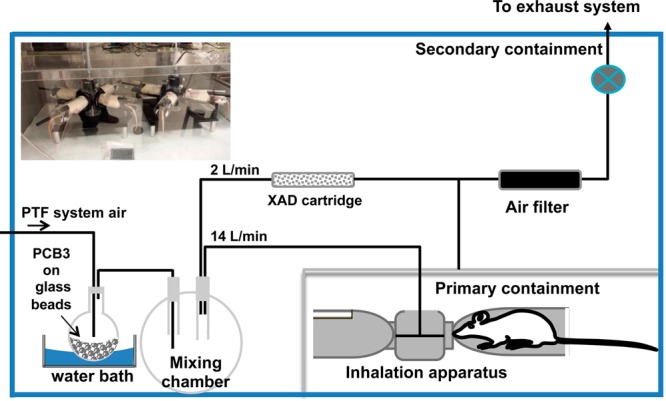
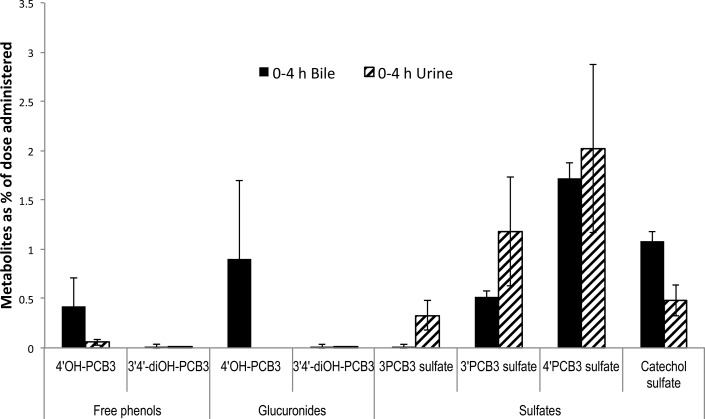
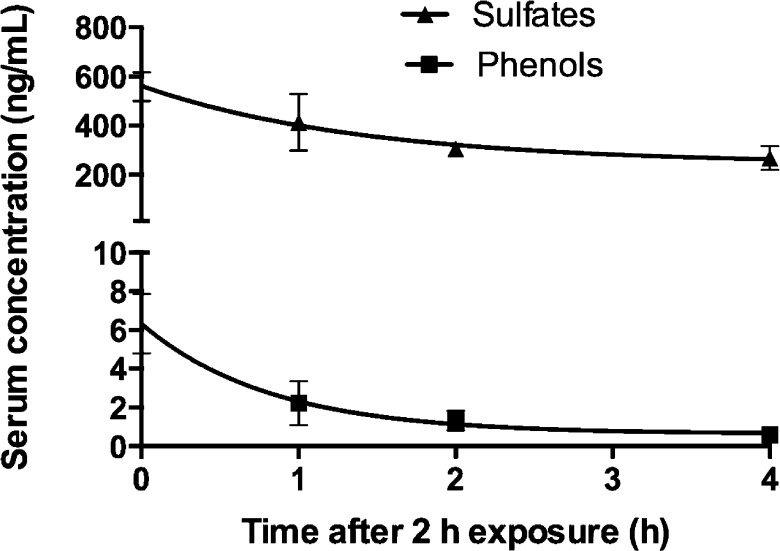
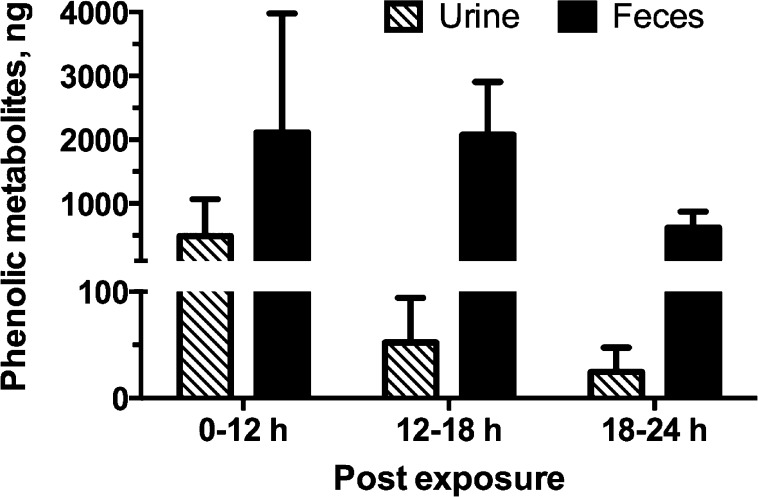
PCBs, such as PCB3, are air contaminants in buildings and outdoors. Metabolites of PCB3 are potential endocrine disrupting chemicals and genotoxic agents. We studied the disposition of phenolic and sulfated metabolites after acute nose-only inhalation exposure to airborne PCB3 for 2 h in female rats. Inhalation exposure was carried out in three groups. In the first group, rats exposed to an estimated dose of 26 μg/rat were euthanized at 0, 1, 2, and 4 h after exposure. Highest concentrations of phenols and sulfates were observed at 0 h, and the values were 7 ± 1 and 560 ± 60 ng/mL in serum, 213 ± 120 and 842 ± 80 ng/g in liver, 31 ± 27 and 22 ± 7 ng/g in lung, and 27 ± 6 and 3 ± 0 ng/g in brain, respectively. First-order serum clearance half-lives of 0.5 h for phenols and 1 h for sulfates were estimated. In the second group, rats exposed to an estimated dose of 35 μg/rat were transferred to metabolism cages immediately after exposure for the collection of urine and feces over 24 h. Approximately 45 ± 5% of the dose was recovered from urine and consisted mostly of sulfates; the 18 ± 5% of the dose recovered from feces was exclusively phenols. Unchanged PCB3 was detected in both urine and feces but accounted for only 5 ± 3% of the dose. Peak excretion of metabolites in both urine and feces occurred within 18 h postexposure. In the third group, three bile-cannulated rats exposed to an estimated dose of 277 μg/rat were used for bile collection. Bile was collected for 4 h immediately after 2 h exposure. Biliary metabolites consisted mostly of sulfates, some glucuronides, and lower amounts of the free phenols. Control rats in each group were exposed to clean air. Clinical serum chemistry values, serum T4 level, and urinary 8-hydroxy-2'-deoxyguanosine were similar in treated and control rats. These data show that PCB3 is rapidly metabolized to phenols and conjugated to sulfates after inhalation and that both of these metabolites are distributed to liver, lungs, and brain. The sulfates elaborated into bile are either reabsorbed or hydrolyzed in the intestine and excreted in the feces as phenols.
多氯联苯,如多氯联苯3,是建筑物内和室外的空气污染物。多氯联苯3的代谢产物是潜在的内分泌干扰化学物质和基因毒性剂。我们研究了雌性大鼠经鼻仅吸入空气中的多氯联苯3 2小时后酚类和硫酸化代谢产物的处置情况。吸入暴露分为三组进行。在第一组中,暴露于估计剂量为26μg/只的大鼠在暴露后0、1、2和4小时处安乐死。在0小时时观察到血清中酚类和硫酸盐的最高浓度,血清中分别为7±1和560±60 ng/mL,肝脏中为213±120和842±80 ng/g,肺中为31±27和22±7 ng/g,脑中为27±6和3±0 ng/g。估计酚类的血清一级清除半衰期为0.5小时,硫酸盐为1小时。在第二组中,暴露于估计剂量为35μg/只的大鼠在暴露后立即转移到代谢笼中,收集24小时的尿液和粪便。约45±5%的剂量从尿液中回收,主要为硫酸盐;从粪便中回收的剂量的18±5%仅为酚类。尿液和粪便中均检测到未改变的多氯联苯3,但仅占剂量的5±3%。代谢产物在尿液和粪便中的排泄峰值在暴露后18小时内出现。在第三组中,三只经胆管插管的大鼠暴露于估计剂量为277μg/只,用于收集胆汁。在暴露2小时后立即收集4小时的胆汁。胆汁代谢产物主要为硫酸盐、一些葡糖醛酸苷和少量游离酚类。每组的对照大鼠暴露于清洁空气中。治疗组和对照组大鼠的临床血清化学值、血清T4水平和尿8-羟基-2'-脱氧鸟苷相似。这些数据表明,多氯联苯3吸入后迅速代谢为酚类并与硫酸盐结合,并且这两种代谢产物均分布到肝脏、肺和脑中。排入胆汁的硫酸盐在肠道中要么被重新吸收要么被水解,并以酚类形式随粪便排出。