Yang Yi, Yao Zhenjun, Dai Wenda, Shi Peng, Luo Lei, Zhang Chi
J Orthop Surg Res. 2014 Jul 8;9:52. doi: 10.1186/s13018-014-0052-0.
There has been no effective method to monitor the changes of blood coagulation after thromboprophylaxis for elective arthroplasty patients. The objective of this study is to assess the coagulation status of patients undergoing arthroplasty with thromboelastograph (TEG).
Ninety patients undergoing primary elective unilateral arthroplasty were investigated. Thromboprophylaxis continued for at least 10 days. TEG was performed on the day before the operation and on postoperative days 1, 4, and 9.
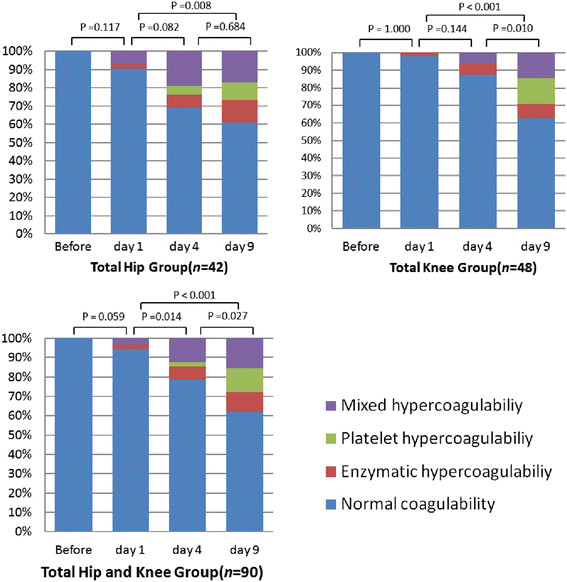
The total hip and total knee groups showed significant changes in the distribution of different hypercoagulable states on days 1-4 and on days 4-9. On day 9 after operation, 34 out of 90 (37.8%) of the total hip and total knee patients were found with hypercoagulable state. Of these 34 patients with hypercoagulable state, 26 (76.5%) demonstrated platelet or mixed hypercoagulability.
Thrombelastography was an effective way to identify hypercoagulability in patients undergoing elective primary total knee and total hip replacement. Platelet may play an important role in the progress of blood hypercoagulability.
对于接受择期关节置换术的患者,在进行血栓预防后,尚无有效的方法来监测凝血变化。本研究的目的是使用血栓弹力图(TEG)评估接受关节置换术患者的凝血状态。
对90例行初次择期单侧关节置换术的患者进行研究。血栓预防持续至少10天。在手术前一天以及术后第1、4和9天进行血栓弹力图检测。
全髋关节和全膝关节置换组在术后第1至4天以及第4至9天不同高凝状态的分布有显著变化。术后第9天,90例全髋关节和全膝关节置换患者中有34例(37.8%)处于高凝状态。在这34例高凝状态患者中,26例(76.5%)表现为血小板或混合性高凝。
血栓弹力图是识别接受择期初次全膝关节和全髋关节置换患者高凝状态的有效方法。血小板可能在血液高凝过程中起重要作用。