Prisco Sasha Z, Prokop Jeremy W, Sarkis Allison B, Yeo Nan Cher, Hoffman Matthew J, Hansen Colin C, Jacob Howard J, Flister Michael J, Lazar Jozef
From the Human and Molecular Genetics Center (S.Z.P., J.W.P., A.B.S., N.C.Y., M.J.H., C.C.H., H.J.J., M.J.F., J.L.) and Departments of Physiology (S.Z.P., J.W.P., A.B.S., N.C.Y., M.J.H., H.J.J., M.J.F., J.L.), Pediatrics (H.J.J.), and Dermatology (J.L.), Medical College of Wisconsin, Milwaukee.
Hypertension. 2014 Oct;64(4):883-90. doi: 10.1161/HYPERTENSIONAHA.114.03550. Epub 2014 Jul 7.
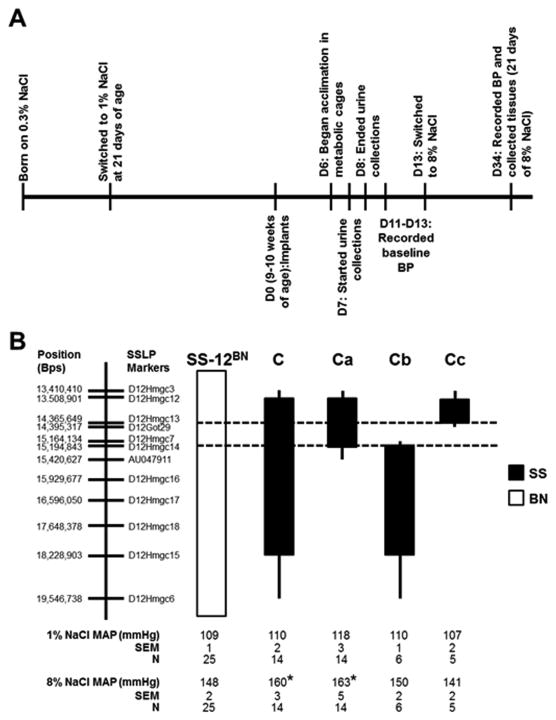
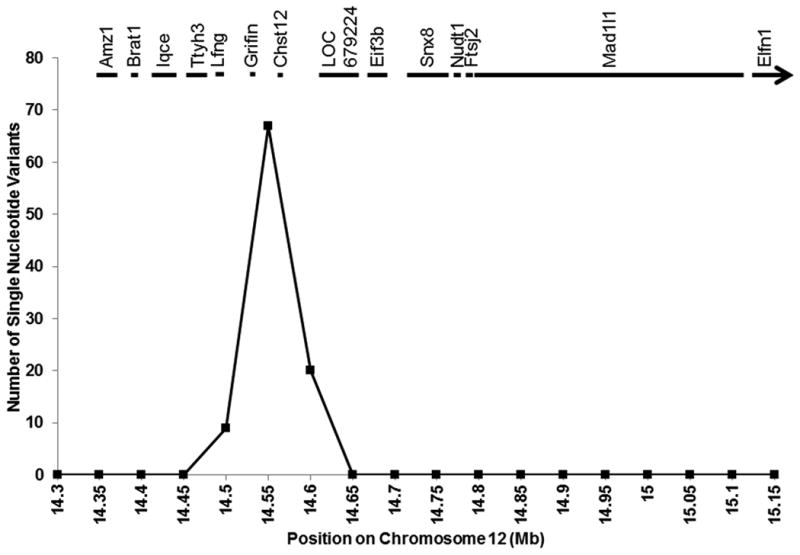
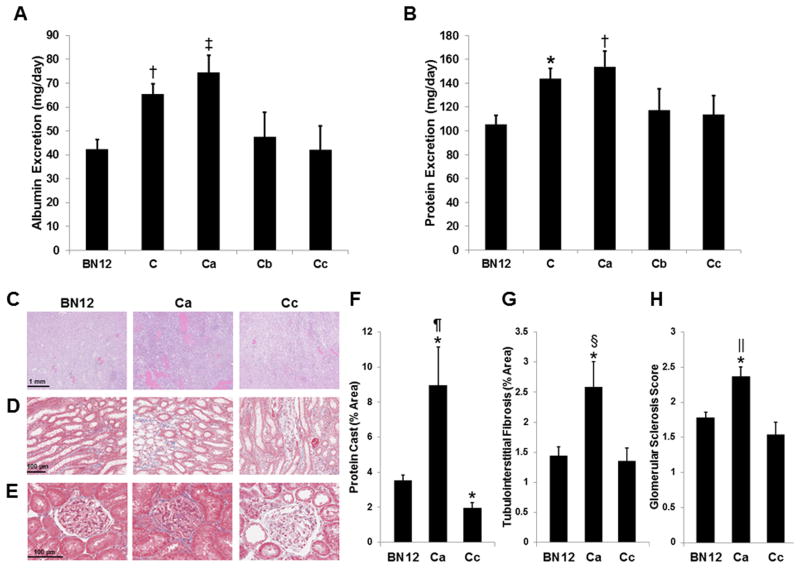
Previously, we found that transferring 6.1 Mb of salt-sensitive (SS) chromosome 12 (13.4-19.5 Mb) onto the consomic SS-12(BN) background significantly elevated mean arterial pressure in response to an 8% NaCl diet (178±7 versus 144±2 mm Hg; P<0.001). Using congenic mapping, we have now narrowed the blood pressure locus by 86% from a 6.1-Mb region containing 133 genes to an 830-kb region (chr12:14.36-15.19 Mb) with 14 genes. Compared with the SS-12(BN) consomic, the 830-kb blood pressure locus was associated with a ∆+15 mm Hg (P<0.01) increase in blood pressure, which coincided with elevated albuminuria (∆+32 mg/d; P<0.001), proteinuria (∆+48 mg/d; P<0.01), protein casting (∆+154%; P<0.05), and renal fibrosis (∆+79%; P<0.05). Of the 14 genes residing in the 830-kb locus, 8 were differentially expressed, and among these, Chst12 (carbohydrate chondroitin 4 sulfotransferase 12) was most consistently downregulated by 2.6- to 4.5-fold (P<0.05) in both the renal medulla and cortex under normotensive and hypertensive conditions. Moreover, whole genome sequence analysis of overlapping blood pressure loci revealed an ≈86-kb region (chr12:14 541 567-14 627 442 bp) containing single-nucleotide variants near Chst12 that are unique to the hypertensive SS strain when compared with the normotensive Brown Norway, Dahl salt-resistant, and Wistar-Kyoto strains. Finally, the 830-kb interval is syntenic to a region on human chromosome 7 that has been genetically linked to blood pressure, suggesting that insight gained from our SS-12(BN) congenic strain may be translated to a better understanding of human hypertension.
此前,我们发现将盐敏感(SS)的12号染色体上6.1 Mb(13.4 - 19.5 Mb)片段转移到代换系SS - 12(BN)背景中,在给予8% NaCl饮食时,平均动脉压显著升高(178±7 vs 144±2 mmHg;P<0.001)。利用近交系定位,我们现在已将血压位点从包含133个基因的6.1 Mb区域缩小了86%,至一个含14个基因的830 kb区域(12号染色体:14.36 - 15.19 Mb)。与SS - 12(BN)代换系相比,这个830 kb的血压位点与血压升高∆+15 mmHg(P<0.01)相关,同时伴有蛋白尿升高(∆+32 mg/d;P<0.001)、蛋白尿(∆+48 mg/d;P<0.01)、蛋白管型(∆+154%;P<0.05)以及肾纤维化(∆+79%;P<0.05)。在位于830 kb位点的14个基因中,有8个基因表达存在差异,其中,在正常血压和高血压条件下,碳水化合物硫酸软骨素4 -磺基转移酶12(Chst12)在肾髓质和皮质中最一致地下调2.6至4.5倍(P<0.05)。此外,对重叠血压位点的全基因组序列分析揭示了一个约86 kb的区域(12号染色体:14 541 567 - 14 627 442 bp),与正常血压的挪威棕鼠、达尔盐抵抗鼠和Wistar - Kyoto鼠相比,该区域在Chst12附近含有高血压SS品系特有的单核苷酸变异。最后,830 kb区间与人类7号染色体上一个与血压存在遗传连锁的区域同线,这表明从我们的SS - 12(BN)近交系获得的见解可能有助于更好地理解人类高血压。