Yang Wentian, Neel Benjamin G
Department of Orthopaedics and COBRE Center for Stem Cell Biology; Brown University Alpert Medical School and Rhode Island Hospital; Providence, RI USA.
Princess Margaret Cancer Center; University Health Network and Department of Medical Biophysics; University of Toronto; Toronto, ON Canada.
Rare Dis. 2013 Oct 2;1:e26657. doi: 10.4161/rdis.26657. eCollection 2013.
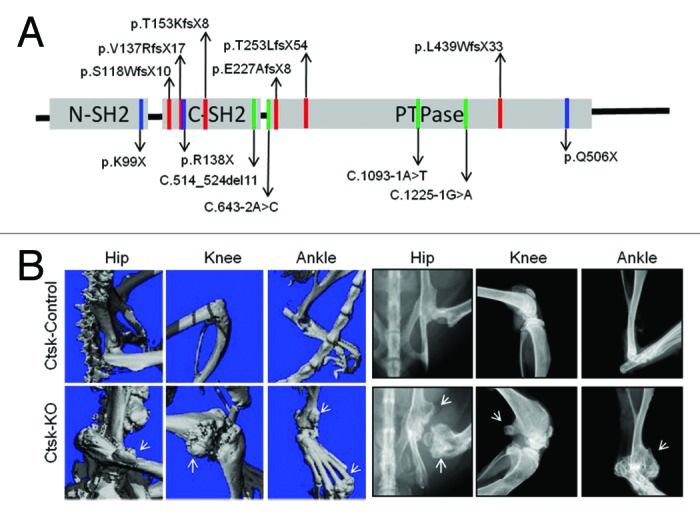
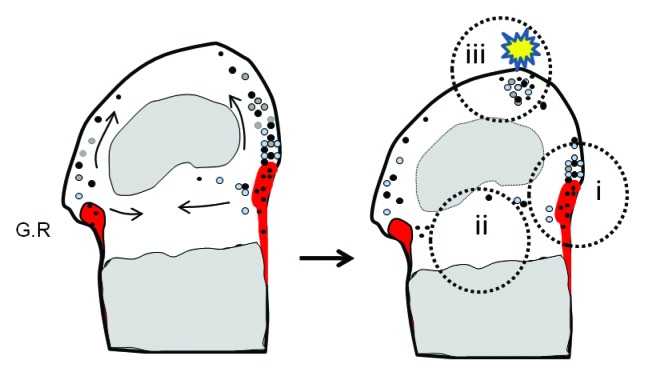
Recently, loss-of-function mutations in PTPN11 were linked to the cartilage tumor syndrome metachondromatosis (MC), a rare inherited disorder featuring osteochondromas, endochondromas and skeletal deformation. However, the underlying molecular and cellular mechanism for MC remained incompletely understood. By studying the role of the Src homology-2 domain-containing protein tyrosine phosphatase Shp2 (encoded by mouse Ptpn11) in cathepsin K-expressing cells, we identified a novel cell population in the perichondrial groove of Ranvier. In the absence of Shp2, these cells exhibit elevated Indian hedgehog (Ihh) signaling, proliferate excessively and cause ectopic cartilage formation and tumors. Our findings establish a critical role for a protein-tyrosine phosphatase (PTP) family member, in addition to the well-known roles of receptor tyrosine kinases (RTKs), in cartilage development and homeostasis. However, whether Shp2 deficiency in other epiphyseal chondroid cells and whether signaling pathways in addition to the IHH/Parathyroid Hormone-related Peptide (PTHrP) axis attribute to the formation of enchondromas and osteochondromas remains elusive. Understanding how chondrogenic events are regulated by SHP2 could aid in the development of novel therapeutic approaches to prevent and treat cartilage diseases, such as MC and osteoarthritis (OA).
最近,蛋白酪氨酸磷酸酶11(PTPN11)的功能丧失突变与软骨肿瘤综合征——间发性软骨瘤病(MC)相关联,MC是一种罕见的遗传性疾病,其特征为骨软骨瘤、内生软骨瘤和骨骼变形。然而,MC潜在的分子和细胞机制仍未完全明确。通过研究含Src同源2结构域的蛋白酪氨酸磷酸酶Shp2(由小鼠Ptpn11编码)在表达组织蛋白酶K的细胞中的作用,我们在朗飞氏软骨膜沟中发现了一种新的细胞群。在缺乏Shp2的情况下,这些细胞表现出印度刺猬因子(Ihh)信号增强、过度增殖,并导致异位软骨形成和肿瘤。我们的研究结果表明,除了受体酪氨酸激酶(RTK)的已知作用外,蛋白酪氨酸磷酸酶(PTP)家族成员在软骨发育和稳态中也起着关键作用。然而,Shp2在其他骨骺软骨样细胞中的缺乏情况,以及除了Ihh/甲状旁腺激素相关肽(PTHrP)轴之外的信号通路是否与内生软骨瘤和骨软骨瘤的形成有关,仍然不清楚。了解SHP2如何调节软骨形成事件,可能有助于开发预防和治疗软骨疾病(如MC和骨关节炎(OA))的新治疗方法。