Li Yu-Fen, Lin Che-Chen, Tai Chien-Kuo
Int J Environ Res Public Health. 2014 Jun;11(6):6504-16. doi: 10.3390/ijerph110606504.
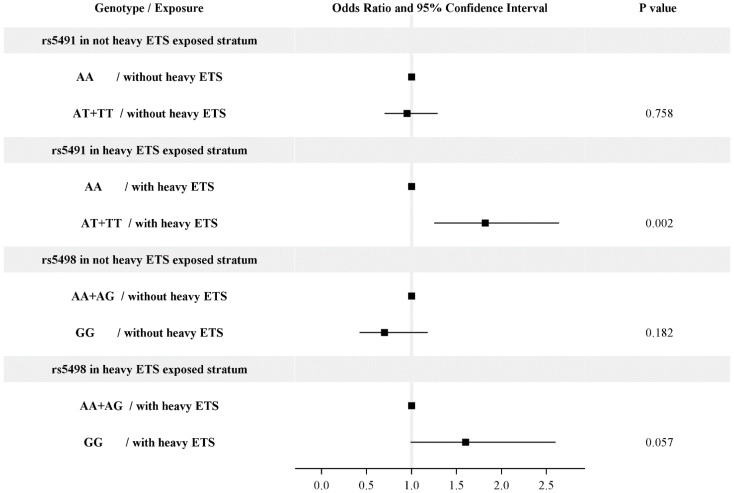
Asthma is a chronic disease that is particularly common in children. The association between polymorphisms of the gene encoding intercellular adhesion molecule 1 (ICAM1) and gene-environment interactions with childhood asthma has not been fully investigated. A cross-sectional study was undertaken to investigate these associations among children in Taiwan. The effects of two functional single-nucleotide polymorphisms (SNPs) of ICAM1, rs5491 (K56M) and rs5498 (K469E), and exposure to environmental tobacco smoke (ETS) were studied. Two hundred and eighteen asthmatic and 877 nonasthmatic children were recruited from elementary schools. It was found that the genetic effect of each SNP was modified by the other SNP and by exposure to ETS. The risk of asthma was higher for children carrying the rs5491 AT or TT genotypes and the rs5498 GG genotype (odds ratio = 1.68, 95% confidence interval 1.09–2.59) than for those with the rs5491 AA and rs5498 AA or AG genotypes (the reference group). The risk for the other two combinations of genotypes did not differ significantly from that of the reference group (p of interaction = 0.0063). The two studied ICAM1 SNPs were associated with childhood asthma among children exposed to ETS, but not among those without ETS exposure (p of interaction = 0.05 and 0.01 for rs5491 and rs5498, respectively). Both ICAM1 and ETS, and interactions between these two factors are likely to be involved in the development of asthma in childhood.
哮喘是一种在儿童中尤为常见的慢性疾病。编码细胞间黏附分子1(ICAM1)的基因多态性与儿童哮喘的基因-环境相互作用之间的关联尚未得到充分研究。开展了一项横断面研究以调查台湾儿童中的这些关联。研究了ICAM1的两个功能性单核苷酸多态性(SNP),即rs5491(K56M)和rs5498(K469E),以及环境烟草烟雾(ETS)暴露的影响。从小学招募了218名哮喘儿童和877名非哮喘儿童。发现每个SNP的遗传效应会受到另一个SNP以及ETS暴露的影响。携带rs5491的AT或TT基因型以及rs5498的GG基因型的儿童患哮喘的风险(优势比=1.68,95%置信区间1.09 - 2.59)高于携带rs5491的AA以及rs5498的AA或AG基因型的儿童(参照组)。其他两种基因型组合的风险与参照组相比无显著差异(交互作用p=0.0063)。所研究的两个ICAM1 SNP与暴露于ETS的儿童的儿童哮喘相关,但与未暴露于ETS的儿童无关(rs5491和rs5498的交互作用p分别为0.05和0.01)。ICAM1和ETS以及这两个因素之间的相互作用可能都参与了儿童哮喘的发生发展。