Tsai Hsiao-Chi, Su Hong-Lin, Huang Chun-Yin, Fong Yi-Chin, Hsu Chin-Jung, Tang Chih-Hsin
Department of Life Sciences, National Chung Hsing University, Taichung, Taiwan.
Graduate Institute of Basic Medical Science, China Medical University, Taichung, Taiwan; Department of Pharmacology, School of Medicine, China Medical University, Taichung, Taiwan; Department of Biotechnology, College of Health Science, Asia University, Taichung, Taiwan.
Oncotarget. 2014 Jun 15;5(11):3800-12. doi: 10.18632/oncotarget.1998.
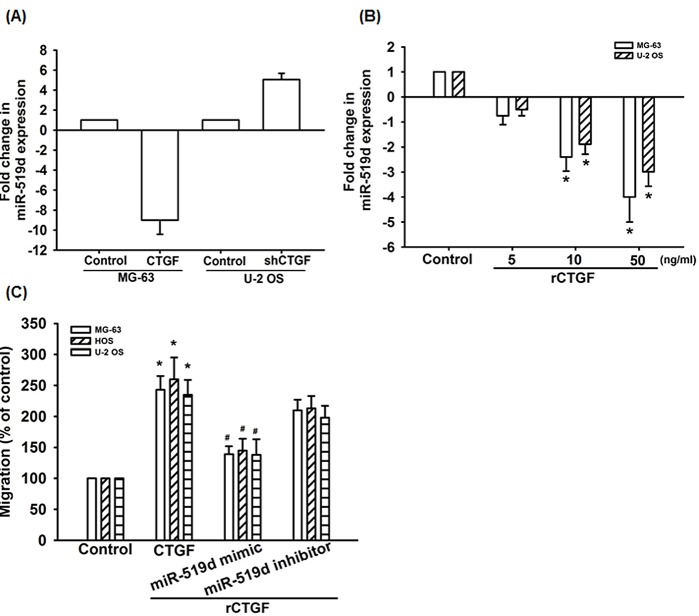
Osteosarcoma, the most common primary malignant bone tumor, shows potent capacity for local invasion and distant metastasis. Connective tissue growth factor (CTGF/CCN2), a secreted protein, binds to integrins, modulates invasive behavior of certain human cancer cells. Effect of CTGF in metastasis of human osteosarcoma is unknown. We found overexpression of CTGF increasing matrix metalloproteinases (MMPs)-2 and MMP-3 expression as well as promoting cell migration. MicroRNA (miRNA) analysis of CTGF-overexpressed osteosarcoma versus control cells probed mechanisms of CTGF-mediated promotion of migration. Among miRNAs regulated by CTGF, miR-519d was most downregulated after CTGF treatment. Co-transfection with miR-519d mimic reversed CTGF-mediated MMPs expression and cell migration. Also, MEK and ERK inhibitors or mutants reduced CTGF-increased cell migration and miR-519d suppression. By contrast, knockdown of CTGF diminished lung metastasis in vivo. Clinical samples indicate CTGF expression as linked with clinical stage and tumor metastasis. Taken together, data show CTGF elevating MMPs expression and subsequently promoting tumor metastasis in human osteosarcoma, down-regulating miR-519d via MEK and ERK pathways, making CTGF a new molecular therapeutic target in osteosarcoma metastasis.
骨肉瘤是最常见的原发性恶性骨肿瘤,具有强大的局部侵袭和远处转移能力。结缔组织生长因子(CTGF/CCN2)是一种分泌蛋白,可与整合素结合,调节某些人类癌细胞的侵袭行为。CTGF在人类骨肉瘤转移中的作用尚不清楚。我们发现CTGF的过表达会增加基质金属蛋白酶(MMPs)-2和MMP-3的表达,并促进细胞迁移。对CTGF过表达的骨肉瘤细胞与对照细胞进行微小RNA(miRNA)分析,以探究CTGF介导的迁移促进机制。在受CTGF调节的miRNA中,miR-519d在CTGF处理后下调最为明显。与miR-519d模拟物共转染可逆转CTGF介导的MMPs表达和细胞迁移。此外,MEK和ERK抑制剂或突变体可减少CTGF诱导的细胞迁移和miR-519d的抑制。相比之下,敲低CTGF可减少体内肺转移。临床样本表明CTGF表达与临床分期和肿瘤转移有关。综上所述,数据表明CTGF可提高MMPs表达,进而促进人类骨肉瘤的肿瘤转移,并通过MEK和ERK途径下调miR-519d,使CTGF成为骨肉瘤转移的新分子治疗靶点。