Cunha F A, Montenegro R A, Midgley A W, Vasconcellos F, Soares P P, Farinatti P
Laboratório de Atividade Física e Promoção da Saúde, Programa de Pós-Graduação em Ciências Médicas, Faculdade de Ciências Médicas, Universidade do Estado do Rio de Janeiro, Rio de Janeiro, RJ, Brasil.
Laboratório de Atividade Física e Promoção da Saúde, Programa de Pós-Graduação em Fisiopatologia Clínica e Experimental, Universidade do Estado do Rio de Janeiro, Rio de Janeiro, RJ, Brasil.
Braz J Med Biol Res. 2014 Aug;47(8):706-14. doi: 10.1590/1414-431x20143713. Epub 2014 Jul 8.
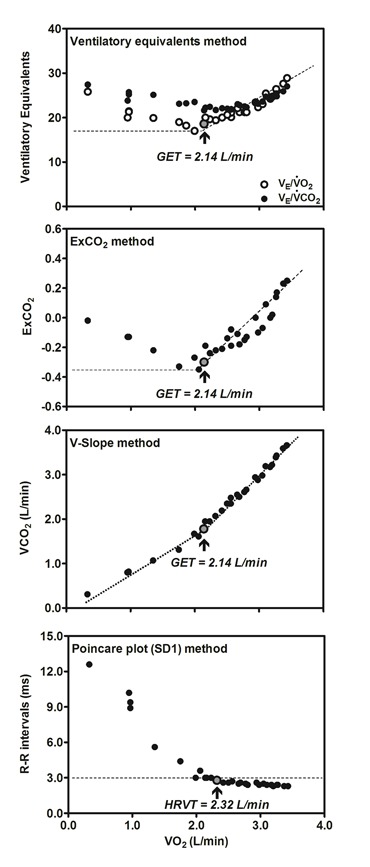
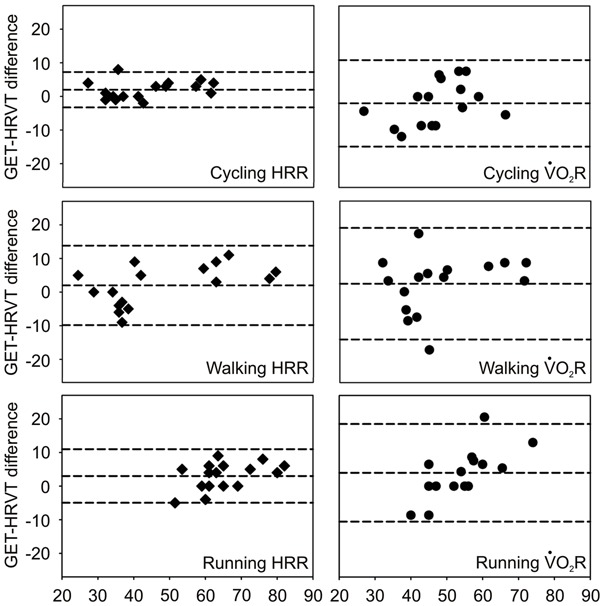
The main purpose of this study was to investigate the level of agreement between the gas exchange threshold (GET) and heart rate variability threshold (HRVT) during maximal cardiopulmonary exercise testing (CPET) using three different exercise modalities. A further aim was to establish whether there was a 1:1 relationship between the percentage heart rate reserve (%HRR) and percentage oxygen uptake reserve (%VO2 R) at intensities corresponding to GET and HRVT. Sixteen apparently healthy men 17 to 28 years of age performed three maximal CPETs (cycling, walking, and running). Mean heart rate and VO2 at GET and HRVT were 16 bpm (P<0.001) and 5.2 mL · kg(-1) · min(-1) (P=0.001) higher in running than cycling, but no significant differences were observed between running and walking, or cycling and walking (P>0.05). There was a strong relationship between GET and HRVT, with R2 ranging from 0.69 to 0.90. A 1:1 relationship between %HRR and % VO2 R was not observed at GET and HRVT. The %HRR was higher during cycling (GET mean difference=7%; HRVT mean difference=11%; both P<0.001), walking (GET mean difference=13%; HRVT mean difference=13%; both P<0.001), or running (GET mean difference=11%; HRVT mean difference=10%; both P<0.001). Therefore, using HRVT to prescribe aerobic exercise intensity appears to be valid. However, to assume a 1:1 relationship between %HRR and % VO2 R at HRVT would probably result in overestimation of the energy expenditure during the bout of exercise.
本研究的主要目的是调查在使用三种不同运动方式进行的最大心肺运动试验(CPET)期间,气体交换阈值(GET)与心率变异性阈值(HRVT)之间的一致性水平。另一个目的是确定在与GET和HRVT相对应的强度下,心率储备百分比(%HRR)与摄氧量储备百分比(%VO₂R)之间是否存在1:1的关系。16名年龄在17至28岁之间、看似健康的男性进行了三次最大CPET(骑自行车、步行和跑步)。在GET和HRVT时,跑步时的平均心率和VO₂分别比骑自行车时高16次/分钟(P<0.001)和5.2毫升·千克⁻¹·分钟⁻¹(P=0.001),但跑步与步行之间或骑自行车与步行之间未观察到显著差异(P>0.05)。GET与HRVT之间存在很强的关系,R²范围为0.69至0.90。在GET和HRVT时未观察到%HRR与%VO₂R之间的1:1关系。在骑自行车(GET平均差异=7%;HRVT平均差异=11%;两者P<0.001)、步行(GET平均差异=13%;HRVT平均差异=13%;两者P<0.001)或跑步(GET平均差异=11%;HRVT平均差异=10%;两者P<0.001)期间,%HRR更高。因此,使用HRVT来规定有氧运动强度似乎是有效的。然而,假设在HRVT时%HRR与%VO₂R之间存在1:1的关系可能会导致对运动期间能量消耗的高估。