
用pH(低)插入肽靶向乳腺肿瘤。
Targeting breast tumors with pH (low) insertion peptides.
作者信息
Adochite Ramona-Cosmina, Moshnikova Anna, Carlin Sean D, Guerrieri Renato A, Andreev Oleg A, Lewis Jason S, Reshetnyak Yana K
机构信息
Physics Department, University of Rhode Island , 2 Lippitt Road, Kingston, Rhode Island 02881, United States.
出版信息
Mol Pharm. 2014 Aug 4;11(8):2896-905. doi: 10.1021/mp5002526. Epub 2014 Jul 8.
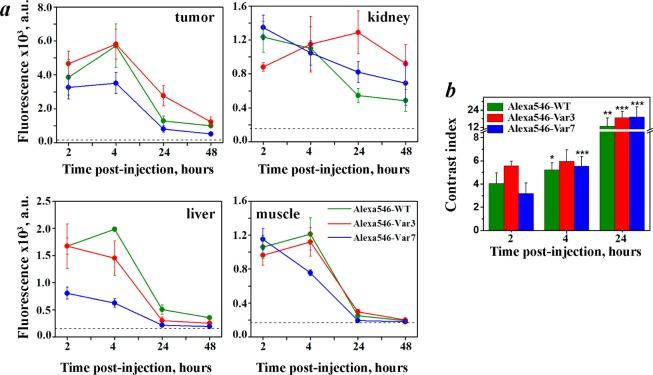
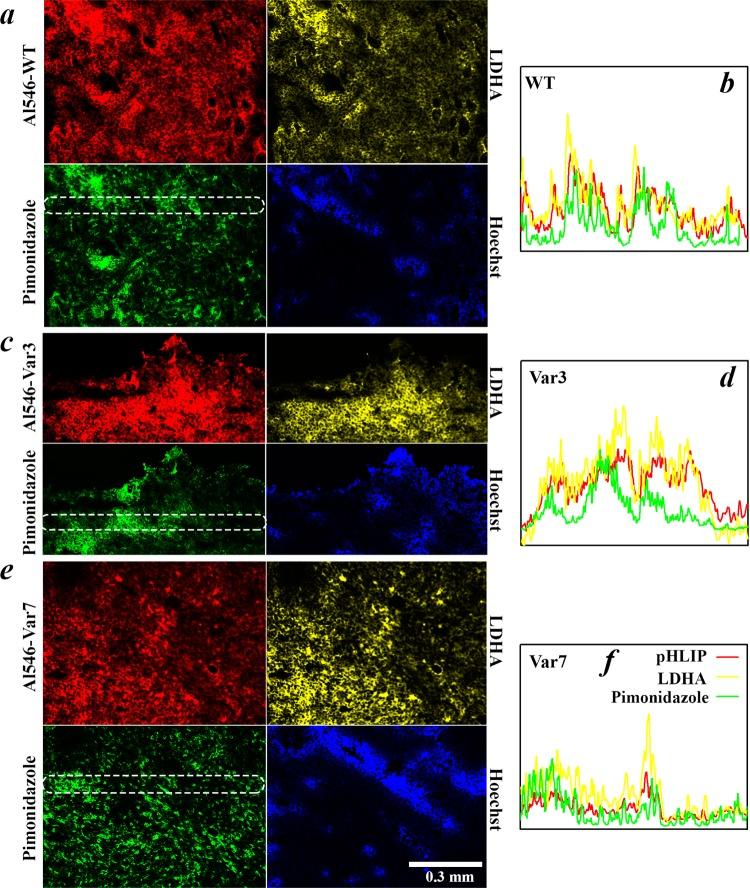
Extracellular acidity is associated with tumor progression. Elevated glycolysis and acidosis promote the appearance of aggressive malignant cells with enhanced multidrug resistance. Thus, targeting of tumor acidity can open new avenues in diagnosis and treatment of aggressive tumors and targeting metastatic cancers cells within a tumor. pH (low) insertion peptides (pHLIPs) belong to the class of pH-sensitive agents capable of delivering imaging and/or therapeutic agents to cancer cells within tumors. Here, we investigated targeting of highly metastatic 4T1 mammary tumors and spontaneous breast tumors in FVB/N-Tg (MMTV-PyMT)634Mul transgenic mice with three fluorescently labeled pHLIP variants including well-characterized WT-pHLIP and, recently introduced, Var3- and Var7-pHLIPs. The Var3- and Var7-pHLIPs constructs have faster blood clearance than the parent WT-pHLIP. All pHLIPs demonstrated excellent targeting of the above breast tumor models with tumor accumulation increasing over 4 h postinjection. Staining of nonmalignant stromal tissues in transgenic mice was minimal. The pHLIPs distribution in tumors showed colocalization with 2-deoxyglucose and the hypoxia marker, Pimonidazole. The highest degree of colocalization of fluorescent pHLIPs was shown to be with lactate dehydrogenase A, which is related to lactate production and acidification of tumors. In sum, the pHLIP-based targeting of breast cancer presents an opportunity to monitor metabolic changes, and to selectively deliver imaging and therapeutic agents to tumors.
细胞外酸度与肿瘤进展相关。糖酵解增加和酸中毒促进具有增强多药耐药性的侵袭性恶性细胞的出现。因此,靶向肿瘤酸度可为侵袭性肿瘤的诊断和治疗以及靶向肿瘤内的转移性癌细胞开辟新途径。pH(低)插入肽(pHLIPs)属于一类能够将成像和/或治疗剂递送至肿瘤内癌细胞的pH敏感剂。在此,我们研究了用三种荧光标记的pHLIP变体靶向FVB/N-Tg (MMTV-PyMT)634Mul转基因小鼠中的高转移性4T1乳腺肿瘤和自发性乳腺肿瘤,包括特征明确的WT-pHLIP以及最近引入的Var3-和Var7-pHLIPs。Var3-和Var7-pHLIPs构建体的血液清除速度比亲本WT-pHLIP更快。所有pHLIPs在上述乳腺肿瘤模型中均表现出优异的靶向性,注射后4小时内肿瘤蓄积增加。转基因小鼠中非恶性基质组织的染色极少。pHLIPs在肿瘤中的分布显示与2-脱氧葡萄糖和缺氧标志物匹莫硝唑共定位。荧光pHLIPs的共定位程度最高的是与乳酸脱氢酶A,其与肿瘤的乳酸产生和酸化有关。总之,基于pHLIPs的乳腺癌靶向为监测代谢变化以及选择性地将成像和治疗剂递送至肿瘤提供了机会。





 Zotero 插件