Department of Nuclear Medicine, The Affiliated Hospital of Qingdao University, No. 59, Haier Rd., Qingdao, 266100, China.
Intensive Care Unit, The Affiliated Hospital of Qingdao University, Qingdao, China.
Breast Cancer Res Treat. 2020 Apr;180(2):379-384. doi: 10.1007/s10549-020-05560-2. Epub 2020 Feb 7.
Protease-activated receptor 1 (PAR1) is a signaling protein ubiquitously present on the surface of tumor cells, and its homologous protein fragment, PAR1-activating peptide (P1AP), can inhibit protein signal transduction of PAR1/G in tumor cells. pH (Low) insertion peptide (pHLIP) can target the acidic tumor microenvironment (TME) and can be used as an excellent carrier to deliver P1AP to tumor cells for therapeutic purposes.
PAR1 expression on the surface of MDA-MB-231 cells and human MCF10A mammary epithelial cells was observed. The binding between fluorescent-labeled pHLIP(Var7)-P1AP and MDA-MB-231 cells under different pH values was analyzed. The effect of pHLIP(Var7)-P1AP on the proliferation of MDA-MB-231 cells was analyzed under the conditions of pH 7.4 and 6.0.
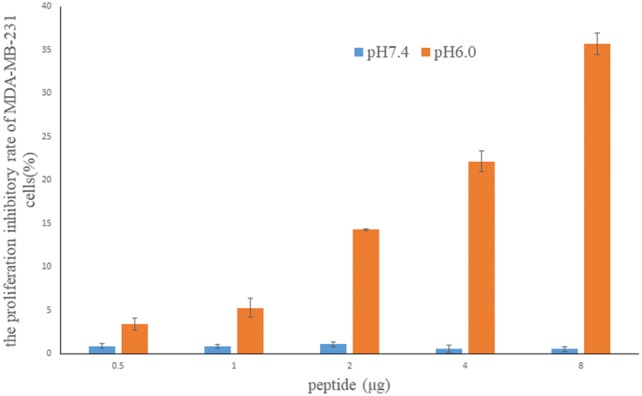
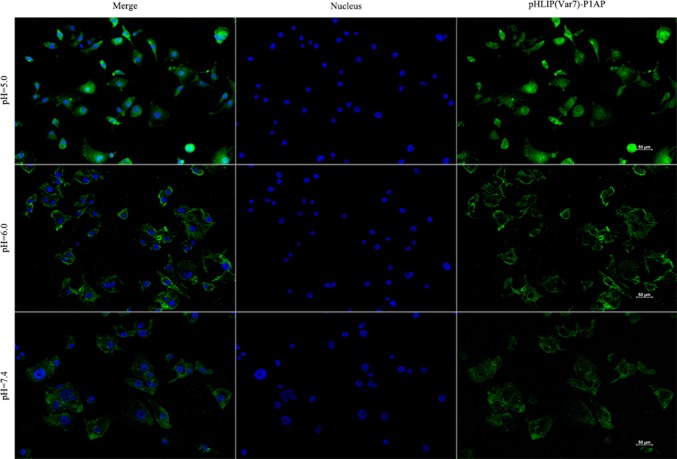
PAR1 was highly expressed on the surface of MDA-MB-231 cells. In an acidic environment (pH 6.0 and 5.0), fluorescent-labeled pHLIP(Var7)-P1AP and MDA-MB-231 cells had a high binding ability, and the binding ability increased with the decrease in pH. In an acidic environment (pH 6.0), pHLIP(Var7)-P1AP significantly inhibited MDA-MB-231 cell proliferation. With 0.5 μg, 1 μg, 2 μg, 4 μg, and 8 μg of pHLIP(Var7)-P1AP, the cell proliferation inhibition rates were 3.39%, 5.27%, 14.29%, 22.14%, and 35.69%, respectively.
PAR1 was highly expressed on the surface of MDA-MB-231 cells. pHLIP(Var7)-P1AP can effectively target MDA-MB-231 cells in an acidic environment and inhibit the growth of MDA-MB-231 cells by inhibiting the signal transduction of PAR1/G protein.
蛋白酶激活受体 1(PAR1)是一种普遍存在于肿瘤细胞表面的信号蛋白,其同源蛋白片段 PAR1 激活肽(P1AP)可以抑制肿瘤细胞中 PAR1/G 蛋白的信号转导。pH(低)插入肽(pHLIP)可以靶向酸性肿瘤微环境(TME),并可用作将 P1AP 递送至肿瘤细胞以用于治疗目的的优秀载体。
观察 MDA-MB-231 细胞和人 MCF10A 乳腺上皮细胞表面的 PAR1 表达。分析不同 pH 值下荧光标记的 pHLIP(Var7)-P1AP 与 MDA-MB-231 细胞的结合情况。在 pH 7.4 和 6.0 条件下分析 pHLIP(Var7)-P1AP 对 MDA-MB-231 细胞增殖的影响。
PAR1 在 MDA-MB-231 细胞表面高度表达。在酸性环境(pH 6.0 和 5.0)下,荧光标记的 pHLIP(Var7)-P1AP 与 MDA-MB-231 细胞具有高结合能力,并且结合能力随 pH 值降低而增加。在酸性环境(pH 6.0)下,pHLIP(Var7)-P1AP 显著抑制 MDA-MB-231 细胞增殖。用 0.5μg、1μg、2μg、4μg 和 8μg 的 pHLIP(Var7)-P1AP,细胞增殖抑制率分别为 3.39%、5.27%、14.29%、22.14%和 35.69%。
PAR1 在 MDA-MB-231 细胞表面高度表达。pHLIP(Var7)-P1AP 可以在酸性环境下有效靶向 MDA-MB-231 细胞,并通过抑制 PAR1/G 蛋白的信号转导抑制 MDA-MB-231 细胞的生长。