Andrade Pedro Beraldo de, Andrade Mônica Vieira Athanazio de, Barbosa Robson Alves, Labrunie André, Hernandes Mauro Esteves, Marino Roberto Luiz, Precoma Dalton Bertolim, Sá Francisco Carleial Feijó de, Berwanger Otávio, Piva e Mattos Luiz Alberto
Santa Casa de Misericórdia de Marília, São Paulo, SP, Brazil.
Santa Casa de Votuporanga, São Paulo, SP, Brazil.
Arq Bras Cardiol. 2014 Jun;102(6):566-70. doi: 10.5935/abc.20140063. Epub 2014 May 27.
The radial access provides a lower risk of bleeding and vascular complications related to the puncture site in comparison to the femoral access. Recent studies have suggested a reduction in mortality associated with the radial access in patients with acute myocardial infarction undergoing percutaneous coronary intervention.
To compare the occurrence of adverse cardiovascular ischemic and hemorrhagic events in patients undergoing primary angioplasty according to the type of arterial access route.
From August 2010 to December 2011, 588 patients undergoing primary percutaneous coronary intervention during acute ST-segment elevation myocardial infarction were assessed; they were recruited from 47 centers participating in the ACCEPT registry. Patients were grouped and compared according to the arterial access used for the procedure.
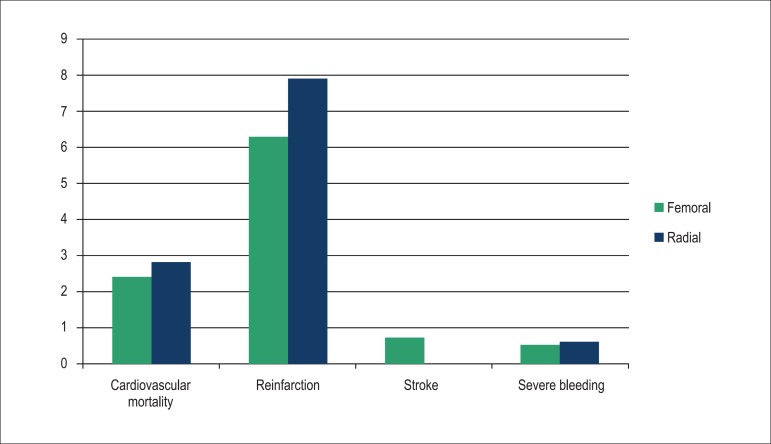
The mean age was 61.8 years; 75% were males and 24% had diabetes mellitus. There was no difference between groups as regards the procedure success rate, as well as regards the occurrence of death, reinfarction, or stroke at six months of follow-up. Severe bleeding was reported in 1.1% of the sample analyzed, with no statistical difference related to the access used.
The femoral and radial accesses are equally safe and effective for the performance of primary percutaneous coronary intervention. The low rate of cardiovascular events and of hemorrhagic complications reflects the quality of the participating centers and the operators expertise with the use of both techniques.
与股动脉入路相比,桡动脉入路与穿刺部位相关的出血和血管并发症风险较低。近期研究表明,在接受经皮冠状动脉介入治疗的急性心肌梗死患者中,桡动脉入路可降低死亡率。
根据动脉入路类型比较接受直接血管成形术患者不良心血管缺血和出血事件的发生率。
2010年8月至2011年12月,对588例急性ST段抬高型心肌梗死期间接受直接经皮冠状动脉介入治疗的患者进行评估;他们来自参与ACCEPT注册研究的47个中心。根据手术所使用的动脉入路对患者进行分组并比较。
平均年龄为61.8岁;75%为男性,24%患有糖尿病。在手术成功率以及随访6个月时的死亡、再梗死或中风发生率方面,各分组之间没有差异。在所分析的样本中,1.1%报告发生严重出血,与所使用的入路无关,无统计学差异。
股动脉和桡动脉入路在进行直接经皮冠状动脉介入治疗时同样安全有效。心血管事件和出血并发症的低发生率反映了参与中心的质量以及术者使用这两种技术的专业水平。