Siraj Abdul K, Bu Rong, Prabhakaran Sarita, Bavi Prashant, Beg Shaham, Al Hazmi Mohsen, Al-Rasheed Maha, Alobaisi Khadija, Al-Dayel Fouad, AlManea Hadeel, Al-Sanea Nasser, Uddin Shahab, Al-Kuraya Khawla S
Human Cancer Genomic Research, Research Center, King Faisal Specialist Hospital and Research Center, MBC#98-16, P,O, Box 3354 Riyadh 11211, Saudi Arabia.
Mol Cancer. 2014 Jul 8;13:168. doi: 10.1186/1476-4598-13-168.
Recent studies emphasize the role of BRAF as a genetic marker for prediction, prognosis and risk stratification in colorectal cancer. Earlier studies have reported the incidence of BRAF mutations in the range of 5-20% in colorectal carcinomas (CRC) and are predominantly seen in the serrated adenoma-carcinoma pathway characterized by microsatellite instability (MSI-H) and hypermethylation of the MLH1 gene in the setting of the CpG island methylator phenotype (CIMP). Due to the lack of data on the true incidence of BRAF mutations in Saudi Arabia, we sought to analyze the incidence of BRAF mutations in this ethnic group.
770 CRC cases were analyzed for BRAF and KRAS mutations by direct DNA sequencing.
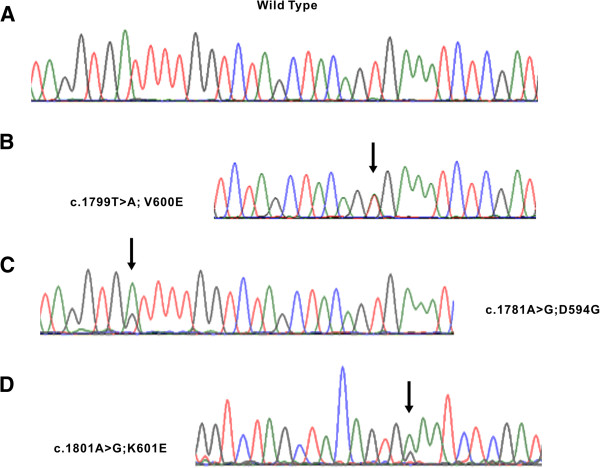
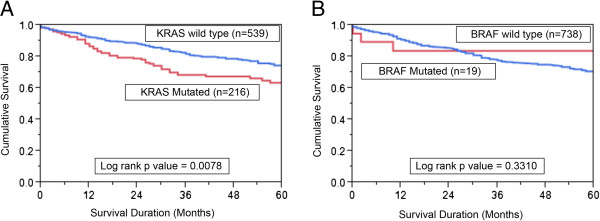
BRAF gene mutations were seen in 2.5% (19/757) CRC analyzed and BRAF V600E somatic mutation constituted 90% (17/19) of all BRAF mutations. BRAF mutations were significantly associated with right sided tumors (p = 0.0019), MSI-H status (p = 0.0144), CIMP (p = 0.0017) and a high proliferative index of Ki67 expression (p = 0.0162). Incidence of KRAS mutations was 28.6% (216/755) and a mutual exclusivity was noted with BRAF mutations (p = 0.0518; a trend was seen).
Our results highlight the low incidence of BRAF mutations and CIMP in CRC from Saudi Arabia. This could be attributed to ethnic differences and warrant further investigation to elucidate the effect of other environmental and genetic factors. These findings indirectly suggest the possibility of a higher incidence of familial hereditary colorectal cancers especially Hereditary non polyposis colorectal cancer (HNPCC) syndrome /Lynch Syndrome (LS) in Saudi Arabia.
近期研究强调了BRAF作为结直肠癌预测、预后及风险分层基因标志物的作用。早期研究报道,结直肠癌(CRC)中BRAF突变的发生率在5%-20%之间,主要见于以微卫星不稳定(MSI-H)和CpG岛甲基化表型(CIMP)背景下MLH1基因高甲基化为特征的锯齿状腺瘤-癌途径。由于沙特阿拉伯缺乏BRAF突变真实发生率的数据,我们试图分析该族群中BRAF突变的发生率。
通过直接DNA测序分析770例CRC病例的BRAF和KRAS突变情况。
在分析的757例CRC中,2.5%(19/757)存在BRAF基因突变,BRAF V600E体细胞突变占所有BRAF突变的90%(17/19)。BRAF突变与右侧肿瘤(p = 0.0019)、MSI-H状态(p = 0.0144)、CIMP(p = 0.0017)以及Ki67表达的高增殖指数(p = 0.0162)显著相关。KRAS突变的发生率为28.6%(216/755),且与BRAF突变存在相互排斥性(p = 0.0518;呈一种趋势)。
我们的结果凸显了沙特阿拉伯CRC中BRAF突变和CIMP的低发生率。这可能归因于种族差异,值得进一步研究以阐明其他环境和遗传因素的影响。这些发现间接提示沙特阿拉伯家族遗传性结直肠癌尤其是遗传性非息肉病性结直肠癌(HNPCC)综合征/林奇综合征(LS)的发生率可能较高。