Dai Ting-Li, Zhang Chan, Peng Fang, Niu Xue-Yuan, Hu Ling, Zhang Qiong, Huang Ying, Chen Ling, Zhang Lei, Zhu Weidong, Ding Yu-Qiang, Song Ning-Ning, Liao Min
Department of Histology and Embryology, Institute of Neuroscience, Wenzhou Medical University, Wenzhou, Zhejiang 325035, P.R. China.
Key Laboratory of Arrhythmias, Ministry of Education of China, East Hospital, Tongji University School of Medicine, Shanghai 200120, P.R. China ; Department of Anatomy and Neurobiology, Tongji University School of Medicine, Shanghai 200092, P.R. China.
Exp Ther Med. 2014 Aug;8(2):384-390. doi: 10.3892/etm.2014.1745. Epub 2014 May 28.
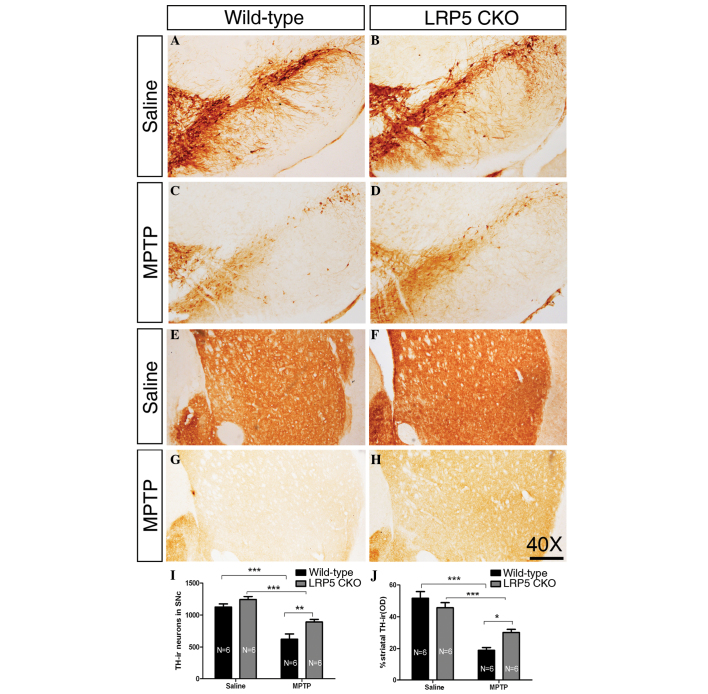
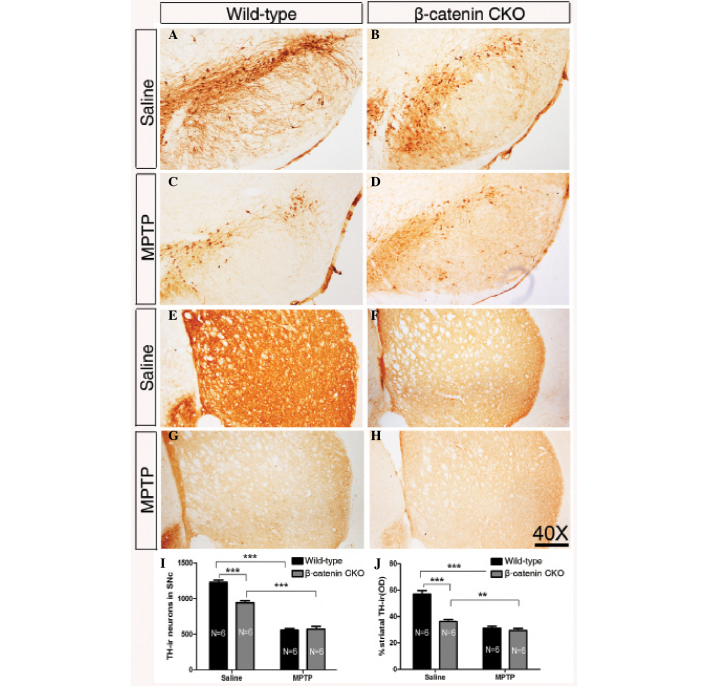
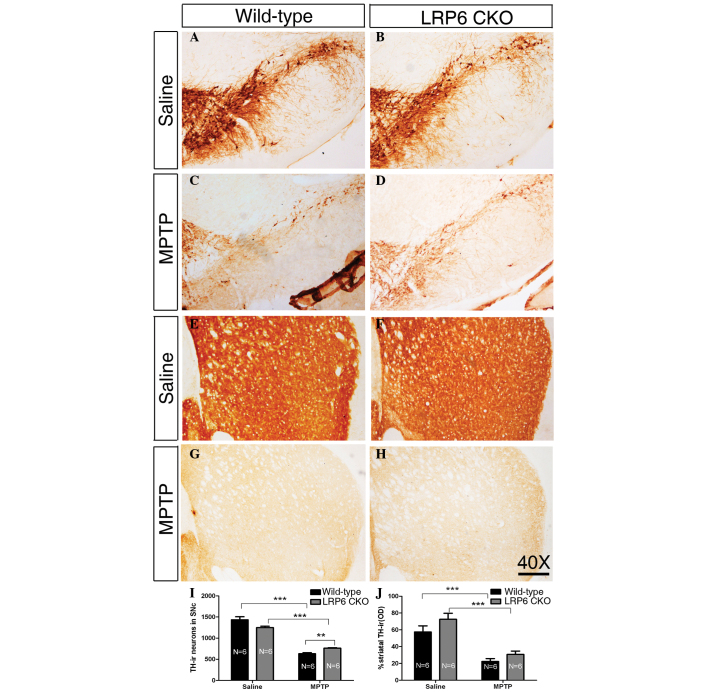
The canonical Wnt signaling pathway is critical for the development of midbrain dopaminergic (DA) neurons, and recent studies have suggested that disruption of this signaling cascade may underlie the pathogenesis of Parkinson's disease (PD). However, the exact role of the canonical Wnt signaling pathway, including low-density lipoprotein receptor-related protein 5 and 6 (LRP5/6) and β-catenin components, in a mouse model of PD remains unclear. In the present study, the tyrosine hydroxylase (TH)-Cre transgenic mouse line was used to generate mice with the specific knockout of LRP5, LRP6 or β-catenin in DA neurons. Following inactivation of LRP5, LRP6 or β-catenin, TH-immunohistochemical staining was performed. The results indicated that β-catenin is required for the development or maintenance of these neurons; however, LRP5 and LRP6 were found to be dispensable. In 1-methyl-4-phenyl-1,2,3,6-tetrahydropyridine (MPTP)-treated mice, the depletion of LRP5, LRP6 or β-catenin was found to be protective for the midbrain DA neurons to a certain extent. These results provide a novel perspective for the function of the canonical Wnt signaling pathway in a mouse model of PD.
经典Wnt信号通路对中脑多巴胺能(DA)神经元的发育至关重要,最近的研究表明,该信号级联的破坏可能是帕金森病(PD)发病机制的基础。然而,在PD小鼠模型中,经典Wnt信号通路的确切作用,包括低密度脂蛋白受体相关蛋白5和6(LRP5/6)以及β-连环蛋白成分,仍不清楚。在本研究中,使用酪氨酸羟化酶(TH)-Cre转基因小鼠品系来生成DA神经元中LRP5、LRP6或β-连环蛋白特异性敲除的小鼠。在LRP5、LRP6或β-连环蛋白失活后,进行TH免疫组织化学染色。结果表明,β-连环蛋白是这些神经元发育或维持所必需的;然而,发现LRP5和LRP6是可有可无的。在1-甲基-4-苯基-1,2,3,6-四氢吡啶(MPTP)处理的小鼠中,发现LRP5、LRP6或β-连环蛋白的缺失在一定程度上对中脑DA神经元具有保护作用。这些结果为经典Wnt信号通路在PD小鼠模型中的功能提供了新的视角。