Shinko Aiko, Agari Takashi, Kameda Masahiro, Yasuhara Takao, Kondo Akihiko, Tayra Judith Thomas, Sato Kenichiro, Sasaki Tatsuya, Sasada Susumu, Takeuchi Hayato, Wakamori Takaaki, Borlongan Cesario V, Date Isao
Department of Neurological Surgery, Okayama University Graduate School of Medicine, Okayama, Japan.
Department of Neurosurgery, University of South Florida College of Medicine, Tampa, Florida, United States of America.
PLoS One. 2014 Jul 10;9(7):e101468. doi: 10.1371/journal.pone.0101468. eCollection 2014.
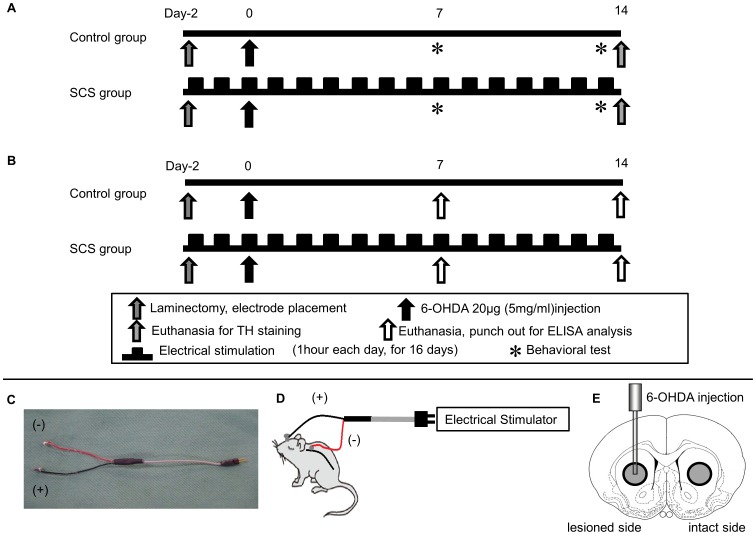
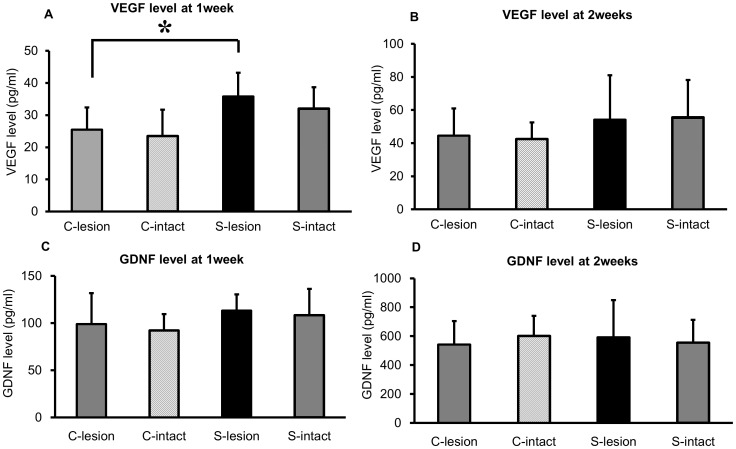
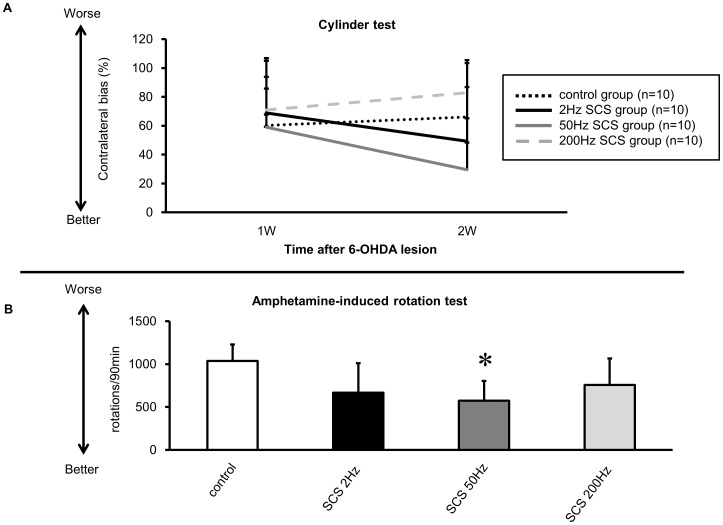
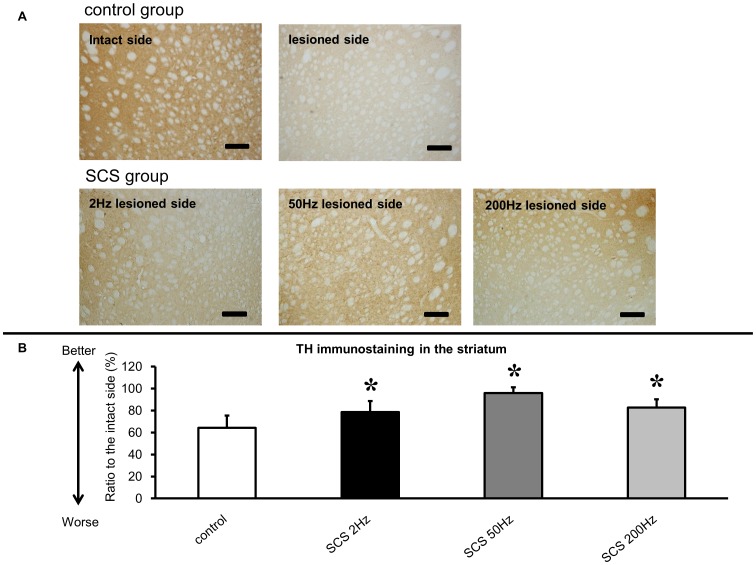
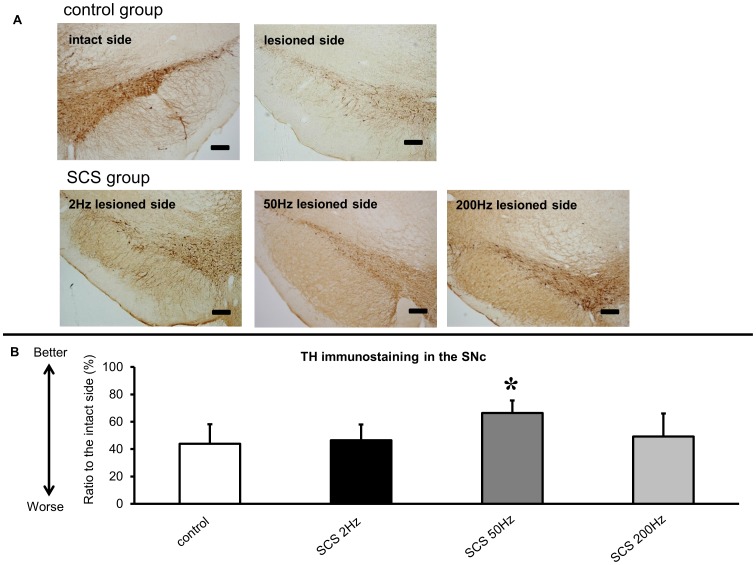
In clinical practice, deep brain stimulation (DBS) is effective for treatment of motor symptoms in Parkinson's disease (PD). However, the mechanisms have not been understood completely. There are some reports that electrical stimulation exerts neuroprotective effects on the central nervous system diseases including cerebral ischemia, head trauma, epilepsy and PD, although there are a few reports on neuroprotective effects of spinal cord stimulation (SCS). We investigated the neuroprotective effects of high cervical SCS on PD model of rats. Adult female Sprague-Dawley rats received hour-long SCS (2, 50 or 200 Hz) with an epidural electrode at C1-2 level for 16 consecutive days. At 2 days after initial SCS, 6-hydroxydopamine (6-OHDA) was injected into the right striatum of rats. Behavioral evaluations of PD symptoms were employed, including cylinder test and amphetamine-induced rotation test performed at 1 and 2 weeks after 6-OHDA injection. Animals were subsequently euthanized for immunohistochemical investigations. In order to explore neurotrophic and growth factor upregulation induced by SCS, another cohort of rats that received 50 Hz SCS was euthanized at 1 and 2 weeks after lesion for protein assays. Behavioral tests revealed that the number of amphetamine-induced rotations decreased in SCS groups. Immunohistochemically, tyrosine hydroxylase (TH)-positive fibers in the striatum were significantly preserved in SCS groups. TH-positive neurons in the substantia nigra pars compacta were significantly preserved in 50 Hz SCS group. The level of vascular endothelial growth factor (VEGF) was upregulated by SCS at 1 week after the lesion. These results suggest that high cervical SCS exerts neuroprotection in PD model of rats, at least partially by upregulation of VEGF. SCS is supposed to suppress or delay PD progression and might become a less invasive option for PD patients, although further preclinical and clinical investigations are needed to confirm the effectiveness and safety.
在临床实践中,深部脑刺激(DBS)对帕金森病(PD)运动症状的治疗有效。然而,其机制尚未完全明确。有一些报道称,电刺激对包括脑缺血、头部创伤、癫痫和PD在内的中枢神经系统疾病具有神经保护作用,尽管关于脊髓刺激(SCS)神经保护作用的报道较少。我们研究了高颈段SCS对大鼠PD模型的神经保护作用。成年雌性Sprague-Dawley大鼠连续16天在C1-2水平使用硬膜外电极接受长达1小时的SCS(2、50或200Hz)。在首次SCS后2天,将6-羟基多巴胺(6-OHDA)注入大鼠右侧纹状体。采用PD症状的行为评估,包括在6-OHDA注射后1周和2周进行的圆筒试验和苯丙胺诱导的旋转试验。随后对动物实施安乐死以进行免疫组织化学研究。为了探究SCS诱导的神经营养和生长因子上调,另一组接受50Hz SCS的大鼠在损伤后1周和2周实施安乐死以进行蛋白质检测。行为测试显示,SCS组中苯丙胺诱导的旋转次数减少。免疫组织化学结果显示,SCS组纹状体中酪氨酸羟化酶(TH)阳性纤维得到显著保留。50Hz SCS组黑质致密部TH阳性神经元得到显著保留。损伤后1周,SCS使血管内皮生长因子(VEGF)水平上调。这些结果表明,高颈段SCS对大鼠PD模型具有神经保护作用,至少部分是通过上调VEGF实现的。SCS有望抑制或延缓PD进展,可能成为PD患者侵入性较小的一种选择,尽管还需要进一步的临床前和临床研究来证实其有效性和安全性。