Stoltzfus Jonathan D, Bart Stephen M, Lok James B
Department of Pathobiology, University of Pennsylvania School of Veterinary Medicine, Philadelphia, Pennsylvania, United States of America; Department of Biology, Hollins University, Roanoke, Virginia, United States of America.
Department of Pathobiology, University of Pennsylvania School of Veterinary Medicine, Philadelphia, Pennsylvania, United States of America.
PLoS Pathog. 2014 Jul 10;10(7):e1004235. doi: 10.1371/journal.ppat.1004235. eCollection 2014 Jul.
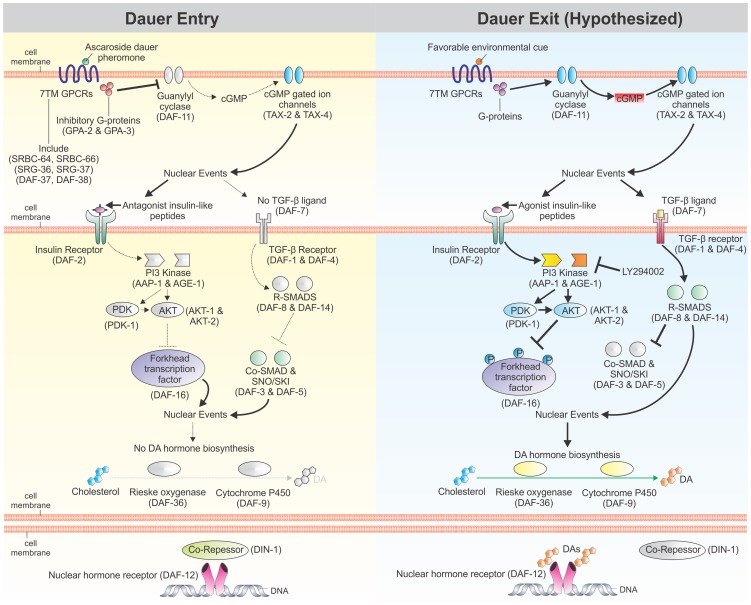
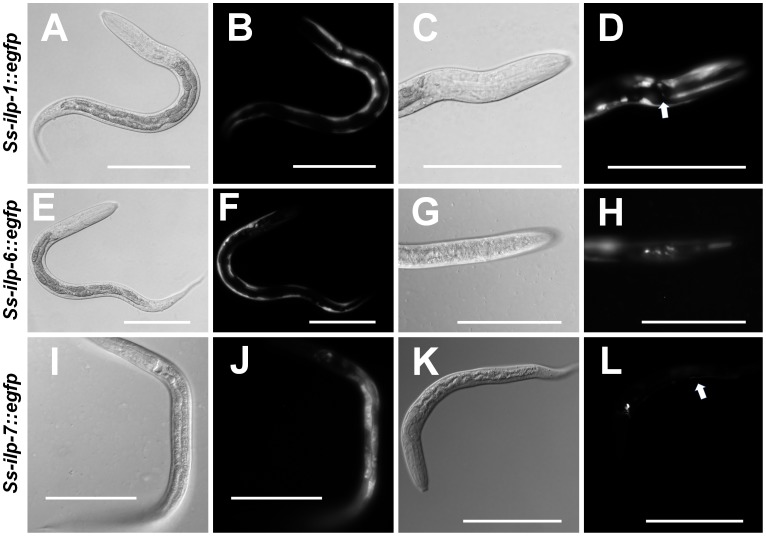
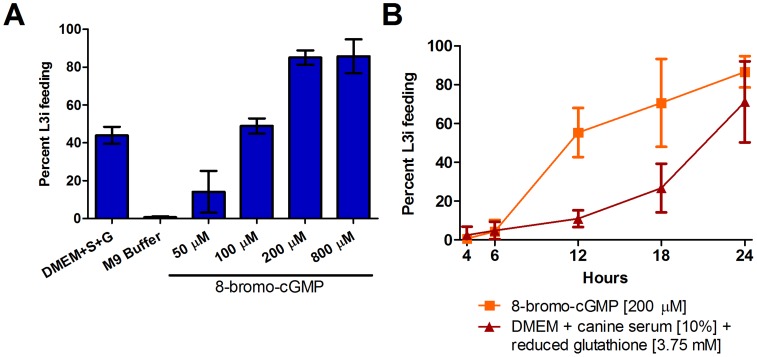
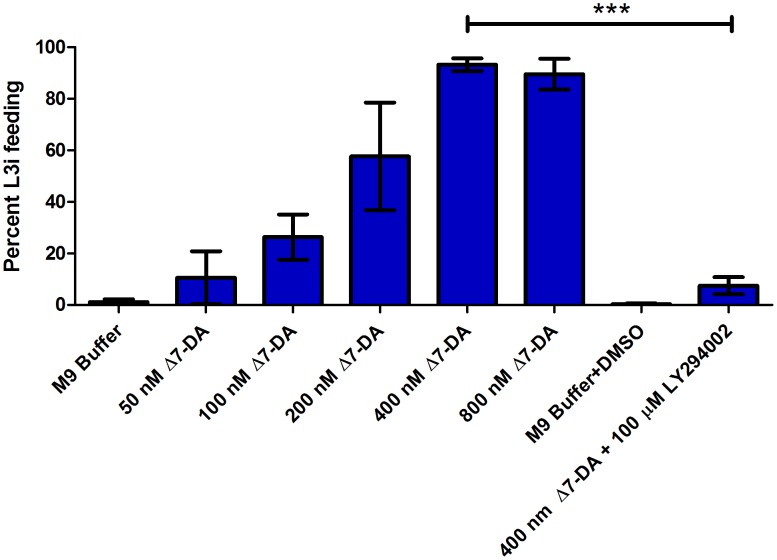
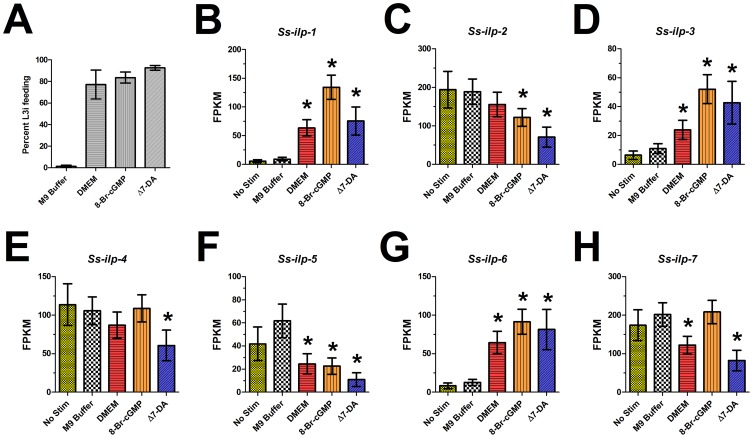
The infectious form of the parasitic nematode Strongyloides stercoralis is a developmentally arrested third-stage larva (L3i), which is morphologically similar to the developmentally arrested dauer larva in the free-living nematode Caenorhabditis elegans. We hypothesize that the molecular pathways regulating C. elegans dauer development also control L3i arrest and activation in S. stercoralis. This study aimed to determine the factors that regulate L3i activation, with a focus on G protein-coupled receptor-mediated regulation of cyclic guanosine monophosphate (cGMP) pathway signaling, including its modulation of the insulin/IGF-1-like signaling (IIS) pathway. We found that application of the membrane-permeable cGMP analog 8-bromo-cGMP potently activated development of S. stercoralis L3i, as measured by resumption of feeding, with 85.1 ± 2.2% of L3i feeding in 200 µM 8-bromo-cGMP in comparison to 0.6 ± 0.3% in the buffer diluent. Utilizing RNAseq, we examined L3i stimulated with DMEM, 8-bromo-cGMP, or the DAF-12 nuclear hormone receptor (NHR) ligand Δ7-dafachronic acid (DA)--a signaling pathway downstream of IIS in C. elegans. L3i stimulated with 8-bromo-cGMP up-regulated transcripts of the putative agonistic insulin-like peptide (ILP) -encoding genes Ss-ilp-1 (20-fold) and Ss-ilp-6 (11-fold) in comparison to controls without stimulation. Surprisingly, we found that Δ7-DA similarly modulated transcript levels of ILP-encoding genes. Using the phosphatidylinositol-4,5-bisphosphate 3-kinase inhibitor LY294002, we demonstrated that 400 nM Δ7-DA-mediated activation (93.3 ± 1.1% L3i feeding) can be blocked using this IIS inhibitor at 100 µM (7.6 ± 1.6% L3i feeding). To determine the tissues where promoters of ILP-encoding genes are active, we expressed promoter::egfp reporter constructs in transgenic S. stercoralis post-free-living larvae. Ss-ilp-1 and Ss-ilp-6 promoters are active in the hypodermis and neurons and the Ss-ilp-7 promoter is active in the intestine and a pair of head neurons. Together, these data provide evidence that cGMP and DAF-12 NHR signaling converge on IIS to regulate S. stercoralis L3i activation.
寄生线虫粪类圆线虫的感染性形态是发育停滞的第三期幼虫(L3i),其形态与自由生活线虫秀丽隐杆线虫中发育停滞的 dauer 幼虫相似。我们假设调节秀丽隐杆线虫 dauer 发育的分子途径也控制粪类圆线虫 L3i 的停滞和激活。本研究旨在确定调节 L3i 激活的因素,重点是 G 蛋白偶联受体介导的环鸟苷单磷酸(cGMP)途径信号传导调节,包括其对胰岛素/IGF-1 样信号传导(IIS)途径的调节。我们发现,应用膜通透性 cGMP 类似物 8-溴-cGMP 可有效激活粪类圆线虫 L3i 的发育,通过恢复进食来衡量,在 200μM 8-溴-cGMP 中,85.1±2.2%的 L3i 进食,而在缓冲液稀释剂中为 0.6±0.3%。利用 RNAseq,我们检测了用 DMEM、8-溴-cGMP 或 DAF-12 核激素受体(NHR)配体Δ7-脱皮甾酸(DA)刺激的 L3i,DA 是秀丽隐杆线虫 IIS 下游的信号通路。与未刺激的对照相比,用 8-溴-cGMP 刺激的 L3i 上调了假定的激动性胰岛素样肽(ILP)编码基因 Ss-ilp-1(20 倍)和 Ss-ilp-6(11 倍)的转录本。令人惊讶的是,我们发现Δ7-DA 同样调节 ILP 编码基因的转录水平。使用磷脂酰肌醇-4,5-二磷酸 3-激酶抑制剂 LY294002,我们证明在 100μM 时,这种 IIS 抑制剂可以阻断 400 nMΔ7-DA 介导的激活(93.3±1.1%的 L3i 进食)(7.6±1.6%的 L3i 进食)。为了确定 ILP 编码基因启动子活跃的组织,我们在转基因粪类圆线虫自由生活后幼虫中表达了启动子::egfp 报告构建体。Ss-ilp-1 和 Ss-ilp-6 启动子在皮下组织和神经元中活跃,Ss-ilp-7 启动子在肠道和一对头部神经元中活跃。总之,这些数据提供了证据,表明 cGMP 和 DAF-12 NHR 信号在 IIS 上汇聚以调节粪类圆线虫 L3i 的激活。