Departamento de Biología Celular y Molecular, Facultad de Ciencias, Universidad de la República, Montevideo, Uruguay.
Departamento de Neurociencias Integrativas y Computacionales, Instituto de Investigaciones Biológicas Clemente Estable, Montevideo, Uruguay.
PLoS Comput Biol. 2014 Jul 10;10(7):e1003722. doi: 10.1371/journal.pcbi.1003722. eCollection 2014 Jul.
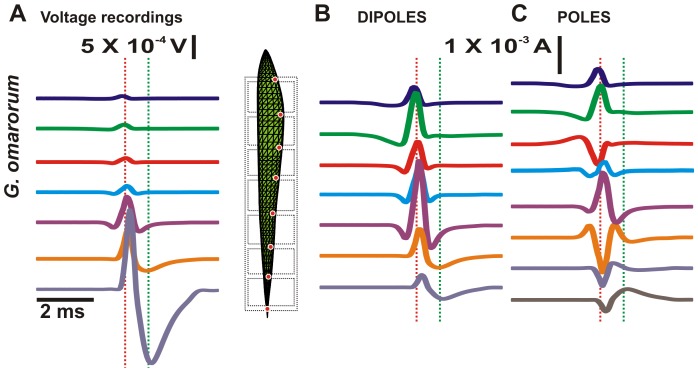
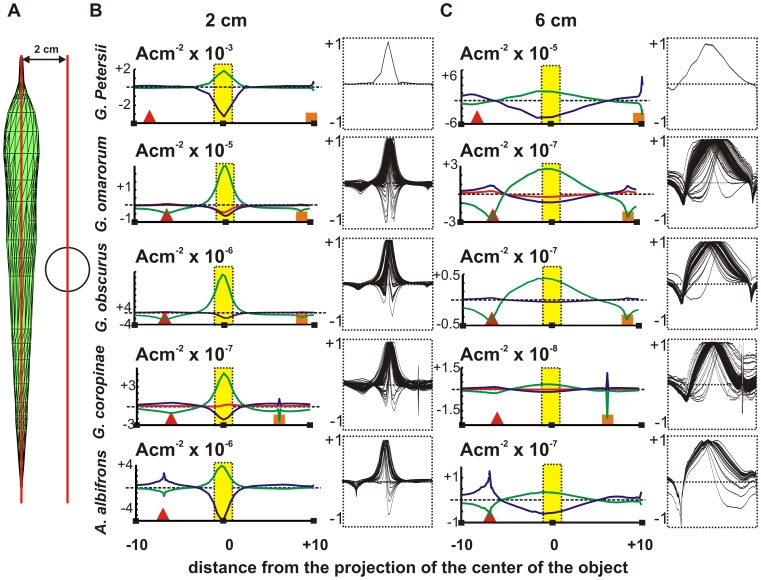
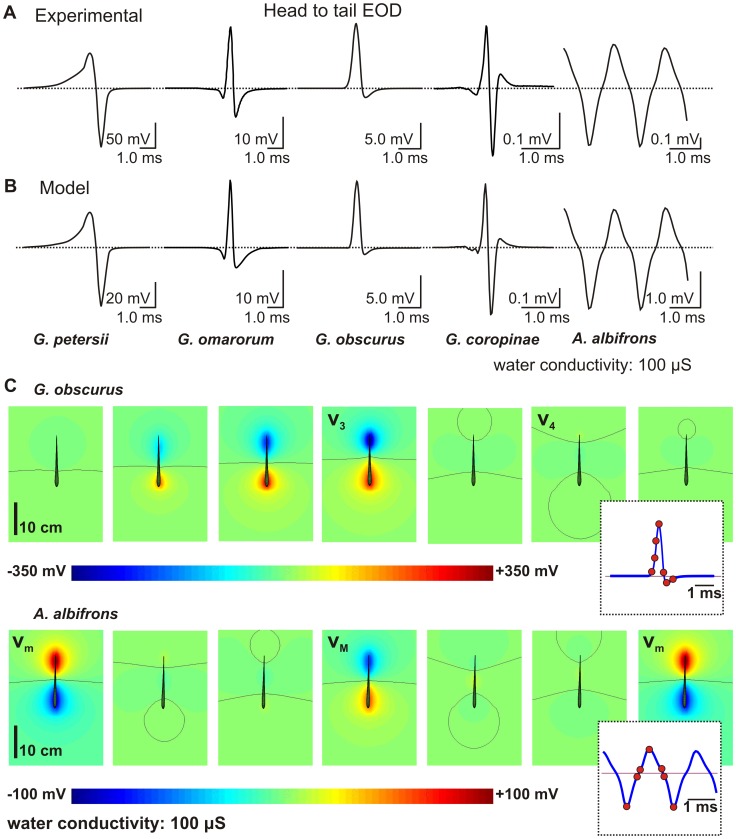
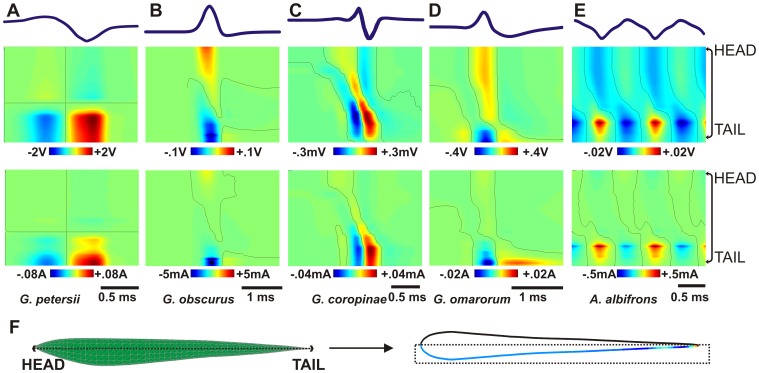
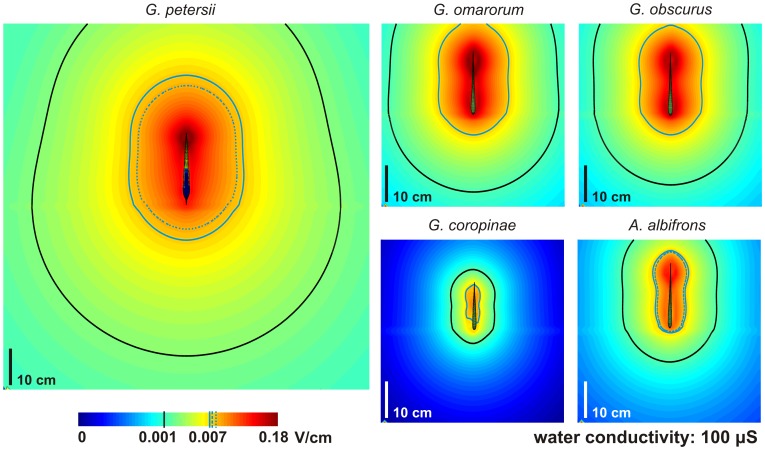
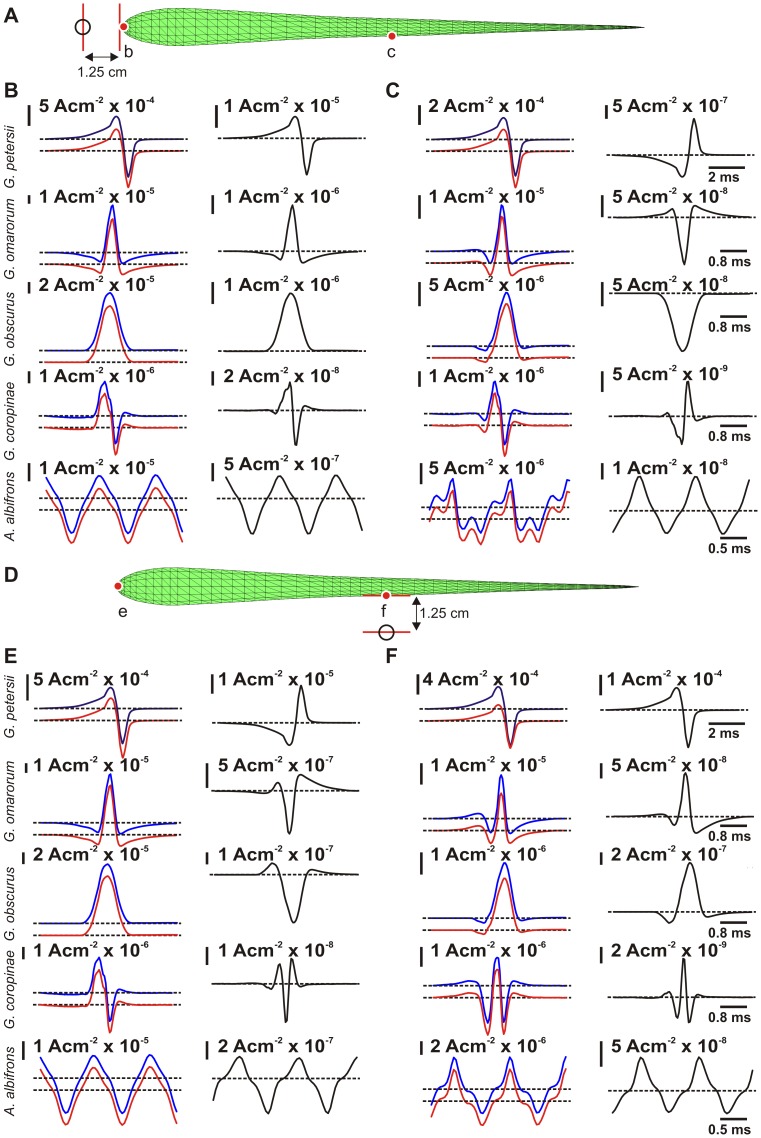
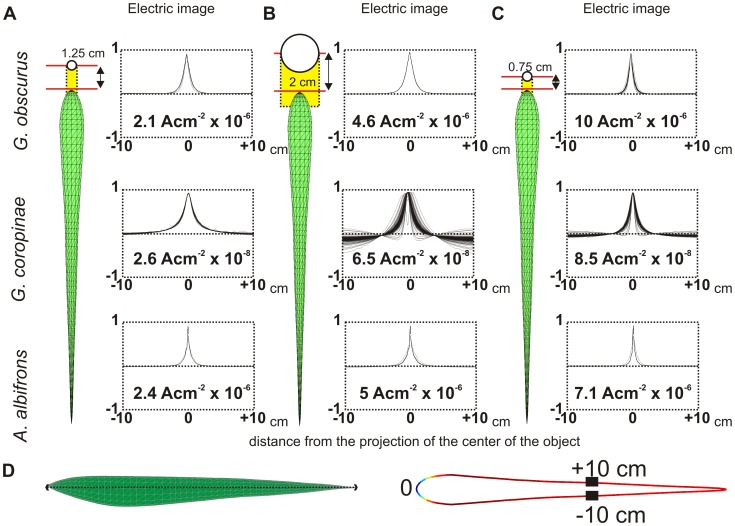
Modeling the electric field and images in electric fish contributes to a better understanding of the pre-receptor conditioning of electric images. Although the boundary element method has been very successful for calculating images and fields, complex electric organ discharges pose a challenge for active electroreception modeling. We have previously developed a direct method for calculating electric images which takes into account the structure and physiology of the electric organ as well as the geometry and resistivity of fish tissues. The present article reports a general application of our simulator for studying electric images in electric fish with heterogeneous, extended electric organs. We studied three species of Gymnotiformes, including both wave-type (Apteronotus albifrons) and pulse-type (Gymnotus obscurus and Gymnotus coropinae) fish, with electric organs of different complexity. The results are compared with the African (Gnathonemus petersii) and American (Gymnotus omarorum) electric fish studied previously. We address the following issues: 1) how to calculate equivalent source distributions based on experimental measurements, 2) how the complexity of the electric organ discharge determines the features of the electric field and 3) how the basal field determines the characteristics of electric images. Our findings allow us to generalize the hypothesis (previously posed for G. omarorum) in which the perioral region and the rest of the body play different sensory roles. While the "electrosensory fovea" appears suitable for exploring objects in detail, the rest of the body is likened to a "peripheral retina" for detecting the presence and movement of surrounding objects. We discuss the commonalities and differences between species. Compared to African species, American electric fish show a weaker field. This feature, derived from the complexity of distributed electric organs, may endow Gymnotiformes with the ability to emit site-specific signals to be detected in the short range by a conspecific and the possibility to evolve predator avoidance strategies.
电鱼的电场和图像建模有助于更好地理解电图像的受体前调节。尽管边界元法在计算图像和场方面非常成功,但复杂的电器官放电对主动电接收建模提出了挑战。我们之前开发了一种直接方法来计算电图像,该方法考虑了电器官的结构和生理学以及鱼类组织的几何形状和电阻率。本文报道了我们的模拟器在研究具有异质、扩展电器官的电鱼中的电图像的一般应用。我们研究了三种电鳗目鱼类,包括波型(Apteronotus albifrons)和脉冲型(Gymnotus obscurus 和 Gymnotus coropinae)鱼类,它们的电器官结构复杂程度不同。结果与之前研究的非洲(Gnathonemus petersii)和美洲(Gymnotus omarorum)电鱼进行了比较。我们解决了以下问题:1)如何根据实验测量结果计算等效源分布,2)电器官放电的复杂性如何决定电场的特征,3)基场如何决定电图像的特征。我们的发现允许我们对以前提出的关于 G. omarorum 的假设进行概括,即口周区域和身体的其余部分发挥不同的感觉作用。虽然“电感觉黄斑”似乎适合详细探索物体,但身体的其余部分类似于“外围视网膜”,用于检测周围物体的存在和运动。我们讨论了物种之间的异同。与非洲物种相比,美洲电鱼的电场较弱。这种特征源自分布式电器官的复杂性,可能使电鳗目鱼类具有发出特定位置信号的能力,以便同种个体在短距离内检测到,并有可能进化出逃避捕食者的策略。