Psychiatric Research Center, Roozbeh Psychiatric Hospital, Tehran University of Medical Sciences, South Kargar Street 13337, Tehran, Iran.
Daru. 2014 Jul 10;22(1):55. doi: 10.1186/2008-2231-22-55.
Cumulative evidence from epidemiological, preclinical and clinical studies suggests estrogens may have psychoprotective effects in schizophrenic patients. Selective Estrogen Receptor Modulators could have therapeutic benefits in schizophrenia for both sexes without being hazardous to gynecological tissues or having feminizing effects. Few studies have been conducted regarding the effects of raloxifene on postmenopausal women suffering from schizophrenia. We conducted this placebo-controlled trial to compare the add-on effect of raloxifene to risperidone versus risperidone with placebo.
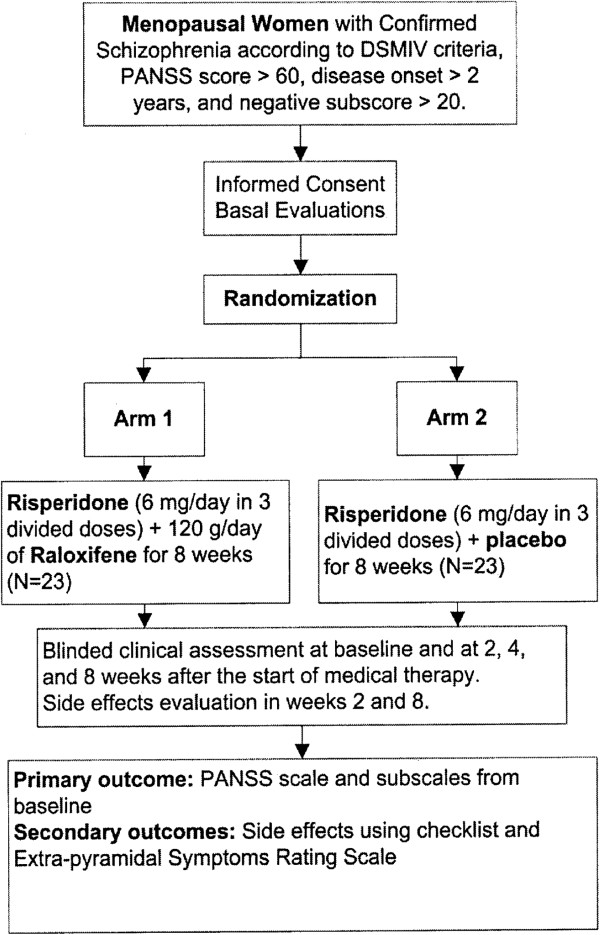
This was an 8-week, parallel-group, placebo-controlled trial undertaken at two universities affiliated psychiatric Hospitals in Iran. Forty-six postmenopausal women with the definite diagnosis of schizophrenia were enrolled in the study. Patients received risperidone (6 mg/day in 3 divided doses) combined with either placebo (N = 23) or 120 mg/day of raloxifene (N = 23) for 8 weeks. Patients were assessed by a psychiatrist at baseline and at 2 and 8 weeks after the start of medical therapy. Efficacy was defined as the change from baseline to endpoint in score on Positive and Negative Syndrome Scale (PANSS).
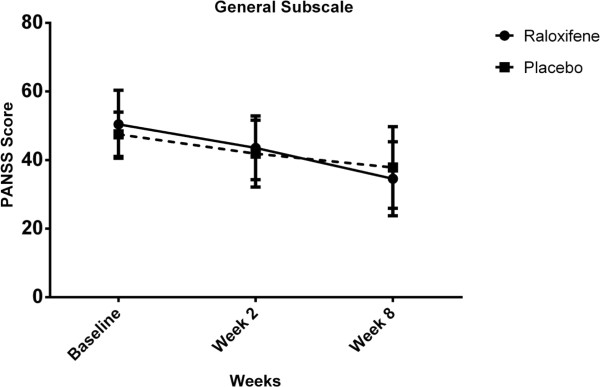
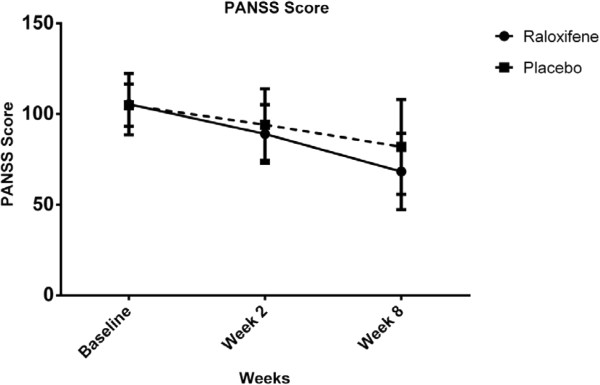
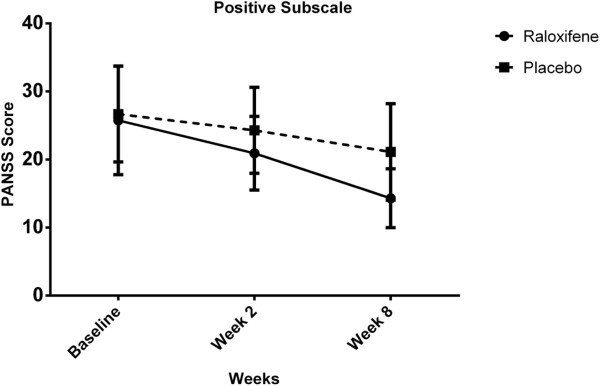
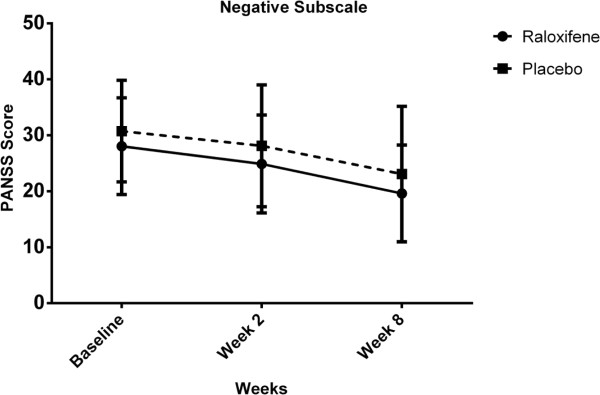
For PANSS scores, the main effect comparing two types of intervention was not significant [F (1, 48) = 1.77, p = 0.18]. For positive subscale scores, there was marginal significant interaction between intervention type and time [F (2, 47) = 2.93, p = 0.06] and there was substantial main effect for time [F (2, 47) = 24.39, p = 0.001] within both groups showing reduction in positive subscale scores across the three time periods. In addition, the main effect comparing two types of intervention was significant [F (1, 48) = 3.78, p = 0.02]. On the other hand, for negative subscale scores, the main effect comparing two types of intervention was not significant [F (1, 48) = 1.43, p = 0.23]. For general subscale scores, the main effect comparing two types of intervention was not significant [F (1, 48) = 0.03, p = 0.86].
According to our findings, raloxifene as an adjunctive treatment to risperidone was only superior in improvement of positive symptoms and it was not effective in treating negative and general psychopathology symptoms.
The trial was registered at the Iranian registry of clinical trials: IRCT201205131556N42.
来自流行病学、临床前和临床研究的累积证据表明,雌激素可能对精神分裂症患者具有保护作用。选择性雌激素受体调节剂可能对男女精神分裂症患者具有治疗益处,而不会对妇科组织造成危害,也不会产生女性化作用。关于雷洛昔芬对患有精神分裂症的绝经后妇女的影响,很少有研究。我们进行了这项安慰剂对照试验,以比较雷洛昔芬与利培酮联合治疗与利培酮联合安慰剂治疗的附加效果。
这是一项为期 8 周的、平行组、安慰剂对照试验,在伊朗的两所附属精神病院进行。46 名确诊为精神分裂症的绝经后妇女被纳入研究。患者接受利培酮(每天 6 毫克,分 3 次服用)联合安慰剂(n = 23)或雷洛昔芬 120 毫克/天(n = 23)治疗 8 周。在开始医疗治疗后的基线和 2 周和 8 周,由精神科医生对患者进行评估。疗效定义为阳性和阴性综合征量表(PANSS)评分从基线到终点的变化。
对于 PANSS 评分,两种干预类型的主要效果不显著[F(1,48)= 1.77,p = 0.18]。对于阳性量表评分,干预类型和时间之间存在边缘显著的交互作用[F(2,47)= 2.93,p = 0.06],并且两组均有显著的主要时间效应[F(2,47)= 24.39,p = 0.001],表明阳性量表评分在三个时间段内均有所下降。此外,两种干预类型的主要效果比较具有统计学意义[F(1,48)= 3.78,p = 0.02]。另一方面,对于阴性量表评分,两种干预类型的主要效果不显著[F(1,48)= 1.43,p = 0.23]。对于一般量表评分,两种干预类型的主要效果不显著[F(1,48)= 0.03,p = 0.86]。
根据我们的发现,雷洛昔芬作为利培酮的辅助治疗,仅在改善阳性症状方面更优,而在治疗阴性和一般精神病理学症状方面无效。
该试验在伊朗临床试验注册处注册:IRCT201205131556N42。