Department of Surgery, Asan Medical Center, University of Ulsan College of Medicine, Seoul, Korea.
Department of Radiology, Health Promotion Center, Asan Medical Center, University of Ulsan College of Medicine, Seoul, Korea.
J Breast Cancer. 2014 Jun;17(2):174-9. doi: 10.4048/jbc.2014.17.2.174. Epub 2014 Jun 27.
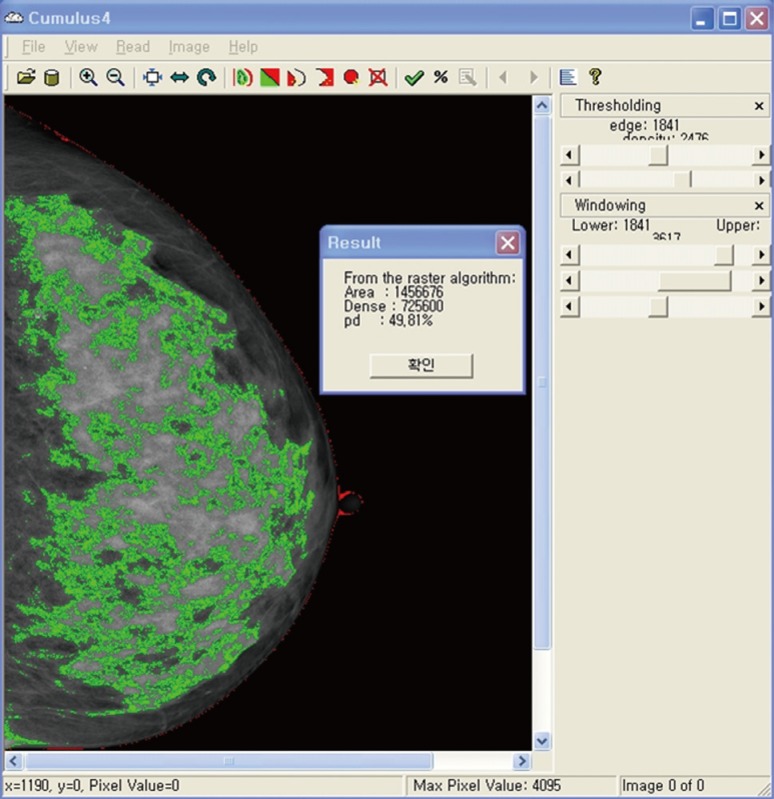
The reliability of the quantitative measurement of breast density with a semi-automated thresholding method (Cumulus™) has mainly been investigated with film mammograms. This study aimed to evaluate the intrarater reproducibility of percent density (PD) by Cumulus™ with digital mammograms.
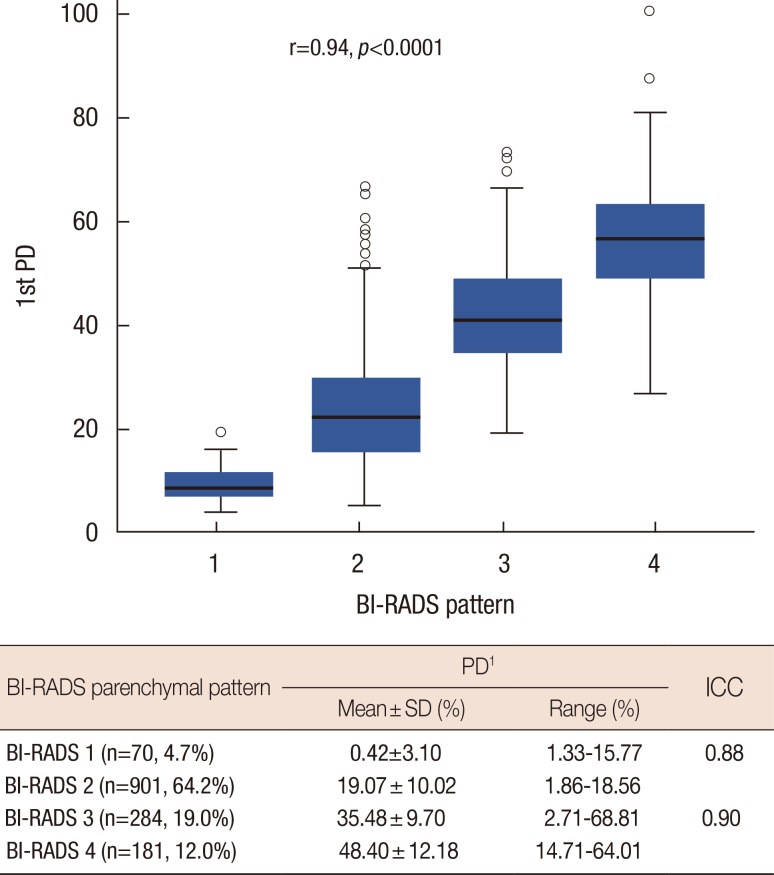
This study included 1,496 craniocaudal digital mammograms from the unaffected breast of breast cancer patients. One rater reviewed each mammogram and estimated the PD using the Cumulus™ method. All images were reassessed by the same rater 1 month later without reference to the previously assigned values. The repeatability of the PD was evaluated by an intraclass correlation coefficient (ICC). All patients were grouped based on their body mass index (BMI), age, family history of breast cancer, breastfeeding history and breast area (calculated with Cumulus™), and subgroup analysis for the ICC of each group was performed. All patients were categorized by their Breast Imaging Reporting and Data System (BI-RADS) density pattern, and the mean and standard deviation of the PD by each BI-RADS categories were compared.
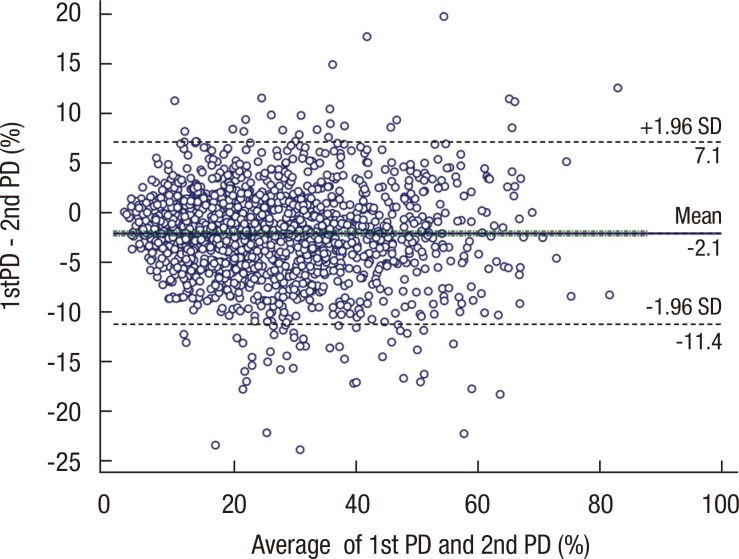
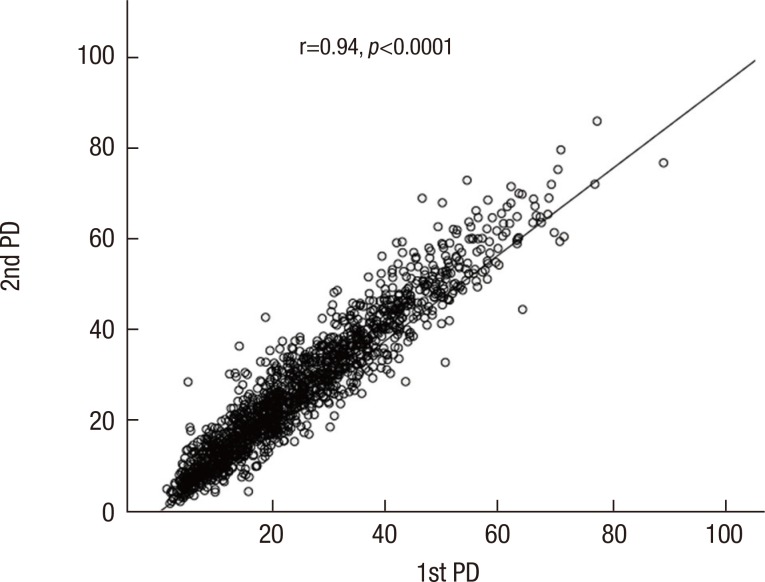
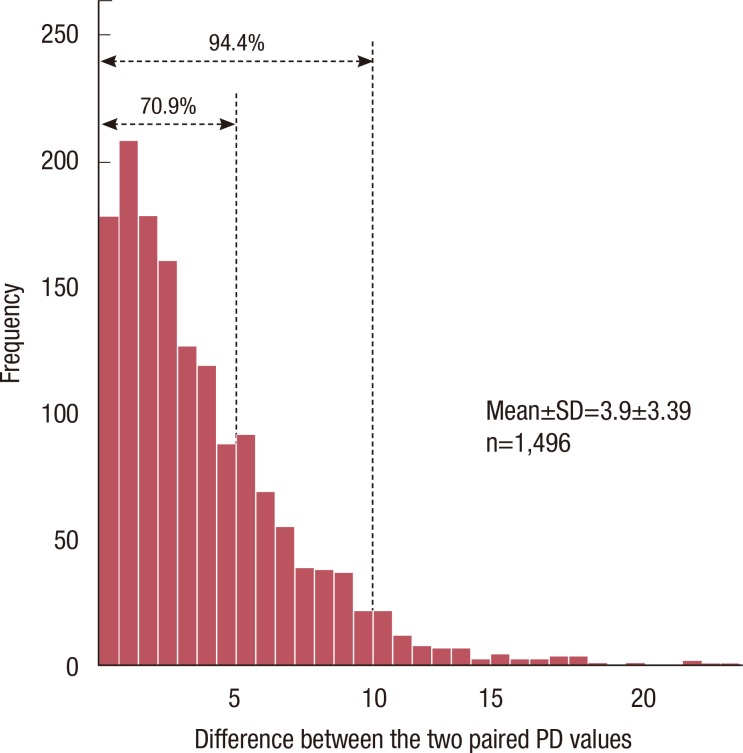
The ICC for the PD was 0.94, indicating excellent repeatability. The discrepancy between the paired PD values ranged from 0 to 23.93, with an average of 3.90 (standard deviation=3.39). The subgroup ICCs for the PD ranged from 0.88 to 0.96, indicating excellent reliability in all subgroups regardless of patient variables. The ICCs of the PD for the high-risk (BI-RADS 3 and 4) and low-risk (BI-RADS 1 and 2) groups were 0.90 and 0.88, respectively.
This study suggests that PD calculated with digital mammograms has an acceptable reliability regardless of patient age, BMI, family history of breast cancer, breastfeeding history, breast size, and BI-RADS density pattern.
使用半自动阈值方法(Cumulus)对乳腺密度进行定量测量的可靠性主要是在胶片 mammograms 上进行研究的。本研究旨在评估 Cumulus 数字 mammograms 上的密度百分比(PD)的内部评估者可重复性。
本研究纳入了 1496 例来自乳腺癌患者对侧乳腺的头尾位数字 mammograms。一名评估者使用 Cumulus 方法对每张 mammogram 进行评估,并估计 PD。所有图像在 1 个月后由同一名评估者重新评估,而不参考之前分配的值。通过组内相关系数(ICC)评估 PD 的重复性。所有患者根据其体重指数(BMI)、年龄、乳腺癌家族史、母乳喂养史和乳房面积(使用 Cumulus 计算)进行分组,并对每组的 ICC 进行亚组分析。所有患者均按 Breast Imaging Reporting and Data System(BI-RADS)密度模式进行分类,并比较每个 BI-RADS 类别下 PD 的平均值和标准差。
PD 的 ICC 为 0.94,表明可重复性极好。配对 PD 值的差异范围为 0 至 23.93,平均为 3.90(标准差=3.39)。PD 的亚组 ICC 范围为 0.88 至 0.96,表明在所有亚组中,无论患者变量如何,均可获得可靠的结果。高风险(BI-RADS 3 和 4)和低风险(BI-RADS 1 和 2)组的 PD ICC 分别为 0.90 和 0.88。
本研究表明,使用数字 mammograms 计算的 PD 具有可接受的可靠性,而与患者年龄、BMI、乳腺癌家族史、母乳喂养史、乳房大小和 BI-RADS 密度模式无关。