Kirchheimer J C, Wojta J, Christ G, Binder B R
Department of Medical Physiology, University of Vienna, Austria.
Proc Natl Acad Sci U S A. 1989 Jul;86(14):5424-8. doi: 10.1073/pnas.86.14.5424.
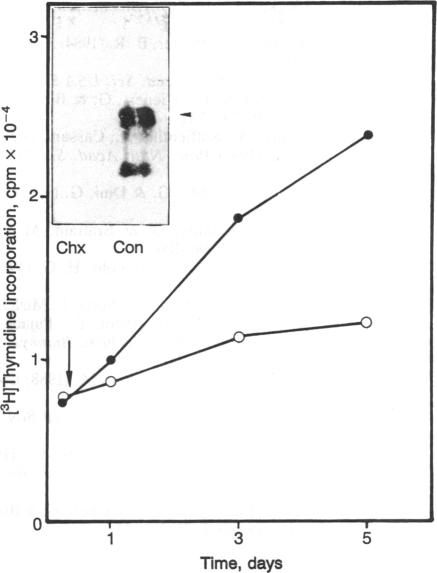
Binding of urokinase-type plasminogen activator (u-PA) to its receptor has been shown not only to focus proteolytic activity to the cell surface but also to exert a mitogenic effect on the human epidermal tumor cell line CCL 20.2. This report shows that u-PA is an autocrine mitogen in the human melanoma cell line GUBSB and that inhibition of receptor-bound u-PA by specific anti-u-PA antibodies causes a significant suppression of cell proliferation in this system. The GUBSB cell line secretes 70-80% of the u-PA in its active form and expresses high-affinity u-PA receptors with a Kd of 5.2 x 10(-10) M and 2.8 x 10(4) binding sites per cell. Approximately 70% of the u-PA receptors on these cells are occupied by endogenously secreted u-PA. Addition of the monoclonal anti-u-PA antibody MPW5UK (10 nM), directed against the active site of u-PA, twice daily to the cell cultures resulted in a significant decrease of [3H]thymidine incorporation by the tumor cells, whereas a 10 times higher concentration of the monoclonal antibody MPW4UK, which does not inhibit plasminogen activator activity of u-PA, was necessary to achieve the same effect. In addition, diisopropyl fluorophosphate-inactivated u-PA, in a concentration 50-fold higher than the concentration necessary to saturate the u-PA receptor (250 pM), decreased [3H]thymidine incorporation similarly to the specific antibody, proving that active u-PA is required for the mitogenic effect. Inhibition of endogenous u-PA production by cycloheximide reduced [3H]thymidine incorporation significantly; after addition of exogenous u-PA, [3H]thymidine incorporation increased again in the cycloheximide-treated cells. Therefore, inhibition of receptor-bound u-PA might represent a tool not only to inactivate cell-bound proteolytic activity, necessary for invasion, but also to exert a specific antiproliferative effect on certain tumor cells.
已证明尿激酶型纤溶酶原激活剂(u-PA)与其受体的结合不仅能将蛋白水解活性集中于细胞表面,还能对人表皮肿瘤细胞系CCL 20.2产生促有丝分裂作用。本报告表明,u-PA是人类黑色素瘤细胞系GUBSB中的一种自分泌促有丝分裂原,并且特异性抗u-PA抗体对受体结合的u-PA的抑制会导致该系统中细胞增殖的显著抑制。GUBSB细胞系以其活性形式分泌70%-80%的u-PA,并表达高亲和力的u-PA受体,解离常数(Kd)为5.2×10⁻¹⁰ M,每个细胞有2.8×10⁴个结合位点。这些细胞上约70%的u-PA受体被内源性分泌的u-PA占据。每天两次向细胞培养物中添加针对u-PA活性位点的单克隆抗u-PA抗体MPW5UK(10 nM),导致肿瘤细胞的[³H]胸腺嘧啶核苷掺入量显著降低,而对于不抑制u-PA纤溶酶原激活剂活性的单克隆抗体MPW4UK,需要10倍更高的浓度才能达到相同效果。此外,二异丙基氟磷酸酯失活的u-PA,其浓度比饱和u-PA受体所需浓度(250 pM)高50倍,与特异性抗体类似地降低了[³H]胸腺嘧啶核苷掺入量,证明活性u-PA是促有丝分裂作用所必需的。用环己酰亚胺抑制内源性u-PA的产生显著降低了[³H]胸腺嘧啶核苷掺入量;添加外源性u-PA后,经环己酰亚胺处理的细胞中[³H]胸腺嘧啶核苷掺入量再次增加。因此,抑制受体结合的u-PA可能不仅是一种使侵袭所必需的细胞结合蛋白水解活性失活的工具,而且还能对某些肿瘤细胞发挥特异性抗增殖作用。