Kushnir Vitaly A, Yu Yao, Barad David H, Weghofer Andrea, Himaya Eric, Lee Ho-Joon, Wu Yan-Guang, Shohat-Tal Aya, Lazzaroni-Tealdi Emanuela, Gleicher Norbert
Center for Human Reproduction, New York, New York, United States of America.
Center for Human Reproduction, New York, New York, United States of America; Foundation for Reproductive Medicine, New York, New York, United States of America.
PLoS One. 2014 Jul 14;9(7):e102274. doi: 10.1371/journal.pone.0102274. eCollection 2014.
Mutations of the fragile X mental retardation 1 (FMR1) gene are associated with distinct ovarian aging patterns.
To confirm in human in vitro fertilization (IVF) that FMR1 affects outcomes, and to determine whether this reflects differences in ovarian aging between FMR1 mutations, egg/embryo quality or an effect on implantation.
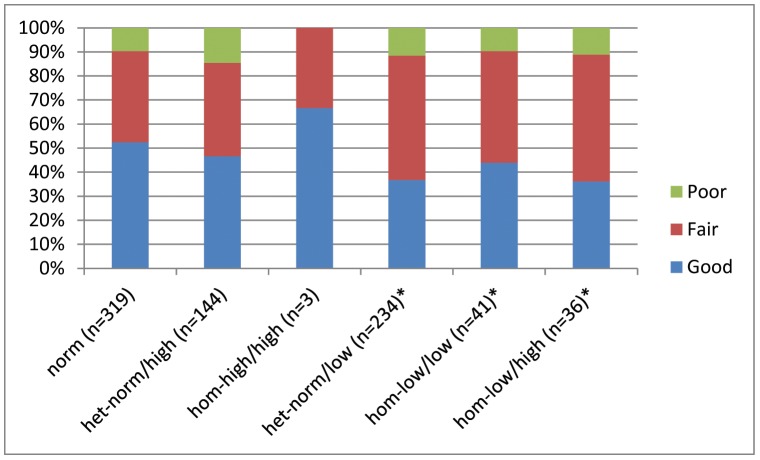
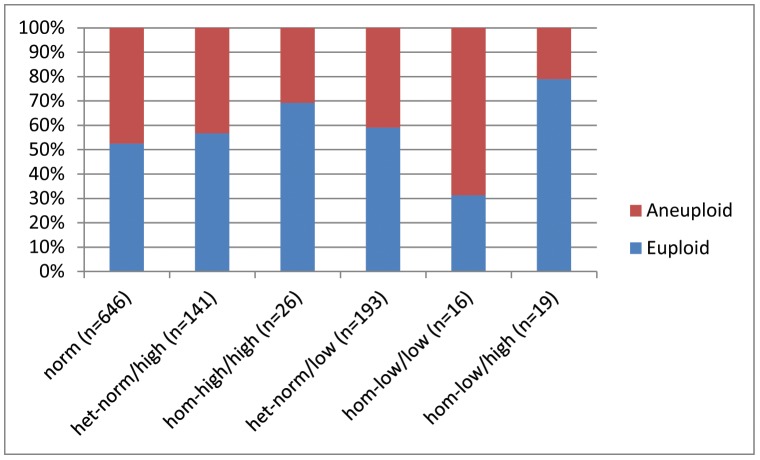
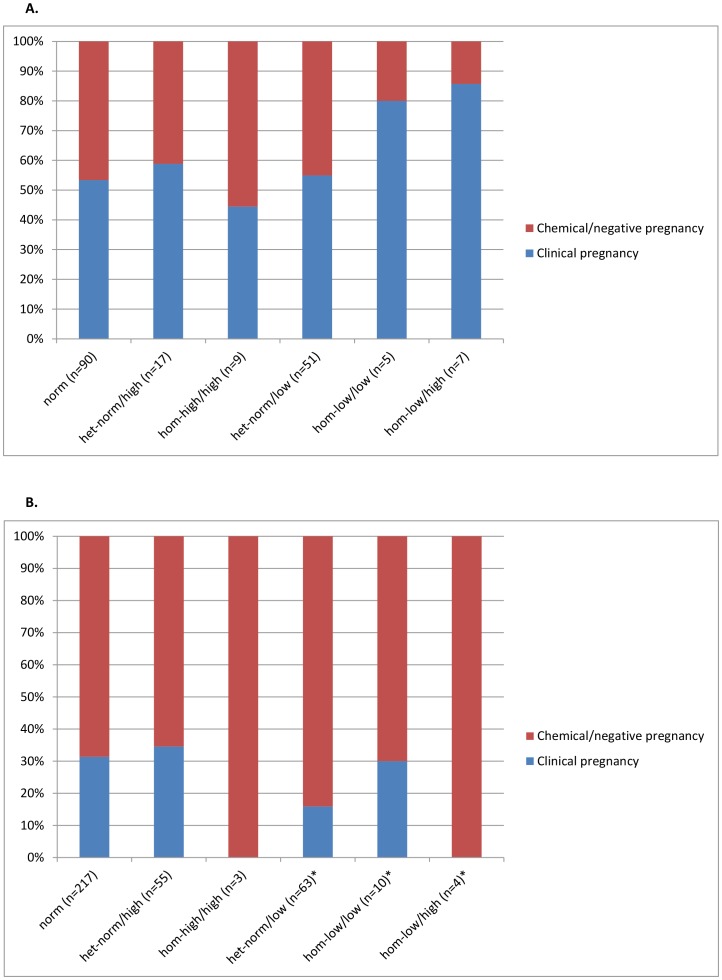
DESIGN, SETTING, PATIENTS: IVF outcomes were investigated in a private infertility center in reference to patients' FMR1 mutations based on a normal range of CGG(n = 26-34) and sub-genotypes high (CGG(n>34)) and low (CGG(<26)). The study included 3 distinct sections and study populations: (i) A generalized mixed-effects model of morphology (777 embryos, 168 IVF cycles, 125 infertile women at all ages) investigated whether embryo quality is associated with FMR1; (ii) 1041 embryos in 149 IVF cycles in presumed fertile women assessed whether the FMR1 gene is associated with aneuploidy; (iii) 352 infertile patients (< age 38; in 1st IVF cycles) and 179 donor-recipient cycles, assessed whether the FMR1 gene affects IVF pregnancy chances via oocyte/embryo quality or non-oocyte maternal factors.
Standardized IVF protocols.
Morphologic embryo quality, ploidy and pregnancy rates.
(i) Embryo morphology was reduced in presence of a low FMR1 allele (P = 0.032). In absence of a low allele, the odds ratio (OR) of chance of good (vs. fair/poor) embryos was 1.637. (ii) FMR1 was not associated with aneuploidy, though aneuploidy increased with female age. (iii) Recipient pregnancy rates were neither associated with donor age or donor FMR1. In absence of a low FMR1 allele, OR of clinical pregnancy (vs. chemical or no pregnancy) was 2.244 in middle-aged infertility patients.
A low FMR1 allele (CGG(<26)) is associated with significantly poorer morphologic embryo quality and pregnancy chance. As women age, low FMR1 alleles affect IVF pregnancy chances by reducing egg/embryo quality by mechanisms other than embryo aneuploidy.
脆性X智力低下1(FMR1)基因的突变与不同的卵巢衰老模式相关。
在人类体外受精(IVF)中证实FMR1对结果有影响,并确定这是否反映了FMR1突变之间卵巢衰老的差异、卵子/胚胎质量或对着床的影响。
设计、地点、患者:在一家私立不孕不育中心,根据CGG的正常范围(n = 26 - 34)以及高(CGG(n>34))和低(CGG(<26))亚基因型,参考患者的FMR1突变情况,对IVF结果进行了研究。该研究包括3个不同的部分和研究人群:(i)一个关于形态学的广义混合效应模型(777个胚胎、168个IVF周期、各年龄段的125名不孕女性),研究胚胎质量是否与FMR1相关;(ii)对149个IVF周期中的1041个胚胎进行研究,这些胚胎来自推测可育的女性,评估FMR1基因是否与非整倍体相关;(iii)352名不孕患者(年龄<38岁;处于第1个IVF周期)和179个供体 - 受体周期,评估FMR1基因是否通过卵母细胞/胚胎质量或非卵母细胞母体因素影响IVF妊娠几率。
标准化的IVF方案。
胚胎形态质量、倍性和妊娠率。
(i)存在低FMR1等位基因时,胚胎形态学表现降低(P = 0.032)。在不存在低等位基因的情况下,优质(与中等/差相比)胚胎出现几率的优势比(OR)为1.637。(ii)FMR1与非整倍体无关,尽管非整倍体随女性年龄增加而增加。(iii)受体妊娠率与供体年龄或供体FMR1均无关。在不存在低FMR1等位基因的情况下,中年不孕患者临床妊娠(与生化妊娠或未妊娠相比)的OR为2.244。
低FMR1等位基因(CGG(<26))与明显较差的胚胎形态质量和妊娠几率相关。随着女性年龄增长,低FMR1等位基因通过除胚胎非整倍体之外的机制降低卵子/胚胎质量,从而影响IVF妊娠几率。