College of Resources and Environment, University of Chinese Academy of Sciences NO. 19-A Yuquan Road, Shijingshan District, Beijing, 100049, China.
Key Laboratory and Ecosystem Network Observation and Modelling, Institute of Geographic Sciences and Natural Resources Research, Chinese Academy of Sciences NO.11-A Datun Road, Chaoyang District, Beijing, 100101, China.
Ecol Evol. 2014 Mar;4(5):648-55. doi: 10.1002/ece3.970. Epub 2014 Feb 12.
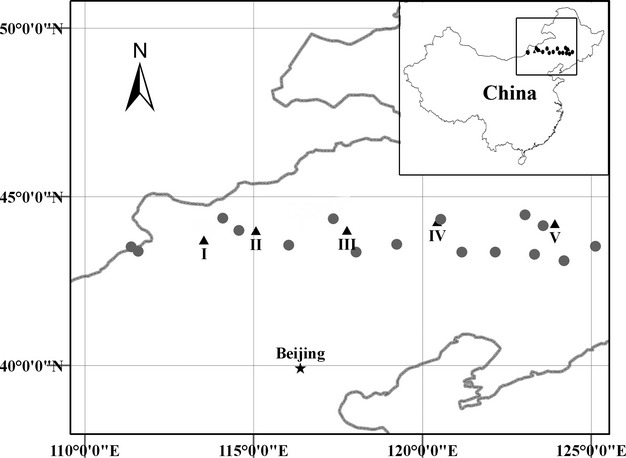
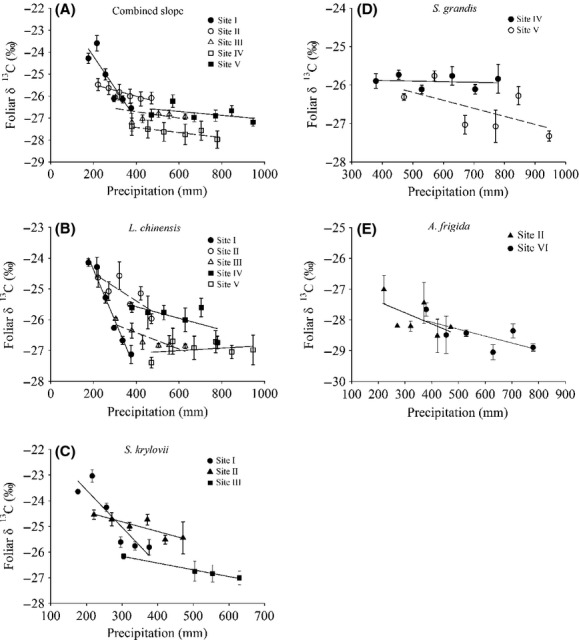
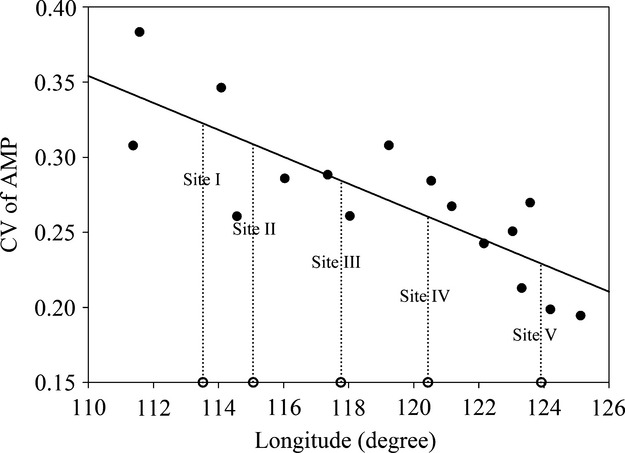
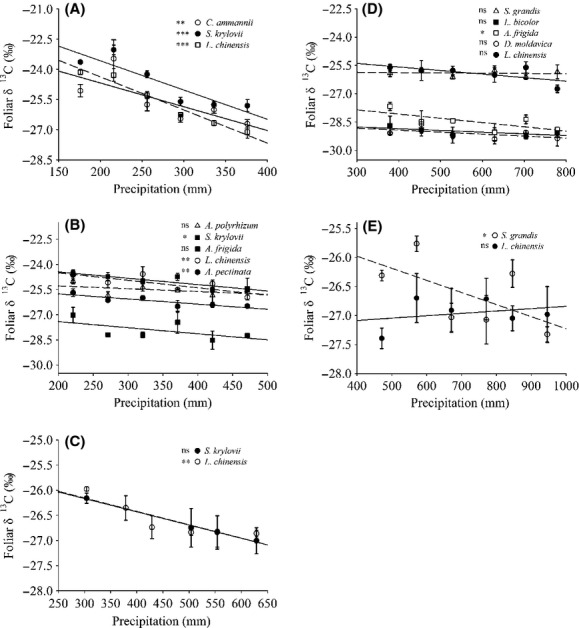
A decrease in foliar δ (13)C with increasing precipitation is a common tendency in steppe plants. However, the rate of decrease has been reported to differ between different species or populations. We here hypothesized that plant populations in the same habitat of temperate steppes may not differ in foliar δ (13)C response patterns to precipitation, but could differ in the levels of plasticity of foliar δ (13)C across different habitats. In order to test this hypothesis, we conducted controlled watering experiments in northeast China at five sites along a west-east transect at latitude 44°N, which show substantial interannual fluctuations and intra-annual changes in precipitation among them. In 2001, watering treatment (six levels, three replicates) was assigned to 18 plots at each site. The responses of foliar δ (13)C to precipitation (i.e., the sum of watering and rainfall) were determined in populations of several grass species that were common across all sites. Although similar linear regression slopes were observed for populations of different species growing at the same site, significantly different slopes were obtained for populations of the same species growing at different sites. Further, the slope of the line progressively decreased from Site I to Site V for all species in this study. These results suggest habitat-specific differences in plasticity of foliar δ (13)C in temperate steppe grasses. This indicates that species' δ (13)C response to precipitation is conservative at the same site due to their long-term acclimation, but the mechanism responsible behind this needs further investigations.
随着降水的增加,叶片 δ(13)C 减少是草原植物的普遍趋势。然而,不同物种或种群的减少率据报道有所不同。我们假设温带草原同一生境中的植物种群,其叶片 δ(13)C 对降水的响应模式可能没有差异,但在不同生境中叶片 δ(13)C 的可塑性水平可能存在差异。为了验证这一假设,我们在中国东北的五个地点进行了控制浇水实验,这些地点位于北纬 44°的东西向横断线上,其间降水存在显著的年际波动和年内变化。2001 年,在每个地点的 18 个样方中进行了浇水处理(六个水平,三个重复)。在所有样地都常见的几种草种群中,测定了叶片 δ(13)C 对降水(即浇水和降雨之和)的响应。尽管在同一地点生长的不同物种的种群观察到相似的线性回归斜率,但在不同地点生长的同一物种的种群获得了显著不同的斜率。此外,对于本研究中的所有物种,从第 I 地点到第 V 地点,该线的斜率逐渐减小。这些结果表明,温带草原草中叶片 δ(13)C 可塑性存在特定于生境的差异。这表明,由于物种的长期驯化,它们对降水的 δ(13)C 响应在同一地点是保守的,但这种机制背后的原因需要进一步研究。