Chu Houjuan, Wang Shiping, Yue Haowei, Lin Qiaoyan, Hu Yigang, Li Xiangzhen, Zhou Jizhong, Yang Yunfeng
State Key Joint Laboratory of Environment Simulation and Pollution Control, School of Environment, Tsinghua University, Beijing, 100084, China.
Microbiologyopen. 2014 Oct;3(5):585-94. doi: 10.1002/mbo3.190. Epub 2014 Jul 7.
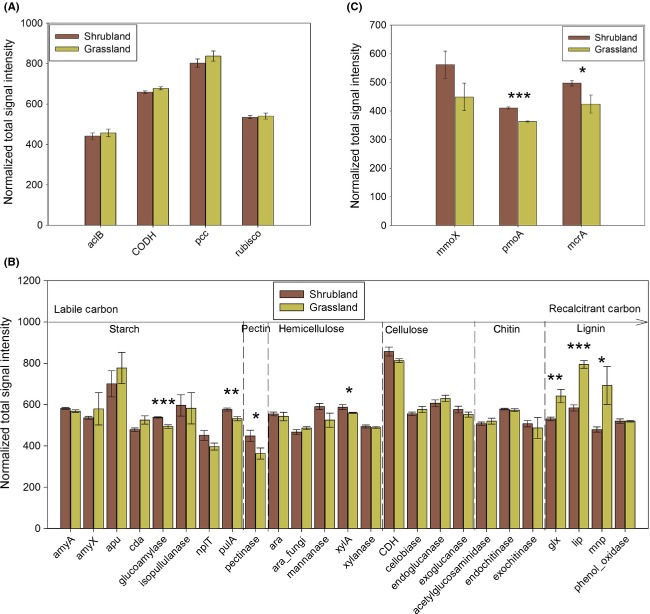
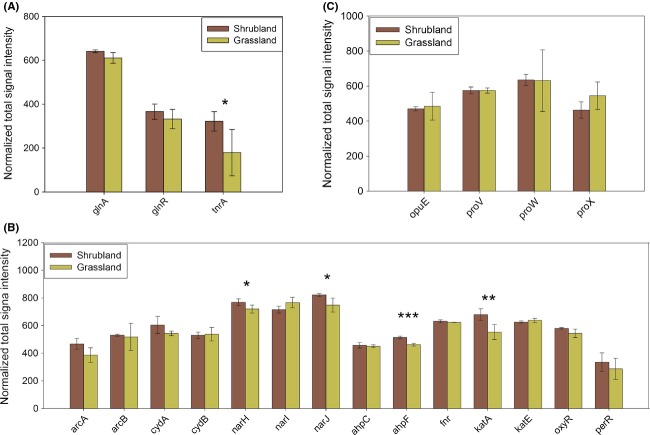
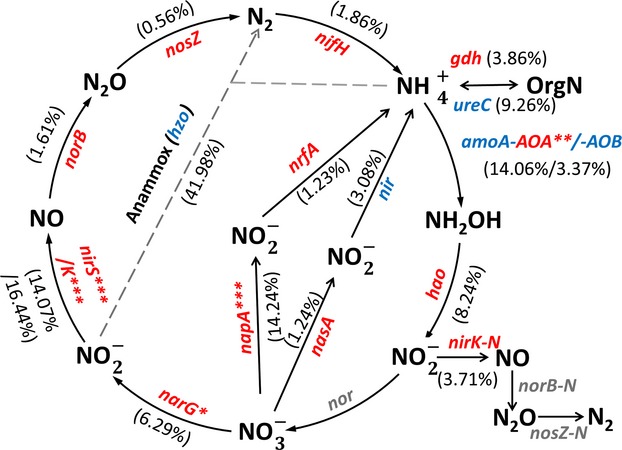
The grassland and shrubland are two major landscapes of the Tibetan alpine meadow, a region very sensitive to the impact of global warming and anthropogenic perturbation. Herein, we report a study showing that a majority of differences in soil microbial community functional structures, measured by a functional gene array named GeoChip 4.0, in two adjacent shrubland and grassland areas, were explainable by environmental properties, suggesting that the harsh environments in the alpine grassland rendered niche adaptation important. Furthermore, genes involved in labile carbon degradation were more abundant in the shrubland than those of the grassland but genes involved in recalcitrant carbon degradation were less abundant, which was conducive to long-term carbon storage and sequestration in the shrubland despite low soil organic carbon content. In addition, genes of anerobic nitrogen cycling processes such as denitrification and dissimilatory nitrogen reduction were more abundant, shifting soil nitrogen cycling toward ammonium biosynthesis and consequently leading to higher soil ammonium contents. We also noted higher abundances of stress genes responsive to nitrogen limitation and oxygen limitation, which might be attributed to low total nitrogen and higher water contents in the shrubland. Together, these results provide mechanistic knowledge about microbial linkages to soil carbon and nitrogen storage and potential consequences of vegetation shifts in the Tibetan alpine meadow.
草原和灌丛是青藏高原高寒草甸的两种主要景观,该地区对全球变暖和人为干扰的影响极为敏感。在此,我们报告一项研究,该研究表明,在两个相邻的灌丛和草原区域,通过名为GeoChip 4.0的功能基因阵列测量的土壤微生物群落功能结构的大部分差异,可以用环境特性来解释,这表明高寒草原的恶劣环境使得生态位适应变得重要。此外,参与易分解碳降解的基因在灌丛中比在草原中更为丰富,但参与难分解碳降解的基因则较少,尽管灌丛土壤有机碳含量较低,但这有利于灌丛中长期碳的储存和固存。此外,反硝化和异化氮还原等厌氧氮循环过程的基因更为丰富,使土壤氮循环向铵生物合成方向转变,从而导致土壤铵含量更高。我们还注意到,对氮限制和氧限制有响应的应激基因丰度更高,这可能归因于灌丛中总氮含量较低和含水量较高。总之,这些结果提供了关于微生物与土壤碳氮储存之间联系的机制知识,以及青藏高原高寒草甸植被变化的潜在后果。