Department of Plant Molecular Biology, Institute of Plant Genetics, Leibniz University Hannover Hannover, Germany.
Front Plant Sci. 2014 Jul 17;5:341. doi: 10.3389/fpls.2014.00341. eCollection 2014.
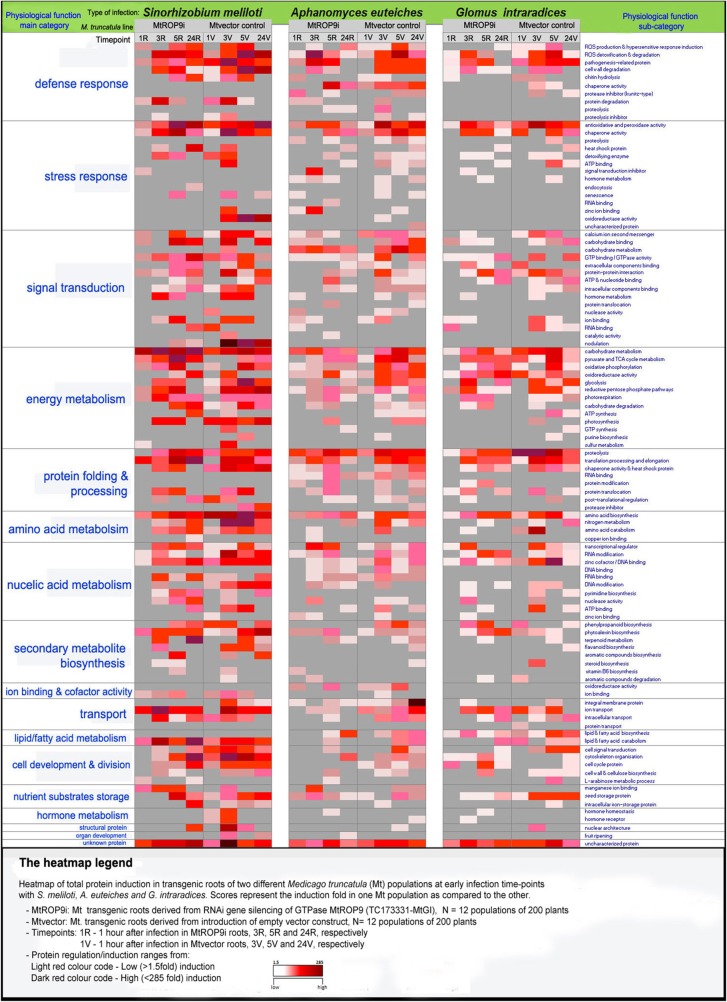
ROP-type GTPases of plants function as molecular switches within elementary signal transduction pathways such as the regulation of ROS synthesis via activation of NADPH oxidases (RBOH-respiratory burst oxidase homolog in plants). Previously, we reported that silencing of the Medicago truncatula GTPase MtROP9 led to reduced ROS production and suppressed induction of ROS-related enzymes in transgenic roots (MtROP9i) infected with pathogenic (Aphanomyces euteiches) and symbiotic microorganisms (Glomus intraradices, Sinorhizobium meliloti). While fungal infections were enhanced, S. meliloti infection was drastically impaired. In this study, we investigate the temporal proteome response of M. truncatula MtROP9i transgenic roots during the same microbial interactions under conditions of deprived potential to synthesize ROS. In comparison with control roots (Mtvector), we present a comprehensive proteomic analysis using sensitive MS protein identification. For four early infection time-points (1, 3, 5, 24 hpi), 733 spots were found to be different in abundance: 213 spots comprising 984 proteins (607 unique) were identified after S. meliloti infection, 230 spots comprising 796 proteins (580 unique) after G. intraradices infection, and 290 spots comprising 1240 proteins (828 unique) after A. euteiches infection. Data evaluation by GelMap in combination with a heatmap tool allowed recognition of key proteome changes during microbial interactions under conditions of hampered ROS synthesis. Overall, the number of induced proteins in MtROP9i was low as compared with controls, indicating a dual function of ROS in defense signaling as well as alternative response patterns activated during microbial infection. Qualitative analysis of induced proteins showed that enzymes linked to ROS production and scavenging were highly induced in control roots, while in MtROP9i the majority of proteins were involved in alternative defense pathways such as cell wall and protein degradation.
植物中的 ROP 型 GTPases 作为基本信号转导途径中的分子开关发挥作用,例如通过激活 NADPH 氧化酶(植物中的 RBOH-呼吸爆发氧化酶同源物)来调节 ROS 合成。以前,我们报道沉默 Medicago truncatula GTPase MtROP9 会导致 ROS 产生减少,并抑制转基因根(MtROP9i)中感染病原(Aphanomyces euteiches)和共生微生物(Glomus intraradices、Sinorhizobium meliloti)时 ROS 相关酶的诱导。虽然真菌感染增强了,但 S. meliloti 的感染却大大受损。在这项研究中,我们在剥夺产生 ROS 的潜在能力的相同微生物相互作用下,研究了 M. truncatula MtROP9i 转基因根的时间蛋白质组响应。与对照根(Mtvector)相比,我们使用敏感的 MS 蛋白鉴定进行了全面的蛋白质组分析。对于四个早期感染时间点(1、3、5、24 hpi),发现 733 个斑点的丰度不同:在 S. meliloti 感染后,有 213 个斑点包含 984 种蛋白质(607 个独特),在 G. intraradices 感染后,有 230 个斑点包含 796 种蛋白质(580 个独特),在 A. euteiches 感染后,有 290 个斑点包含 1240 种蛋白质(828 个独特)。通过 GelMap 与热图工具相结合的数据评估,允许识别在 ROS 合成受阻的情况下微生物相互作用期间关键蛋白质组变化。总体而言,与对照相比,MtROP9i 中诱导的蛋白质数量较少,表明 ROS 在防御信号传导中的双重功能以及在微生物感染期间激活的替代反应模式。诱导蛋白的定性分析表明,与 ROS 产生和清除相关的酶在对照根中高度诱导,而在 MtROP9i 中,大多数蛋白质参与替代防御途径,如细胞壁和蛋白质降解。