Higginbotham Katherine, Tian Yufeng, Gawlak Grzegorz, Moldobaeva Nurgul, Shah Alok, Birukova Anna A
Section of Pulmonary and Critical Care Medicine, Department of Medicine, University of Chicago, Chicago, IL 60637, USA.
Section of Pulmonary and Critical Care Medicine, Department of Medicine, University of Chicago, Chicago, IL 60637, USA.
Cell Signal. 2014 Nov;26(11):2306-16. doi: 10.1016/j.cellsig.2014.07.032. Epub 2014 Aug 4.
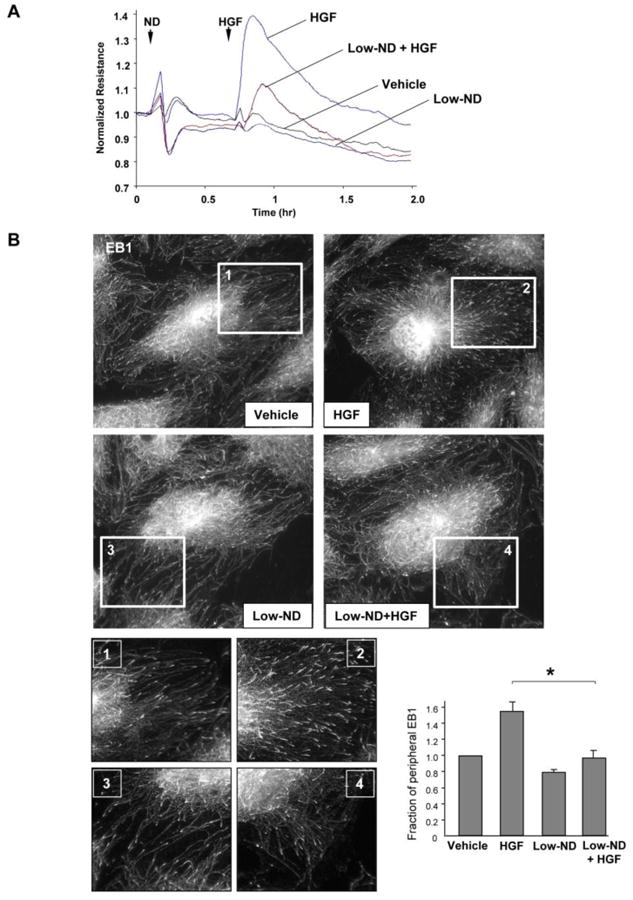
Previous reports described an important role of hepatocyte growth factor (HGF) in mitigation of pulmonary endothelial barrier dysfunction and cell injury induced by pathologic agonists and mechanical forces. HGF protective effects have been associated with Rac-GTPase signaling pathway activated by Rac-specific guanine nucleotide exchange factor Tiam1 and leading to enhancement of intercellular adherens junctions. This study tested involvement of a novel Rac-specific activator, Asef, in endothelial barrier enhancement by HGF and investigated a mechanism of HGF-induced Asef activation. Si-RNA-based knockdown of Tiam1 and Asef had an additive effect on attenuation of HGF-induced Rac activation and endothelial cell (EC) barrier enhancement. Tiam1 and Asef activation was abolished by pharmacologic inhibitors of HGF receptor and PI3-kinase. In contrast to Tiam1, Asef interacted with APC and associated with microtubule fraction upon HGF stimulation. EC treatment by low dose nocodazole to inhibit peripheral microtubule dynamics partially attenuated HGF-induced Asef peripheral translocation, but had negligible effect on Tiam1 translocation. These effects were associated with attenuation of HGF-induced barrier enhancement in EC pretreated with low ND dose and activation of Rac and its cytoskeletal effectors PAK1 and cortactin. These data demonstrate, that in addition to microtubule-independent Tiam1 activation, HGF engages additional microtubule- and APC-dependent pathway of Asef activation. These mechanisms may complement each other to provide the fine tuning of Rac signaling and endothelial barrier enhancement in response to various agonists.
先前的报道描述了肝细胞生长因子(HGF)在减轻由病理性激动剂和机械力诱导的肺内皮屏障功能障碍和细胞损伤方面的重要作用。HGF的保护作用与由Rac特异性鸟嘌呤核苷酸交换因子Tiam1激活并导致细胞间黏附连接增强的Rac-GTPase信号通路有关。本研究测试了一种新型Rac特异性激活剂Asef在HGF增强内皮屏障中的作用,并研究了HGF诱导Asef激活的机制。基于小干扰RNA(Si-RNA)敲低Tiam1和Asef对减弱HGF诱导的Rac激活和内皮细胞(EC)屏障增强具有累加效应。HGF受体和PI3激酶的药理抑制剂消除了Tiam1和Asef的激活。与Tiam1不同,Asef在HGF刺激后与APC相互作用并与微管部分相关联。用低剂量诺考达唑处理EC以抑制外周微管动力学,部分减弱了HGF诱导的Asef外周转位,但对Tiam1转位的影响可忽略不计。这些效应与低剂量诺考达唑预处理的EC中HGF诱导的屏障增强减弱以及Rac及其细胞骨架效应器PAK1和皮层肌动蛋白的激活有关。这些数据表明,除了不依赖微管的Tiam1激活外,HGF还参与了依赖微管和APC的Asef激活途径。这些机制可能相互补充,以微调Rac信号并响应各种激动剂增强内皮屏障。