
模拟变化环境中病原体传播媒介的种群遗传学:指南及巴西锥蝽的应用
Simulating population genetics of pathogen vectors in changing landscapes: guidelines and application with Triatoma brasiliensis.
作者信息
Rebaudo Francois, Costa Jane, Almeida Carlos E, Silvain Jean-Francois, Harry Myriam, Dangles Olivier
机构信息
BEI-UR072, IRD, Gif-sur-Yvette, France; LEGS-UPR9034, CNRS-UPSud11, Gif-sur-Yvette, France.
Laboratório de Biodiversidade Entomológica, Instituto Oswaldo Cruz - Fiocruz, Rio de Janeiro, Rio de Janeiro, Brasil.
出版信息
PLoS Negl Trop Dis. 2014 Aug 7;8(8):e3068. doi: 10.1371/journal.pntd.0003068. eCollection 2014 Aug.
BACKGROUND
Understanding the mechanisms that influence the population dynamics and spatial genetic structure of the vectors of pathogens infecting humans is a central issue in tropical epidemiology. In view of the rapid changes in the features of landscape pathogen vectors live in, this issue requires new methods that consider both natural and human systems and their interactions. In this context, individual-based model (IBM) simulations represent powerful yet poorly developed approaches to explore the response of pathogen vectors in heterogeneous social-ecological systems, especially when field experiments cannot be performed.
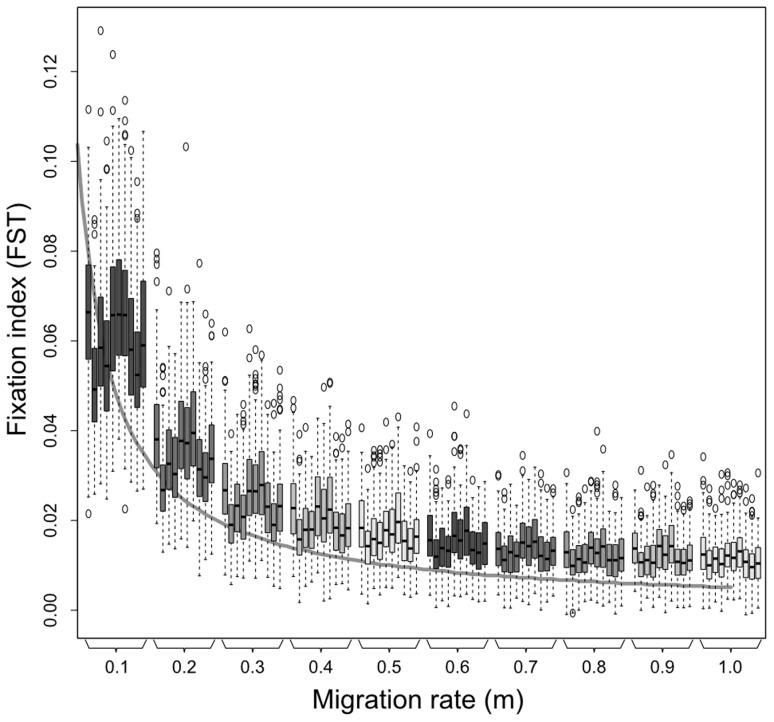
METHODOLOGY/PRINCIPAL FINDINGS: We first present guidelines for the use of a spatially explicit IBM, to simulate population genetics of pathogen vectors in changing landscapes. We then applied our model with Triatoma brasiliensis, originally restricted to sylvatic habitats and now found in peridomestic and domestic habitats, posing as the most important Trypanosoma cruzi vector in Northeastern Brazil. We focused on the effects of vector migration rate, maximum dispersal distance and attraction by domestic habitat on T. brasiliensis population dynamics and spatial genetic structure. Optimized for T. brasiliensis using field data pairwise fixation index (FST) from microsatellite loci, our simulations confirmed the importance of these three variables to understand vector genetic structure at the landscape level. We then ran prospective scenarios accounting for land-use change (deforestation and urbanization), which revealed that human-induced land-use change favored higher genetic diversity among sampling points.
CONCLUSIONS/SIGNIFICANCE: Our work shows that mechanistic models may be useful tools to link observed patterns with processes involved in the population genetics of tropical pathogen vectors in heterogeneous social-ecological landscapes. Our hope is that our study may provide a testable and applicable modeling framework to a broad community of epidemiologists for formulating scenarios of landscape change consequences on vector dynamics, with potential implications for their surveillance and control.
背景
了解影响感染人类病原体传播媒介种群动态和空间遗传结构的机制是热带流行病学的核心问题。鉴于病原体传播媒介所处景观特征的快速变化,这一问题需要新的方法来同时考虑自然和人类系统及其相互作用。在此背景下,基于个体的模型(IBM)模拟是探索异质社会生态系统中病原体传播媒介反应的强大但发展不完善的方法,尤其是在无法进行实地实验的情况下。
方法/主要发现:我们首先提出使用空间明确的IBM来模拟变化景观中病原体传播媒介种群遗传学的指南。然后,我们将模型应用于巴西锥蝽,它原本局限于野生栖息地,现在也出现在家栖和家养栖息地,是巴西东北部最重要的克氏锥虫传播媒介。我们重点研究了传播媒介迁移率、最大扩散距离和家栖栖息地吸引力对巴西锥蝽种群动态和空间遗传结构的影响。利用微卫星位点的实地数据成对固定指数(FST)对巴西锥蝽进行优化后,我们的模拟证实了这三个变量对于理解景观层面传播媒介遗传结构的重要性。然后,我们运行了考虑土地利用变化(森林砍伐和城市化)的前瞻性情景,结果表明人为引起的土地利用变化有利于采样点之间更高的遗传多样性。
结论/意义:我们的工作表明,机制模型可能是将观察到的模式与异质社会生态景观中热带病原体传播媒介种群遗传学所涉及的过程联系起来的有用工具。我们希望我们的研究能够为广大流行病学家提供一个可测试且适用的建模框架,用于制定景观变化对传播媒介动态影响的情景,这可能对它们的监测和控制具有潜在意义。



 Zotero 插件