Kada Sarah, McCoy Karen D, Boulinier Thierry
Centre d'Ecologie Fonctionnelle et Evolutive (CEFE) - CNRS Université Montpellier UMR 5175, 1919 route de Mende, 34293, Montpellier, France.
Maladies Infectieuses et Vecteurs: Ecologie, Génétique, Evolution et Contrôle, UMR CNRS 5290 - UR IRD 224 - Université Montpellier, Centre IRD, 34394, Montpellier, France.
Parasit Vectors. 2017 Aug 4;10(1):375. doi: 10.1186/s13071-017-2261-y.
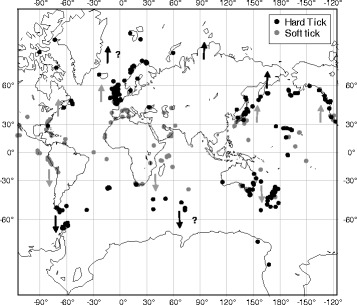
When colonization and gene flow depend on host-mediated dispersal, a key factor affecting vector dispersal potential is the time spent on the host for the blood meal, a characteristic that can vary strongly among life history stages. Using a 2-patch vector-pathogen population model and seabird ticks as biological examples, we explore how vector colonization rates and the spread of infectious agents may be shaped by life stage-dependent dispersal. We contrast hard (Ixodidae) and soft (Argasidae) tick systems, which differ strongly in blood- feeding traits.
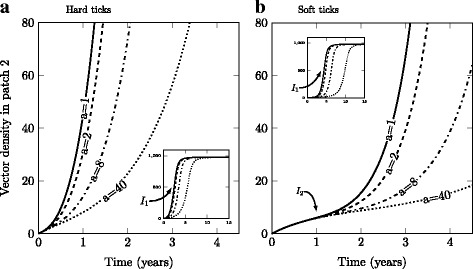
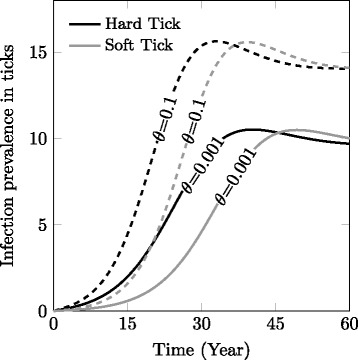
We find that vector life history characteristics (i.e. length of blood meal) and demographic constraints (Allee effects) condition the colonization potential of ticks; hard ticks, which take a single, long blood meal per life stage, should have much higher colonization rates than soft ticks, which take repeated short meals. Moreover, this dispersal potential has direct consequences for the spread of vector-borne infectious agents, in particular when transmission is transovarial.
These results have clear implications for predicting the dynamics of vector and disease spread in the context of large-scale environmental change. The findings highlight the need to include life-stage dispersal in models that aim to predict species and disease distributions, and provide testable predictions related to the population genetic structure of vectors and pathogens along expansion fronts.
当定殖和基因流动依赖于宿主介导的扩散时,影响病媒扩散潜力的一个关键因素是在宿主身上获取血餐所花费的时间,这一特征在不同生活史阶段可能有很大差异。以2斑块病媒-病原体种群模型和海鸟蜱作为生物学实例,我们探讨了生活阶段依赖性扩散如何塑造病媒定殖率和传染病原体的传播。我们对比了硬蜱(硬蜱科)和软蜱(argasidae)系统,它们在吸血特性上有很大差异。
我们发现病媒生活史特征(即血餐长度)和种群统计学限制(阿利效应)决定了蜱的定殖潜力;硬蜱在每个生活阶段摄取单一的长时间血餐,其定殖率应比摄取多次短时间血餐的软蜱高得多。此外,这种扩散潜力对病媒传播传染病原体的传播有直接影响,特别是在经卵传播时。
这些结果对于预测大规模环境变化背景下病媒和疾病传播动态具有明确意义。研究结果强调了在旨在预测物种和疾病分布的模型中纳入生活阶段扩散的必要性,并提供了与病媒和病原体在扩张前沿的种群遗传结构相关的可检验预测。