Instituto de Bioquímica Vegetal y Fotosíntesis, Universidad de Sevilla - Consejo Superior de Investigaciones Científicas Sevilla, Spain.
Front Plant Sci. 2014 Jul 28;5:366. doi: 10.3389/fpls.2014.00366. eCollection 2014.
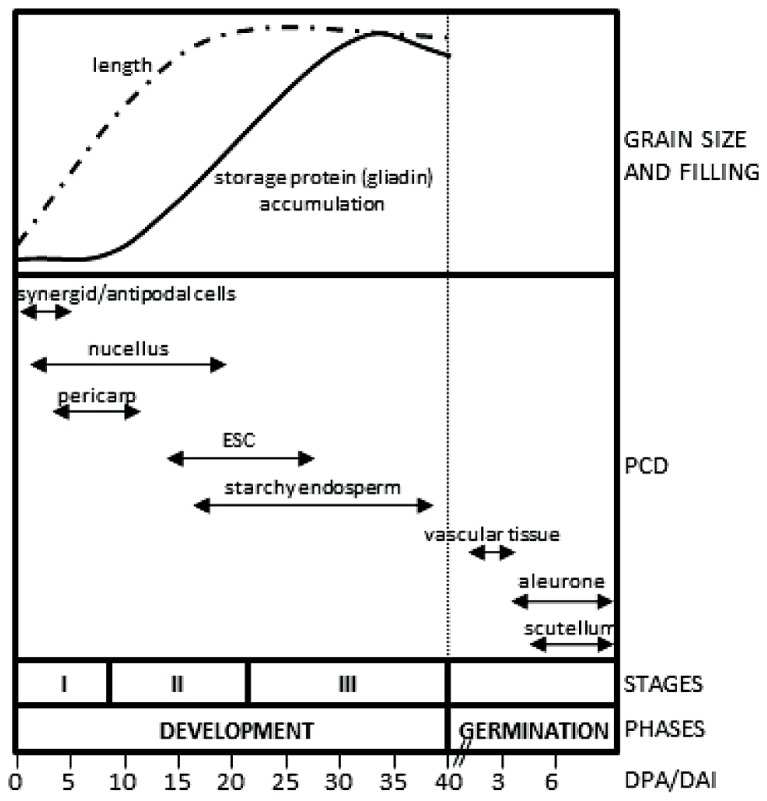
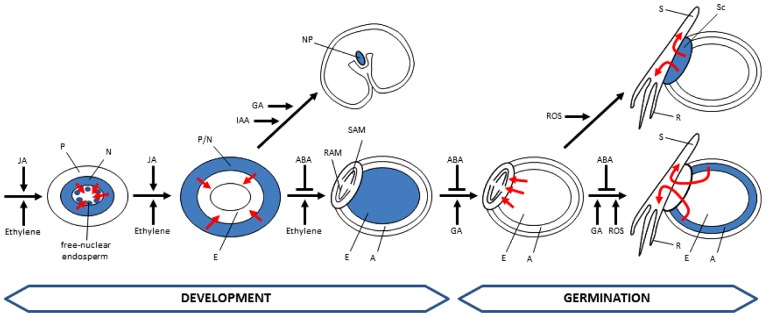
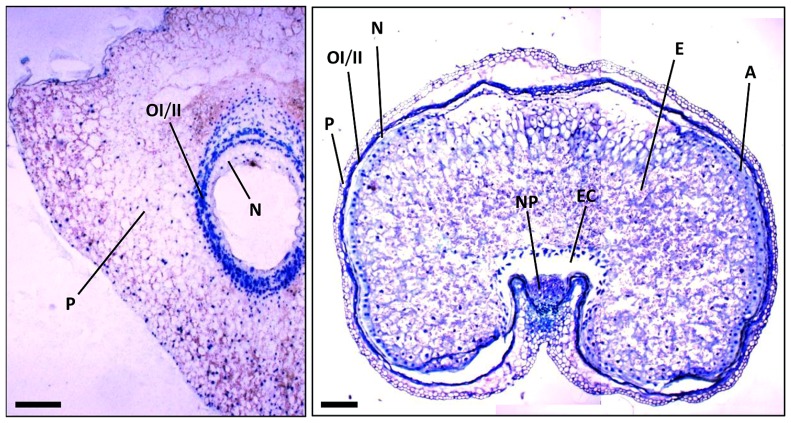
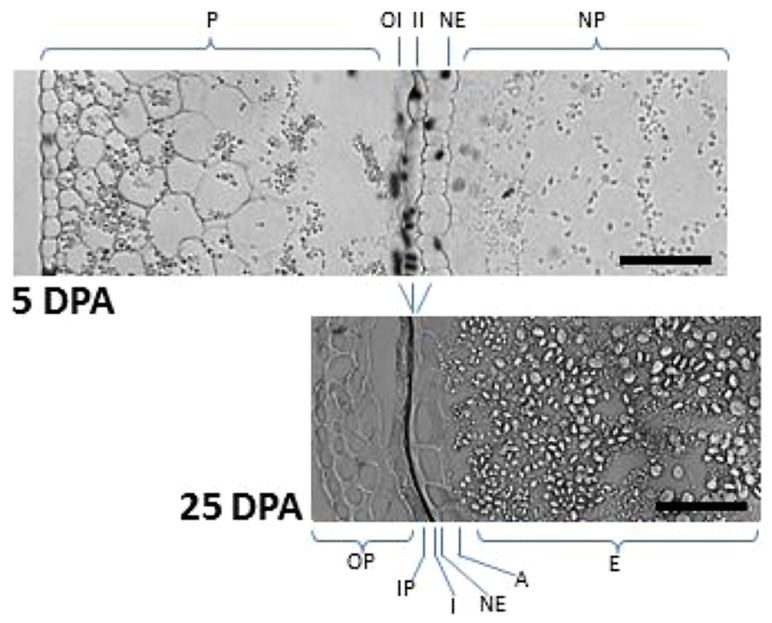
The life cycle of cereal seeds can be divided into two phases, development and germination, separated by a quiescent period. Seed development and germination require the growth and differentiation of new tissues, but also the ordered disappearance of cells, which takes place by a process of programmed cell death (PCD). For this reason, cereal seeds have become excellent model systems for the study of developmental PCD in plants. At early stages of seed development, maternal tissues such as the nucellus, the pericarp, and the nucellar projections undergo a progressive degeneration by PCD, which allows the remobilization of their cellular contents for nourishing new filial tissues such as the embryo and the endosperm. At a later stage, during seed maturation, the endosperm undergoes PCD, but these cells remain intact in the mature grain and their contents will not be remobilized until germination. Thus, the only tissues that remain alive when seed development is completed are the embryo axis, the scutellum and the aleurone layer. In germinating seeds, both the scutellum and the aleurone layer play essential roles in producing the hydrolytic enzymes for the mobilization of the storage compounds of the starchy endosperm, which serve to support early seedling growth. Once this function is completed, scutellum and aleurone cells undergo PCD; their contents being used to support the growth of the germinated embryo. PCD occurs with tightly controlled spatial-temporal patterns allowing coordinated fluxes of nutrients between the different seed tissues. In this review, we will summarize the current knowledge of the tissues undergoing PCD in developing and germinating cereal seeds, focussing on the biochemical features of the process. The effect of hormones and redox regulation on PCD control will be discussed.
谷类种子的生命周期可以分为两个阶段,即发育和萌发,它们之间有一个静止期隔开。种子的发育和萌发需要新组织的生长和分化,但也需要细胞有序地消失,这是通过程序性细胞死亡(PCD)来实现的。因此,谷类种子成为研究植物发育性 PCD 的极好模型系统。在种子发育的早期阶段,母体组织如珠心、果皮和珠心突起通过 PCD 逐渐退化,这使得它们的细胞内容物能够重新分配,为胚胎和胚乳等新的亲代组织提供营养。在后期,在种子成熟过程中,胚乳经历 PCD,但这些细胞在成熟的谷物中保持完整,它们的内容物在萌发之前不会重新分配。因此,当种子发育完成时,唯一存活的组织是胚轴、盾片和糊粉层。在萌发的种子中,盾片和糊粉层在产生淀粉胚乳储存化合物的水解酶方面都起着至关重要的作用,这些酶用于支持早期幼苗的生长。一旦这个功能完成,盾片和糊粉层细胞就会经历 PCD;它们的内容物被用来支持萌发胚胎的生长。PCD 发生的时空模式受到严格控制,以允许不同种子组织之间的营养物质进行协调流动。在这篇综述中,我们将总结发育中和萌发中的谷类种子中经历 PCD 的组织的当前知识,重点讨论该过程的生化特征。我们将讨论激素和氧化还原调节对 PCD 控制的影响。