
脓毒症患者第一周的红细胞分布宽度与疾病严重程度及死亡率相关。
Red blood cell distribution width during the first week is associated with severity and mortality in septic patients.
作者信息
Lorente Leonardo, Martín María M, Abreu-González Pedro, Solé-Violán Jordi, Ferreres José, Labarta Lorenzo, Díaz César, González Oswaldo, García Daida, Jiménez Alejandro, Borreguero-León Juan M
机构信息
Intensive Care Unit, Hospital Universitario de Canarias, La Laguna, Tenerife, Spain.
Intensive Care Unit, Hospital Universitario Nuestra Señora Candelaria, Santa Cruz de Tenerife, Tenerife, Spain.
出版信息
PLoS One. 2014 Aug 25;9(8):e105436. doi: 10.1371/journal.pone.0105436. eCollection 2014.
OBJECTIVE
Higher values of red blood cell distribution width (RDW) have been found in non-surviving than in surviving septic patients. However, it is unknown whether RDW during the first week of sepsis evolution is associated with sepsis severity and early mortality, oxidative stress and inflammation states, and these were the aims of the study.
METHODS
We performed a prospective, observational, multicenter study in six Spanish Intensive Care Units with 297 severe septic patients. We measured RDW, serum levels of malondialdehyde (MDA) to assess oxidative stress, and tumour necrosis factor (TNF)-α to assess inflammation at days 1, 4, and 8. The end-point was 30-day mortality.
RESULTS
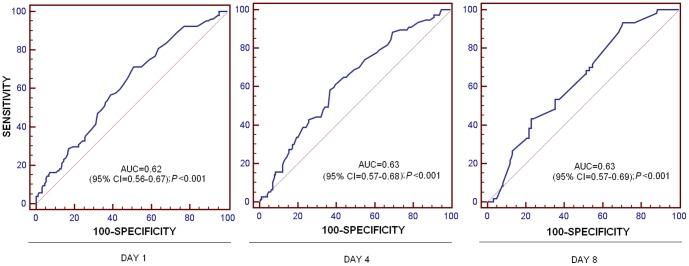
We found higher RDW in non-surviving (n = 104) than in surviving (n = 193) septic patients at day 1 (p = 0.001), day 4 (p = 0.001), and day 8 (p = 0.002) of ICU admission. Cox regression analyses showed that RDW at day 1 (p<0.001), 4 (p = 0.005) and 8 (p = 0.03) were associated with 30-day mortality. Receiver operating characteristic curves showed that RDW at day 1 (p<0.001), 4 (p<0.001), and 8 (p<0.001) could be used to predict 30-day mortality. RDW showed a positive correlation with serum MDA levels at day 1 and day 4, with serum TNF-α levels at days 4 and 8, and with SOFA score at days 1, 4 and 8.
CONCLUSIONS
The major findings of our study were that non-surviving septic patients showed persistently higher RDW during the first week of ICU stay than survivors, that RDW during the first week was associated with sepsis severity and mortality, that RDW during the first week could be used as biomarker of outcome in septic patients, and that there was an association between RDW, serum MDA levels, and serum TNF-α levels during the first week.
目的
在脓毒症患者中,已发现死亡患者的红细胞分布宽度(RDW)值高于存活患者。然而,脓毒症进展第一周的RDW是否与脓毒症严重程度、早期死亡率、氧化应激和炎症状态相关尚不清楚,而这些正是本研究的目的。
方法
我们在西班牙的6个重症监护病房对297例严重脓毒症患者进行了一项前瞻性、观察性、多中心研究。在第1、4和8天测量RDW、用于评估氧化应激的血清丙二醛(MDA)水平以及用于评估炎症的肿瘤坏死因子(TNF)-α水平。终点为30天死亡率。
结果
我们发现,在入住ICU的第1天(p = 0.001)、第4天(p = 0.001)和第8天(p = 0.002),死亡的脓毒症患者(n = 104)的RDW高于存活患者(n = 193)。Cox回归分析显示,第1天(p<0.001)、第4天(p = 0.005)和第8天(p = 0.03)的RDW与30天死亡率相关。受试者工作特征曲线显示,第1天(p<0.001)、第4天(p<0.001)和第8天(p<0.001)的RDW可用于预测30天死亡率。RDW在第1天和第4天与血清MDA水平呈正相关,在第


 Zotero 插件