Øvrevik Johan, Låg Marit, Lecureur Valerie, Gilot David, Lagadic-Gossmann Dominique, Refsnes Magne, Schwarze Per E, Skuland Tonje, Becher Rune, Holme Jørn A
Cell Commun Signal. 2014 Jul 24;12:48. doi: 10.1186/s12964-014-0048-8.
The aryl hydrocarbon receptor (AhR) has gradually emerged as a regulator of inflammation in the lung and other tissues. AhR may interact with the p65-subunit of the nuclear factor (NF)-κB transcription factors, but reported outcomes of AhR/NF-κB-interactions are conflicting. Some studies suggest that AhR possess pro-inflammatory activities while others suggest that AhR may be anti-inflammatory. The present study explored the impact of AhR and its binding partner AhR nuclear translocator (Arnt) on p65-activation and two differentially regulated chemokines, CXCL8 (IL-8) and CCL5 (RANTES), in human bronchial epithelial cells (BEAS-2B).
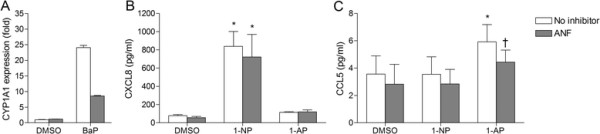
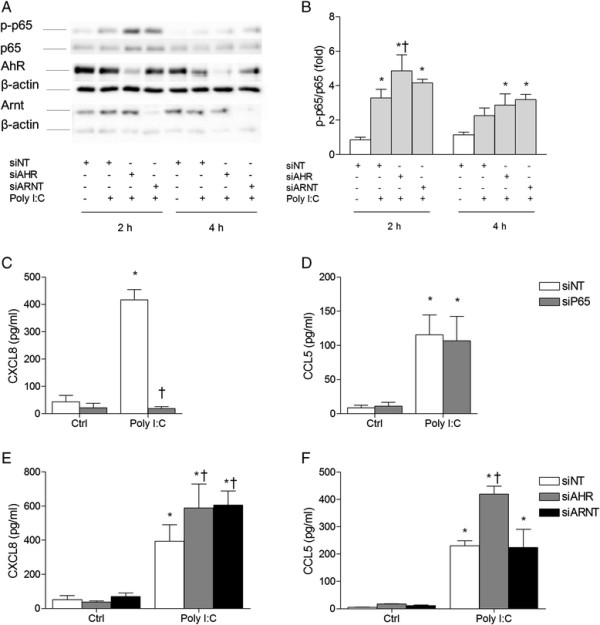
Cells were exposed to CXCL8- and CCL5-inducing chemicals, 1-nitropyrene (1-NP) and 1-aminopyrene (1-AP) respectively, or the synthetic double-stranded RNA analogue, polyinosinic-polycytidylic acid (Poly I:C) which induced both chemokines. Only CXCL8, and not CCL5, appeared to be p65-dependent. Yet, constitutively active unligated AhR suppressed both CXCL8 and CCL5, as shown by siRNA knock-down and the AhR antagonist α-naphthoflavone. Moreover, AhR suppressed activation of p65 by TNF-α and Poly I:C as assessed by luciferase-assay and p65-phosphorylation at serine 536, without affecting basal p65-activity. In contrast, Arnt suppressed only CXCL8, but did not prevent the p65-activation directly. However, Arnt suppressed expression of the NF-κB-subunit RelB which is under transcriptional regulation by p65. Furthermore, AhR-ligands alone at high concentrations induced a moderate CXCL8-response, without affecting CCL5, but suppressed both CXCL8 and CCL5-responses by Poly I:C.
AhR and Arnt may differentially and independently regulate chemokine-responses induced by both inhaled pollutants and pulmonary infections. Constitutively active, unligated AhR suppressed the activation of p65, while Arnt may possibly interfere with the action of activated p65. Moreover, ligand-activated AhR suppressed CXCL8 and CCL5 responses by other agents, but AhR ligands alone induced CXCL8 responses when given at sufficiently high concentrations, thus underscoring the duality of AhR in regulation of inflammation. We propose that AhR-signaling may be a weak activator of p65-signaling that suppresses p65-activity induced by strong activators of NF-κB, but that its anti-inflammatory properties also are due to interference with additional pathways.
芳烃受体(AhR)已逐渐成为肺和其他组织中炎症的调节因子。AhR可能与核因子(NF)-κB转录因子的p65亚基相互作用,但关于AhR/NF-κB相互作用的报道结果相互矛盾。一些研究表明AhR具有促炎活性,而另一些研究则表明AhR可能具有抗炎作用。本研究探讨了AhR及其结合伴侣AhR核转运蛋白(Arnt)对人支气管上皮细胞(BEAS-2B)中p65激活以及两种差异调节的趋化因子CXCL8(IL-8)和CCL5(RANTES)的影响。
细胞分别暴露于诱导CXCL8和CCL5的化学物质1-硝基芘(1-NP)和1-氨基芘(1-AP),或诱导两种趋化因子的合成双链RNA类似物聚肌苷酸-聚胞苷酸(Poly I:C)。似乎只有CXCL8,而不是CCL5,是p65依赖性的。然而,如siRNA敲低和AhR拮抗剂α-萘黄酮所示,组成型活性未结合的AhR抑制了CXCL8和CCL5。此外,通过荧光素酶测定和丝氨酸536处的p65磷酸化评估,AhR抑制了TNF-α和Poly I:C对p65的激活,而不影响基础p65活性。相比之下,Arnt仅抑制CXCL8,但不直接阻止p65激活。然而,Arnt抑制了受p65转录调控的NF-κB亚基RelB的表达。此外,高浓度的单独AhR配体诱导了适度的CXCL8反应,而不影响CCL5,但抑制了Poly I:C诱导的CXCL8和CCL5反应。
AhR和Arnt可能以不同且独立的方式调节吸入污染物和肺部感染诱导的趋化因子反应。组成型活性、未结合的AhR抑制p65激活,而Arnt可能干扰活化p65的作用。此外,配体激活的AhR抑制其他试剂诱导的CXCL8和CCL5反应,但单独的AhR配体在足够高的浓度下诱导CXCL8反应,从而突出了AhR在炎症调节中的双重性。我们提出,AhR信号可能是p65信号的弱激活剂,可抑制NF-κB强激活剂诱导的p65活性,但其抗炎特性也归因于对其他途径的干扰。