Division of Parasitology, Central Drug Research Institute , Lucknow , India.
Division of Molecular and Structural Biology, Central Drug Research Institute , Lucknow , India.
Front Immunol. 2014 Aug 22;5:380. doi: 10.3389/fimmu.2014.00380. eCollection 2014.
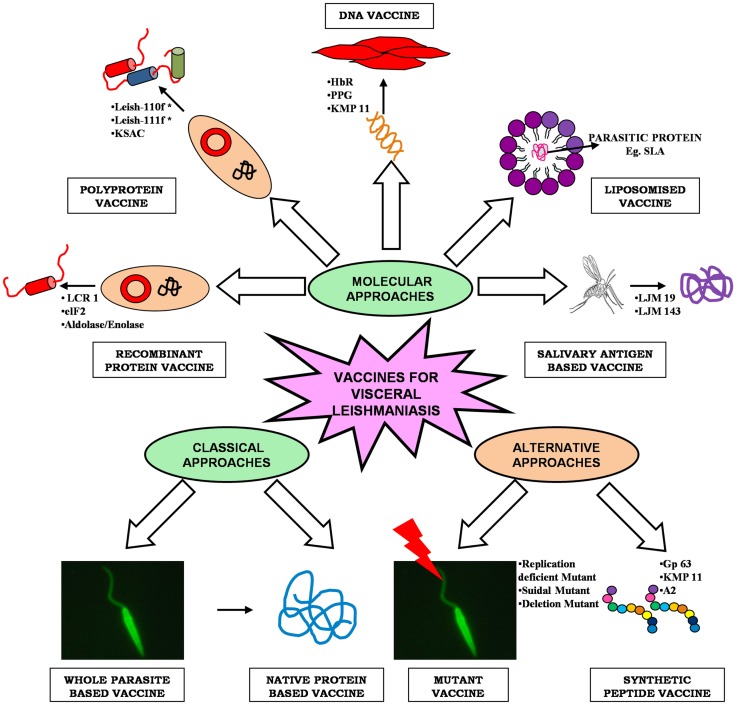
Visceral leishmaniasis (VL) or kala-azar, a vector-borne protozoan disease, shows endemicity in larger areas of the tropical, subtropical and the Mediterranean countries. WHO report suggested that an annual incidence of VL is nearly 200,000 to 400,000 cases, resulting in 20,000 to 30,000 deaths per year. Treatment with available anti-leishmanial drugs are not cost effective, with varied efficacies and higher relapse rate, which poses a major challenge to current kala-azar control program in Indian subcontinent. Therefore, a vaccine against VL is imperative and knowing the fact that recovered individuals developed lifelong immunity against re-infection, it is feasible. Vaccine development program, though time taking, has recently gained momentum with the emergence of omic era, i.e., from genomics to immunomics. Classical as well as molecular methodologies have been overtaken with alternative strategies wherein proteomics based knowledge combined with computational techniques (immunoinformatics) speed up the identification and detailed characterization of new antigens for potential vaccine candidates. This may eventually help in the designing of polyvalent synthetic and recombinant chimeric vaccines as an effective intervention measures to control the disease in endemic areas. This review focuses on such newer approaches being utilized for vaccine development against VL.
内脏利什曼病(VL)或黑热病,一种由媒介传播的原生动物疾病,在热带、亚热带和地中海国家的更大地区呈现地方性流行。世界卫生组织的报告表明,VL 的年发病率接近 20 万至 40 万例,每年导致 2 万至 3 万人死亡。现有的抗利什曼病药物治疗效果不佳,疗效各异,复发率较高,这对印度次大陆目前的黑热病控制项目构成了重大挑战。因此,迫切需要针对 VL 的疫苗,而且鉴于康复者对再次感染产生了终身免疫力,这是可行的。疫苗开发计划虽然耗时,但随着组学时代的到来,最近已经取得了进展,即从基因组学到免疫组学。经典和分子方法已经被替代策略所取代,其中基于蛋白质组学的知识与计算技术(免疫信息学)相结合,加速了新抗原的识别和详细特征分析,这些新抗原可能成为潜在疫苗候选物。这最终可能有助于设计多价合成和重组嵌合疫苗,作为在流行地区控制疾病的有效干预措施。本文综述了针对 VL 开发疫苗所利用的这些新方法。