Liu Huiliang, Jin Zhigeng, Deng Yunpeng, Jing Limin
Division of Cardiology, General Hospital of Chinese People's Armed Police Forces, Beijing 100039, China.
J Appl Clin Med Phys. 2014 Jul 8;15(4):4805. doi: 10.1120/jacmp.v15i4.4805.
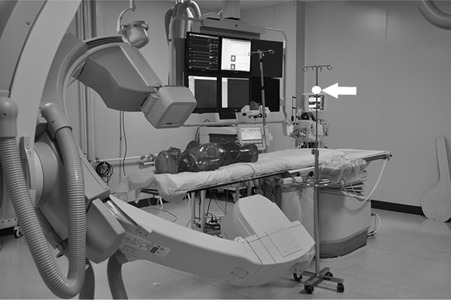
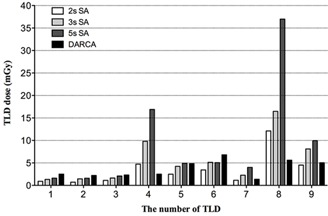
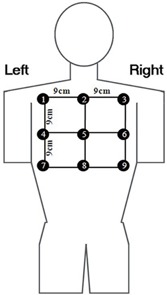
The purpose of this study was to evaluate peak skin dose received by the patient and scattered dose to the operator during dual-axis rotational coronary angiography (DARCA), and to compare with those of standard coronary angiography (SA). An anthropomorphic phantom was used to simulate a patient undergoing diagnostic coronary angiography. Cine imaging was applied on the phantom for 2 s, 3 s, and 5 s in SA projections to mimic clinical situations with normal vessels, and uncomplicated and complicated coronary lesions. DARCA was performed in two curved trajectories around the phantom. During both SA and DARCA, peak skin dose was measured with thermoluminescent dosimeter arrays and scattered dose with a dosimeter at predefined height (approximately at the level of left eye) at the operator's location. Compared to SA, DARCA was found lower in both peak skin dose (range: 44%-82%, p < 0.001) and scattered dose (range: 40%-70%, p < 0.001). The maximal reductions were observed in the set mimicking complicated lesion examinations (82% reduction for peak skin dose, p < 0.001; 70% reduction for scattered dose, p < 0.001). DARCA reduces both peak skin dose and scattered dose in comparison to SA. The benefi t of radiation dose reduction could be especially signifi cant in complicated lesion examinations due to large reduction in X-ray exposure time. The use of DARCA could, therefore, be recommended in clinical practice to minimize radiation dose.
本研究的目的是评估患者在双轴旋转冠状动脉造影(DARCA)过程中接受的皮肤峰值剂量以及术者所受的散射剂量,并与标准冠状动脉造影(SA)进行比较。使用一个仿真人体模型来模拟接受诊断性冠状动脉造影的患者。在SA投照中,对模型进行2秒、3秒和5秒的电影成像,以模拟正常血管、无并发症和有并发症的冠状动脉病变的临床情况。DARCA在围绕模型的两条弯曲轨迹上进行。在SA和DARCA过程中,使用热释光剂量计阵列测量皮肤峰值剂量,并在术者位置的预定义高度(约左眼水平)用剂量计测量散射剂量。与SA相比,发现DARCA的皮肤峰值剂量(范围:44%-82%,p<0.001)和散射剂量(范围:40%-70%,p<0.001)均较低。在模拟有并发症病变检查的设置中观察到最大降幅(皮肤峰值剂量降低82%,p<0.001;散射剂量降低70%,p<0.001)。与SA相比,DARCA可降低皮肤峰值剂量和散射剂量。由于X射线照射时间大幅减少,辐射剂量降低的益处在有并发症病变检查中可能尤为显著。因此,在临床实践中推荐使用DARCA以尽量减少辐射剂量。