Ganschow Rainer, Pollok Jörg-Matthias, Jankofsky Martin, Junge Guido
Department of Pediatrics, University of Bonn, Bonn, Germany.
Department of General, Visceral, Thoracic, and Vascular Surgery, University of Bonn, Bonn, Germany.
Clin Exp Gastroenterol. 2014 Sep 2;7:329-43. doi: 10.2147/CEG.S41780. eCollection 2014.
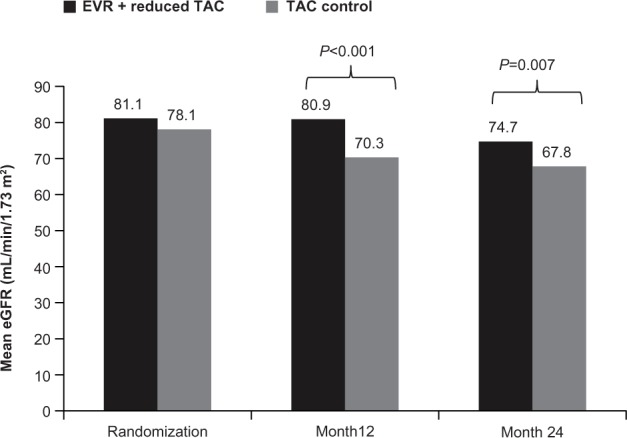
During the last 5 decades, liver transplantation has witnessed rapid development in terms of both technical and pharmacologic advances. Since their discovery, calcineurin inhibitors (CNIs) have remained the standard of care for immunosuppression therapy in liver transplantation, improving both patient and graft survival. However, adverse events, particularly posttransplant nephrotoxicity, associated with long-term CNI use have necessitated the development of alternate treatment approaches. These include combination therapy with a CNI and the inosine monophosphate dehydrogenase inhibitor mycophenolic acid and use of mammalian target of rapamycin (mTOR) inhibitors. Everolimus, a 40-O-(2-hydroxyethyl) derivative of mTOR inhibitor sirolimus, has a distinct pharmacokinetic profile. Several studies have assessed the role of everolimus in liver transplant recipients in combination with CNI reduction or as a CNI withdrawal strategy. The efficacy of everolimus-based immunosuppressive therapy has been demonstrated in both de novo and maintenance liver transplant recipients. A pivotal study in 719 de novo liver transplant recipients formed the basis of the recent approval of everolimus in combination with steroids and reduced-dose tacrolimus in liver transplantation. In this study, everolimus introduced at 30 days posttransplantation in combination with reduced-dose tacrolimus (exposure reduced by 39%) showed comparable efficacy (composite efficacy failure rate of treated biopsy-proven acute rejection, graft loss, or death) and achieved superior renal function as early as month 1 and maintained it over 2 years versus standard exposure tacrolimus. This review provides an overview of the efficacy and safety of everolimus-based regimens in liver transplantation in the de novo and maintenance settings, as well as in special populations such as patients with hepatocellular carcinoma recurrence, hepatitis C virus-positive patients, and pediatric transplant recipients. We also provide an overview of ongoing studies and discuss potential expansion of the role for everolimus in these settings.
在过去的50年里,肝移植在技术和药理学进展方面都取得了快速发展。自发现以来,钙调神经磷酸酶抑制剂(CNIs)一直是肝移植免疫抑制治疗的标准,提高了患者和移植物的存活率。然而,与长期使用CNIs相关的不良事件,特别是移植后肾毒性,促使人们开发替代治疗方法。这些方法包括将CNI与肌苷单磷酸脱氢酶抑制剂霉酚酸联合使用,以及使用雷帕霉素靶蛋白(mTOR)抑制剂。依维莫司是mTOR抑制剂西罗莫司的40-O-(2-羟乙基)衍生物,具有独特的药代动力学特征。多项研究评估了依维莫司在肝移植受者中与减少CNI使用或作为CNI撤药策略联合使用的作用。基于依维莫司的免疫抑制治疗在初治和维持性肝移植受者中均已证明有效。一项针对719例初治肝移植受者的关键研究为依维莫司近期在肝移植中与类固醇和低剂量他克莫司联合使用的获批奠定了基础。在这项研究中,移植后30天开始使用依维莫司并联合低剂量他克莫司(暴露量降低39%)显示出相当的疗效(经活检证实的急性排斥反应、移植物丢失或死亡的综合疗效失败率),并且与标准暴露量的他克莫司相比,早在第1个月就实现了更好的肾功能,并在2年多的时间里保持这一优势。本综述概述了基于依维莫司的方案在初治和维持性肝移植、以及特殊人群(如肝细胞癌复发患者、丙型肝炎病毒阳性患者和儿童移植受者)中的疗效和安全性。我们还概述了正在进行的研究,并讨论了依维莫司在这些情况下潜在的作用扩展。