Takesh Mustafa
Department of Nuclear Medicine, University Hospital Heidelberg, Heidelberg ; Department of Nuclear Medicine and Radiology, Knappschaft Hospital, 66280 Sulzbach, Germany.
World J Nucl Med. 2013 Sep;12(3):101-10. doi: 10.4103/1450-1147.136734.
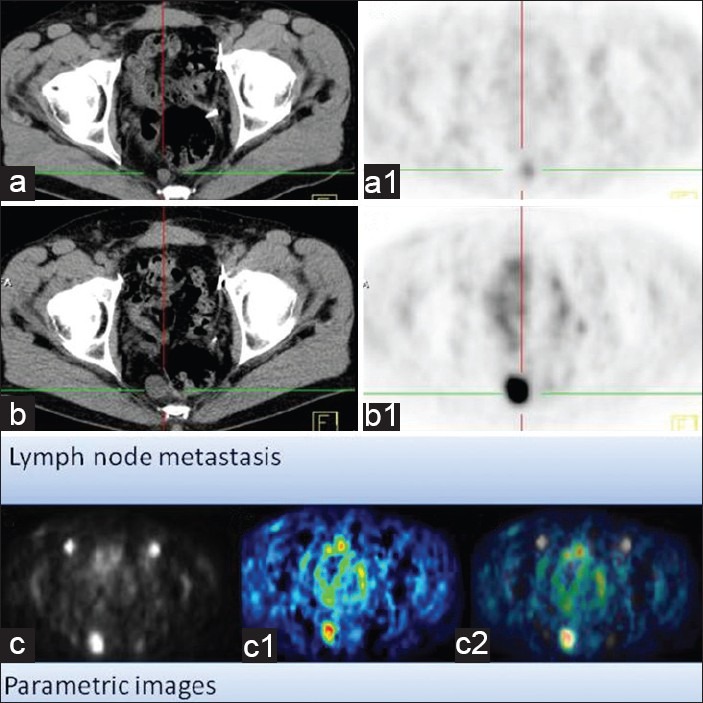
Although (18)F-fludeoxyglucose-positron emission tomography (PET) is the most applied diagnostic method in tumor staging, its role in prostate cancer (PCA) is limited because glucose metabolism tends to be low unless PCA has high Gleason score. Alternatively, choline PET was introduced as a valuable imaging method. Kinetic analysis of PET acquisition has increasingly gained momentum as an investigative tool because it provides a non-invasive approach to obtain kinetic and metabolic data from tissues of interest including transport and metabolism of the administered material. In this regard, we sought to apply it in (18)F-fluoroethylcholine (FECH)-PET/computed tomography (CT) in patients with PCA. 64 patients, the mean age 69 (range: 47-87 years) with primary/recurrent PCA were encompassed. They underwent (18)F-FECH-PET started with a dynamic acquisition using a 20-frame each 30 s over the prostate region and followed at 1 h post-injection by a static whole body imaging. The kinetic evaluation of the data was performed using the software package PMOD (PMOD Technologies Ltd., Zürich, Switzerland). Significant increase in mean values for K1, K3, FD, standardized uptake value (SUV) and global influx in tumor tissue versus normal tissue (P < 0.05). Moderate but significant correlation (r: 0.28, P = 0.023) between SUV and K1. By contrast, no correlation between SUV and K3 (r: -0.08, P = 0.79). In patients with recurrent tumors, there is no significant difference in all kinetic parameters and SUV (P > 0.1) between the different types of recurrences. The kinetic analysis of dynamic FECH-PET provides a novel method in primary PCA diagnosis and could be of potential value in the delineation of tumor focus.
尽管(18)F-氟脱氧葡萄糖正电子发射断层扫描(PET)是肿瘤分期中应用最广泛的诊断方法,但其在前列腺癌(PCA)中的作用有限,因为除非PCA具有高 Gleason 评分,否则葡萄糖代谢往往较低。相比之下,胆碱 PET 作为一种有价值的成像方法被引入。PET 采集的动力学分析作为一种研究工具越来越受到关注,因为它提供了一种非侵入性方法,可从感兴趣的组织中获取动力学和代谢数据,包括所给药物质的转运和代谢。在这方面,我们试图将其应用于PCA患者的(18)F-氟乙基胆碱(FECH)-PET/计算机断层扫描(CT)。纳入了64例原发性/复发性PCA患者,平均年龄69岁(范围:47 - 87岁)。他们接受了(18)F-FECH-PET检查,首先在前列腺区域进行动态采集,每30秒采集20帧,注射后1小时进行全身静态成像。使用软件包PMOD(瑞士苏黎世PMOD Technologies Ltd.)对数据进行动力学评估。肿瘤组织与正常组织相比,K1、K3、FD、标准化摄取值(SUV)和整体流入量的平均值显著增加(P < 0.05)。SUV与K1之间存在中度但显著的相关性(r:0.28,P = 0.023)。相比之下,SUV与K3之间无相关性(r:-0.08,P = 0.79)。在复发肿瘤患者中,不同类型复发之间的所有动力学参数和SUV均无显著差异(P > 0.1)。动态FECH-PET的动力学分析为原发性PCA诊断提供了一种新方法,在肿瘤灶的 delineation 方面可能具有潜在价值。 (注:原文中“delineation”可能有误,推测可能是“delineation”,意为“描绘、划定”,此处保留原文未准确翻译)