Takaki Akinobu, Yagi Takahito, Yamamoto Kazuhide
Department of Gastroenterology and Hepatology, Okayama University Graduate School of Medicine, Dentistry, and Pharmaceutical Sciences, 2-5-1 Shikata-cho, Kita-ku, Okayama 700-8558, Japan.
Department of Gastroenterological Surgery Transplant and Surgical Oncology, Okayama University Graduate School of Medicine, Dentistry, and Pharmaceutical Sciences, 2-5-1 Shikata-cho, Kita-ku, Okayama 700-8558, Japan.
Int J Inflam. 2014;2014:814760. doi: 10.1155/2014/814760. Epub 2014 Aug 24.
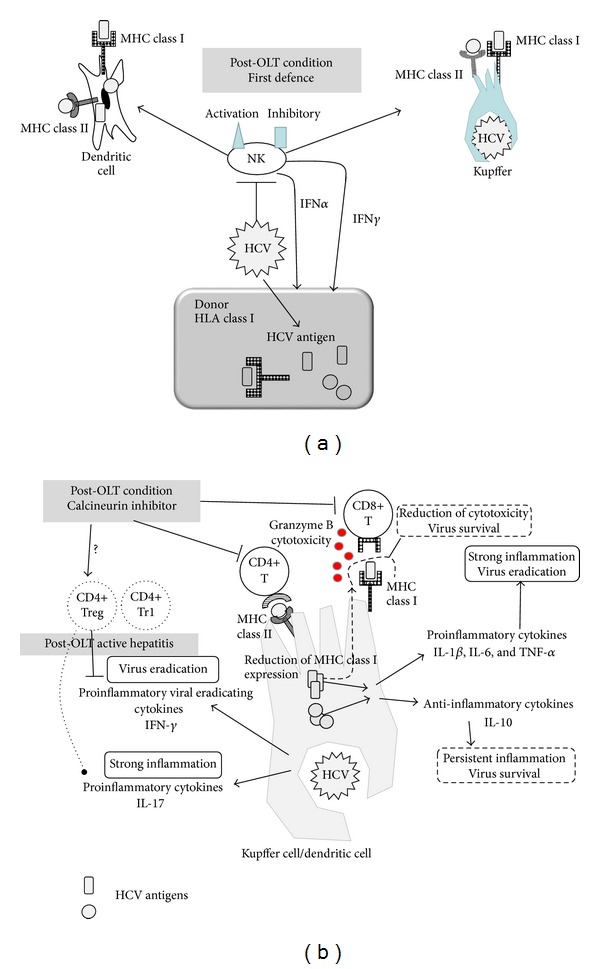
Hepatitis B and C often progress to decompensated liver cirrhosis requiring orthotopic liver transplantation (OLT). After OLT, hepatitis B recurrence is clinically controlled with a combination of hepatitis B immunoglobulin (HBIG) and nucleos(t)ide analogues. Another approach is to induce self-producing anti-hepatitis B virus (HBV) antibodies using a HBV envelope antigen vaccine. Patients who had not been HBV carriers such as acutely infected liver failure or who received liver from HBV self-limited donor are good candidate. For chronic HBV carrier patients, a successful response can only be achieved in selected patients such as those treated with experimentally reduced immunosuppression protocols or received an anti-HBV adaptive memory carrying donor liver. Hepatitis C virus (HCV) reinfects transplanted livers at a rate of >90%. HCV reinfected patients show different severities of hepatitis, from mild and slowly progressing to severe and rapidly progressing, possibly resulting from different adaptive immune responses. More than half the patients require interferon treatment, although the success rate is low and carries risks for leukocytopenia and rejection. Managing the immune response has an important role in controlling recurrent hepatitis C. This study aimed to review the adaptive immune response in post-OLT hepatitis B and C.
乙型肝炎和丙型肝炎常进展为失代偿期肝硬化,需要进行原位肝移植(OLT)。OLT后,通过联合使用乙型肝炎免疫球蛋白(HBIG)和核苷(酸)类似物可临床控制乙型肝炎复发。另一种方法是使用乙肝包膜抗原疫苗诱导自身产生抗乙型肝炎病毒(HBV)抗体。未曾感染过HBV的患者,如急性感染性肝衰竭患者或接受来自HBV自限性供体肝脏的患者,是很好的候选对象。对于慢性HBV携带者患者,只有在部分患者中才能取得成功反应,如那些接受实验性降低免疫抑制方案治疗的患者或接受携带抗HBV适应性记忆的供体肝脏的患者。丙型肝炎病毒(HCV)以>90%的比率再次感染移植肝脏。HCV再次感染的患者表现出不同严重程度的肝炎,从轻度且进展缓慢到重度且进展迅速,这可能是由不同的适应性免疫反应导致的。超过一半的患者需要干扰素治疗,尽管成功率较低且有白细胞减少和排斥反应的风险。控制免疫反应在控制丙型肝炎复发中起着重要作用。本研究旨在综述OLT后乙型肝炎和丙型肝炎的适应性免疫反应。