Rosenberger Karen, Derkow Katja, Dembny Paul, Krüger Christina, Schott Eckart, Lehnardt Seija
J Neuroinflammation. 2014 Sep 20;11:166. doi: 10.1186/s12974-014-0166-7.
Toll-like receptors (TLRs) enable innate immune cells to respond to pathogen- and host-derived molecules. The central nervous system (CNS) exhibits most of the TLRs identified with predominant expression in microglia, the major immune cells of the brain. Although individual TLRs have been shown to contribute to CNS disorders, the consequences of multiple activated TLRs on the brain are unclear. We therefore systematically investigated and compared the impact of sole and pairwise TLR activation on CNS inflammation and injury.
Selected TLRs expressed in microglia and neurons were stimulated with their specific TLR ligands in varying combinations. Cell cultures were then analyzed by immunocytochemistry, FlowCytomix, and ELISA. To determine neuronal injury and neuroinflammation in vivo, C57BL/6J mice were injected intrathecally with TLR agonists. Subsequently, brain sections were analyzed by quantitative real-time PCR and immunohistochemistry.
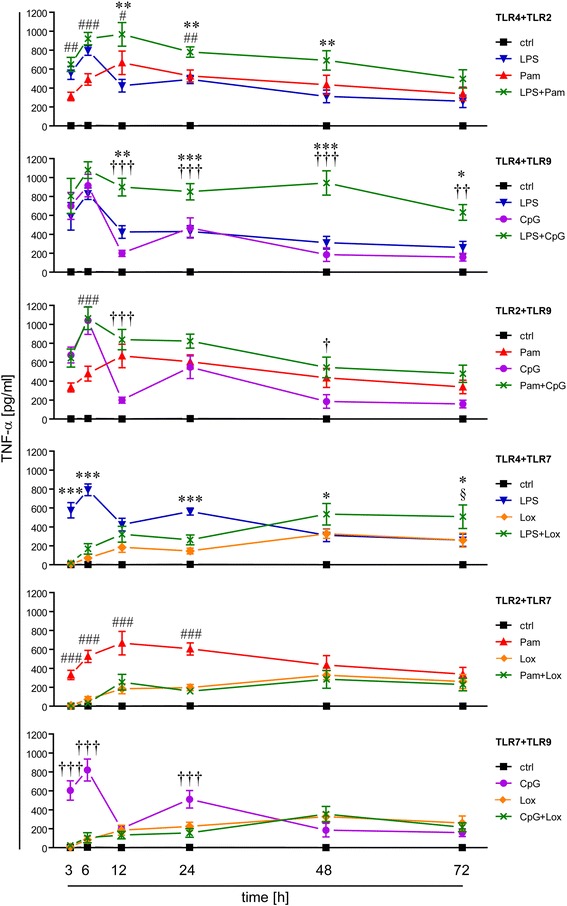
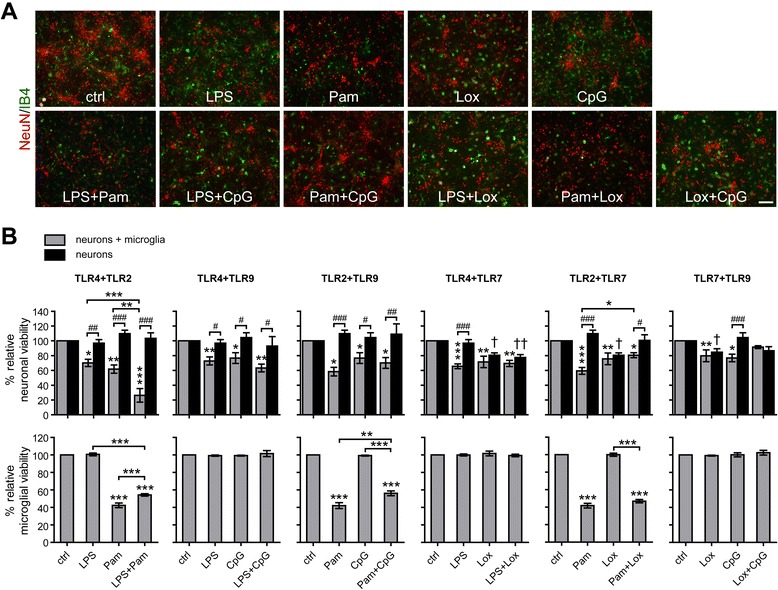
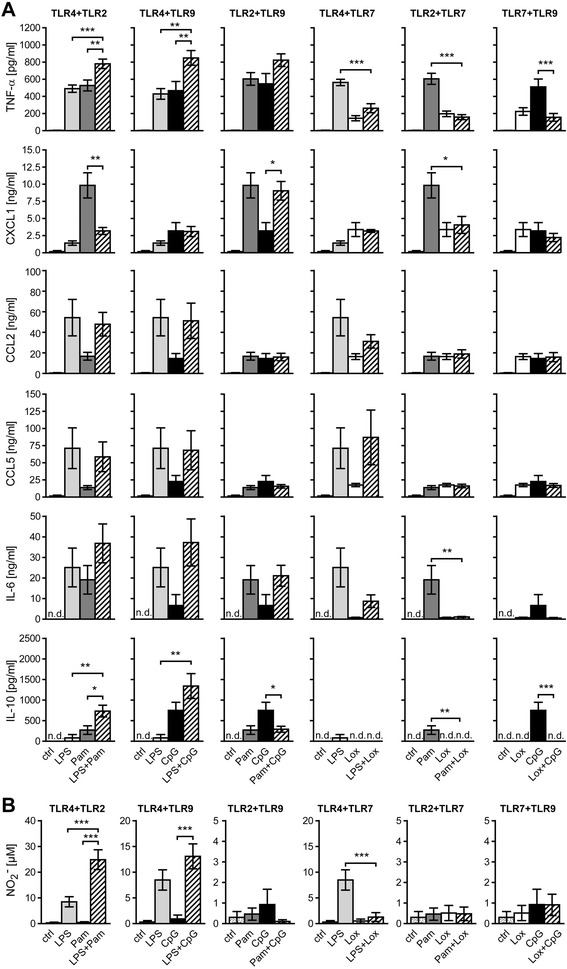
Simultaneous stimulation of TLR4 plus TLR2, TLR4 plus TLR9, and TLR2 plus TLR9 in microglia by their respective specific ligands results in an increased inflammatory response compared to activation of the respective single TLR in vitro. In contrast, additional activation of TLR7 suppresses the inflammatory response mediated by the respective ligands for TLR2, TLR4, or TLR9 up to 24 h, indicating that specific combinations of activated TLRs individually modulate the inflammatory response. Accordingly, the composition of the inflammatory response pattern generated by microglia varies depending on the identity and combination of the activated TLRs engaged. Likewise, neuronal injury occurs in response to activation of only selected TLRs and TLR combinations in vitro. Activation of TLR2, TLR4, TLR7, and TLR9 in the brain by intrathecal injection of the respective TLR ligand into C57BL/6J mice leads to specific expression patterns of distinct TLR mRNAs in the brain and causes influx of leukocytes and inflammatory mediators into the cerebrospinal fluid to a variable extent. Also, the intensity of the inflammatory response and neurodegenerative effects differs according to the respective activated TLR and TLR combinations used in vivo.
Sole and pairwise activation of TLRs modifies the pattern and extent of inflammation and neurodegeneration in the CNS, thereby enabling innate immunity to take account of the CNS diseases' diversity.
Toll样受体(TLRs)使先天免疫细胞能够对病原体和宿主来源的分子作出反应。中枢神经系统(CNS)表达了大多数已鉴定的TLRs,在小胶质细胞(大脑主要免疫细胞)中表达占主导。尽管已表明单个TLRs会导致中枢神经系统疾病,但多个激活的TLRs对大脑的影响尚不清楚。因此,我们系统地研究并比较了单独和成对激活TLRs对中枢神经系统炎症和损伤的影响。
用不同组合的特异性TLR配体刺激小胶质细胞和神经元中表达的选定TLRs。然后通过免疫细胞化学、流式细胞混合技术和酶联免疫吸附测定法对细胞培养物进行分析。为了确定体内神经元损伤和神经炎症,将TLR激动剂鞘内注射到C57BL/6J小鼠体内。随后,通过定量实时聚合酶链反应和免疫组织化学分析脑切片。
与体外激活各自单一的TLR相比,用各自特异性配体同时刺激小胶质细胞中的TLR4加TLR2、TLR4加TLR9和TLR2加TLR9会导致炎症反应增加。相比之下,TLR7的额外激活会在长达24小时内抑制由TLR2、TLR4或TLR9各自配体介导的炎症反应,表明激活的TLRs的特定组合会单独调节炎症反应。因此,小胶质细胞产生的炎症反应模式的组成因所涉及的激活TLRs的身份和组合而异。同样,体外仅激活选定的TLRs和TLR组合会导致神经元损伤。通过向C57BL/6J小鼠鞘内注射各自的TLR配体激活大脑中的TLR2、TLR4、TLR7和TLR9会导致大脑中不同TLR mRNA的特定表达模式,并在不同程度上导致白细胞和炎症介质流入脑脊液。此外,炎症反应的强度和神经退行性作用因体内使用的各自激活的TLR和TLR组合而异。
TLRs的单独和成对激活会改变中枢神经系统炎症和神经退行性变的模式和程度,从而使先天免疫能够考虑到中枢神经系统疾病的多样性。