Zhu Hui, Bi Yongmin, Han Anqin, Luo Jingyu, Li Minghuan, Shi Fang, Kong Li, Yu Jinming
Department of Radiation Oncology, Shandong Cancer Hospital and Institute, Shandong University, Jiyan Rd, 440, Jinan 250117, Shandong Province, China.
Radiat Oncol. 2014 Sep 20;9:216. doi: 10.1186/1748-717X-9-216.
The role of prophylactic cranial irradiation (PCI) on small cell lung cancer (SCLC) has been established based on the two-stage system of limited versus extensive disease and the treatment modality of chemoradiotherapy. However, the use of PCI after combined-modality treatment with surgery for resectable limited-stage SCLC has not been investigated sufficiently. We conducted a retrospective study to evaluate risk factors for brain metastasis (BM) in patients with surgically resected SCLC to identify those most likely to benefit from PCI.
The records of 126 patients with completely resected SCLC and definitive TNM stage based on histological examination between 2003 and 2009 were reviewed. The cumulative incidence of BM was estimated using the Kaplan-Meier method and differences between the groups were analyzed using the log-rank test. Multivariate Cox regression analysis was applied to assess the risk factors of BM.
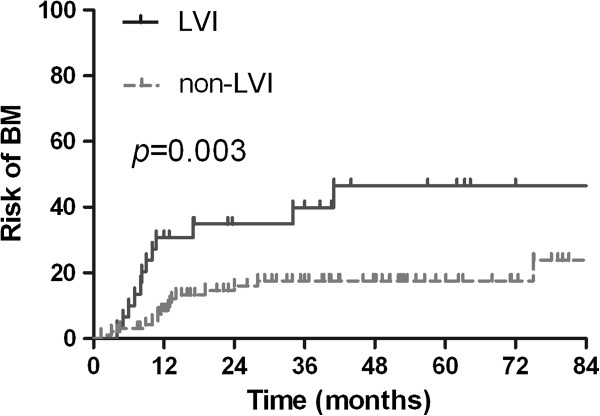
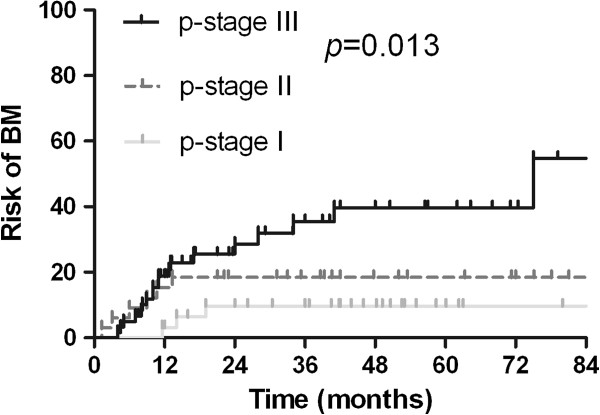
Twenty-eight patients (22.2%) developed BM at some point during their clinical course. The actuarial risk of developing BM at 3 years was 9.7% in patients with p-stage I disease, 18.5% in patients with p-stage II disease, and 35.4% in patients with p-stage III disease (p = 0.013). The actuarial risk of developing BM at 3 years in patients with LVI was 39.9% compared to 17.5% in patients without LVI (p = 0.003). Multivariate analysis identified pathologic stage (hazard ratio [HR] = 2.013, p = 0.017) and LVI (HR = 1.924, p = 0.039) as independent factors related to increased risk of developing BM.
Patients with completely resected p-stage II-III SCLC and LVI are at the highest risk for BM.
基于局限期与广泛期的两阶段系统以及放化疗的治疗方式,预防性颅脑照射(PCI)在小细胞肺癌(SCLC)中的作用已得到确立。然而,对于可切除的局限期SCLC患者在手术联合治疗后使用PCI的情况尚未进行充分研究。我们进行了一项回顾性研究,以评估手术切除的SCLC患者发生脑转移(BM)的危险因素,从而确定最可能从PCI中获益的患者。
回顾了2003年至2009年间126例经组织学检查确诊为完全切除且TNM分期明确的SCLC患者的记录。采用Kaplan-Meier方法估计BM的累积发生率,并使用对数秩检验分析组间差异。应用多因素Cox回归分析评估BM的危险因素。
28例患者(22.2%)在其临床病程中的某个时间点发生了BM。pI期患者3年发生BM的精算风险为9.7%,pII期患者为18.5%,pIII期患者为35.4%(p = 0.013)。有淋巴管侵犯(LVI)的患者3年发生BM的精算风险为39.9%,而无LVI的患者为17.5%(p = 0.003)。多因素分析确定病理分期(风险比[HR]=2.013,p = 0.017)和LVI(HR = 1.924,p = 0.039)是与发生BM风险增加相关的独立因素。
完全切除的pII-III期SCLC且有LVI的患者发生BM的风险最高。