Fröbisch Nadia B, Bickelmann Constanze, Witzmann Florian
Museum für Naturkunde, Leibniz-Institut für Evolutions- und Biodiversitätsforschung, Invalidenstrasse 43, 10115 Berlin, Germany
Museum für Naturkunde, Leibniz-Institut für Evolutions- und Biodiversitätsforschung, Invalidenstrasse 43, 10115 Berlin, Germany.
Proc Biol Sci. 2014 Nov 7;281(1794):20141550. doi: 10.1098/rspb.2014.1550.
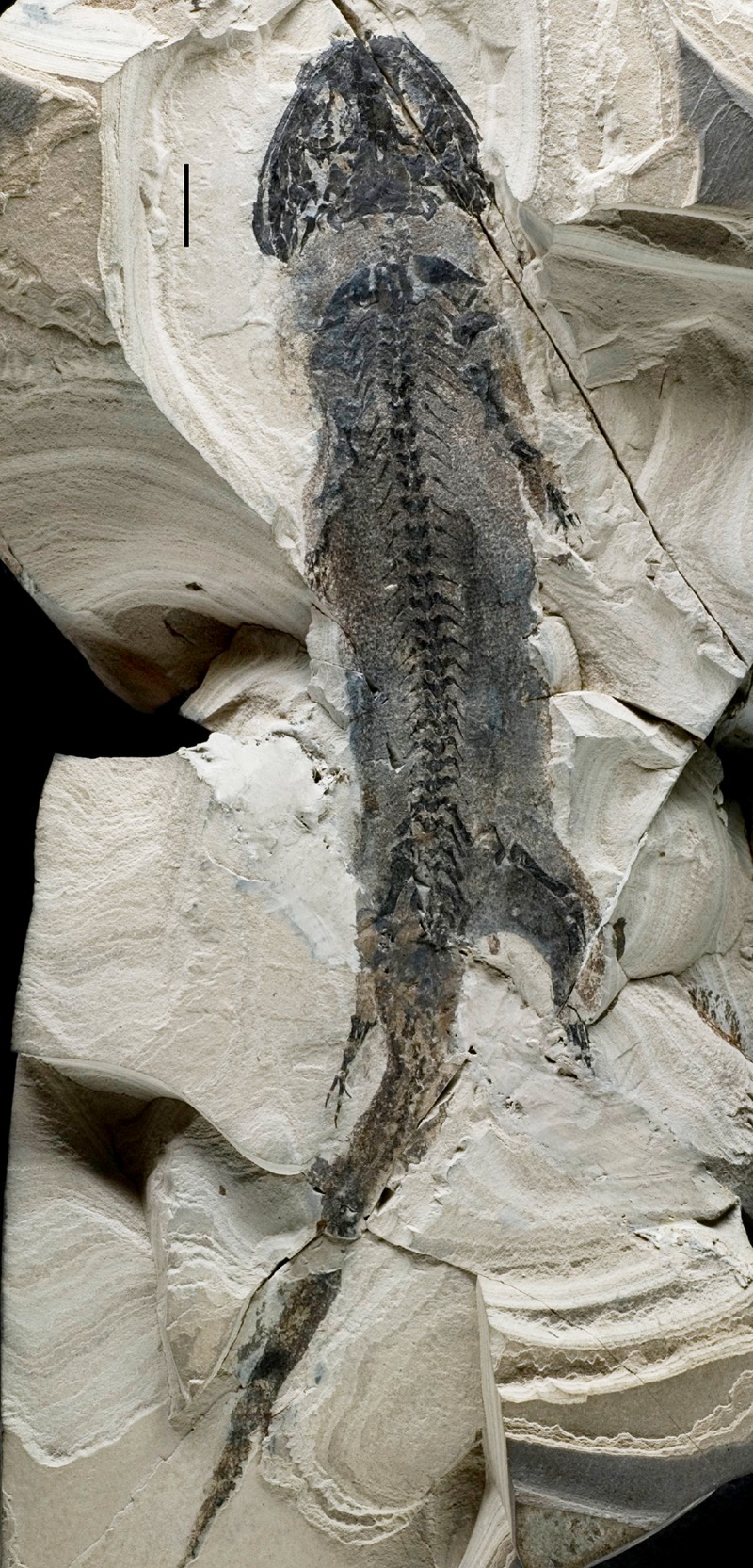
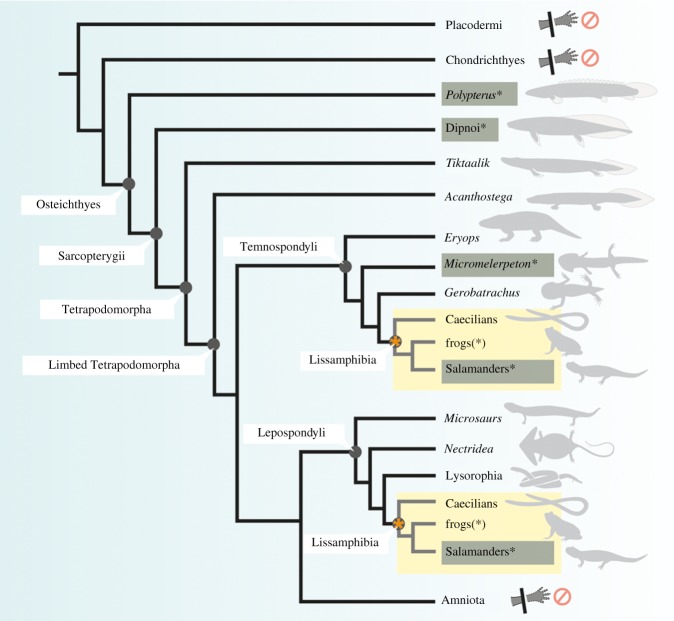
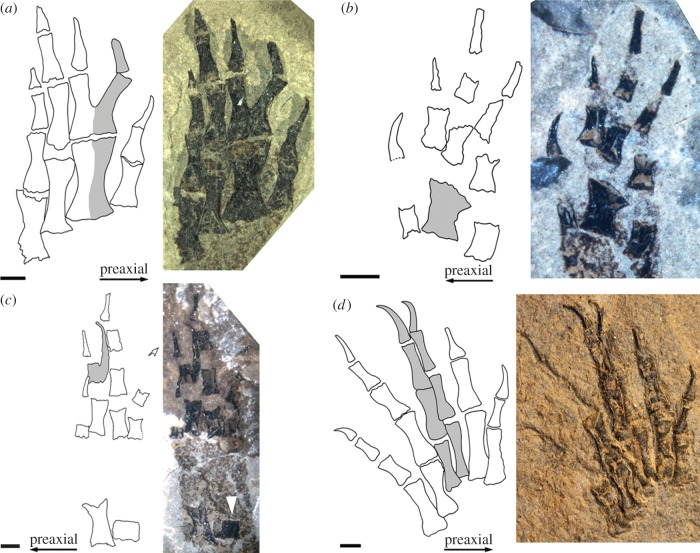
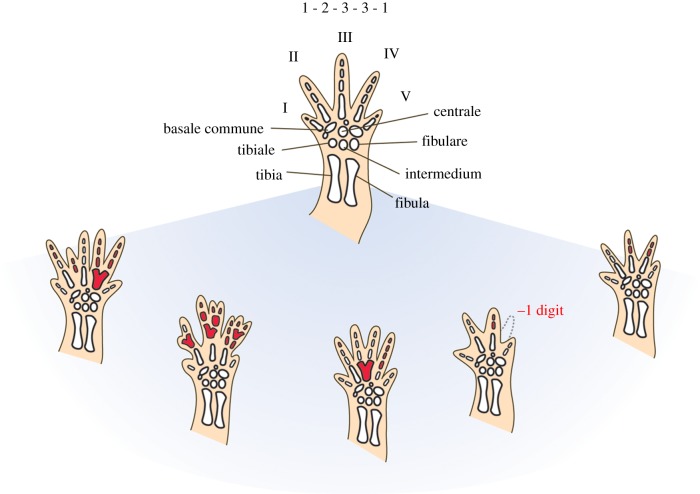
Salamanders are the only tetrapods capable of fully regenerating their limbs throughout their entire lives. Much data on the underlying molecular mechanisms of limb regeneration have been gathered in recent years allowing for new comparative studies between salamanders and other tetrapods that lack this unique regenerative potential. By contrast, the evolution of animal regeneration just recently shifted back into focus, despite being highly relevant for research designs aiming to unravel the factors allowing for limb regeneration. We show that the 300-million-year-old temnospondyl amphibian Micromelerpeton, a distant relative of modern amphibians, was already capable of regenerating its limbs. A number of exceptionally well-preserved specimens from fossil deposits show a unique pattern and combination of abnormalities in their limbs that is distinctive of irregular regenerative activity in modern salamanders and does not occur as variants of normal limb development. This demonstrates that the capacity to regenerate limbs is not a derived feature of modern salamanders, but may be an ancient feature of non-amniote tetrapods and possibly even shared by all bony fish. The finding provides a new framework for understanding the evolution of regenerative capacity of paired appendages in vertebrates in the search for conserved versus derived molecular mechanisms of limb regeneration.
蝾螈是唯一能够在其整个生命周期中完全再生四肢的四足动物。近年来,已经收集了许多关于肢体再生潜在分子机制的数据,这使得能够对蝾螈与其他缺乏这种独特再生潜力的四足动物进行新的比较研究。相比之下,尽管动物再生的进化与旨在揭示允许肢体再生的因素的研究设计高度相关,但直到最近才重新成为焦点。我们发现,生活在3亿年前的离片椎目两栖动物小肢螈,是现代两栖动物的远亲,已经能够再生其四肢。一些来自化石沉积物的保存异常完好的标本显示出其四肢独特的异常模式和组合,这与现代蝾螈不规则的再生活动特征相符,并非正常肢体发育的变体。这表明肢体再生能力并非现代蝾螈的衍生特征,而是非羊膜四足动物的古老特征,甚至可能为所有硬骨鱼所共有。这一发现为理解脊椎动物成对附肢再生能力的进化提供了一个新框架,有助于探寻肢体再生中保守与衍生的分子机制。