Wu Claire, Yuen Jessica, Boyda Heidi N, Procyshyn Ric M, Wang Cathy K, Asiri Yahya I, Pang Catherine C Y, Honer William G, Barr Alasdair M
Department of Pharmacology, University of British Columbia, Vancouver, British Columbia, Canada.
Department of Psychiatry, University of British Columbia, Vancouver, British Columbia, Canada; British Columbia Mental Health and Addictions Research Institute, Vancouver, British Columbia, Canada.
PLoS One. 2014 Sep 25;9(9):e107116. doi: 10.1371/journal.pone.0107116. eCollection 2014.
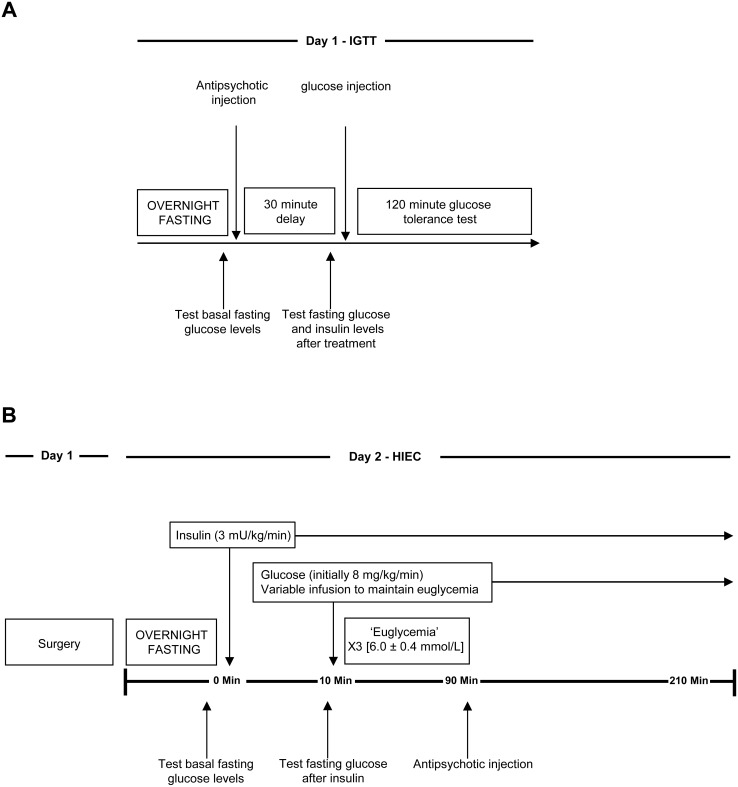
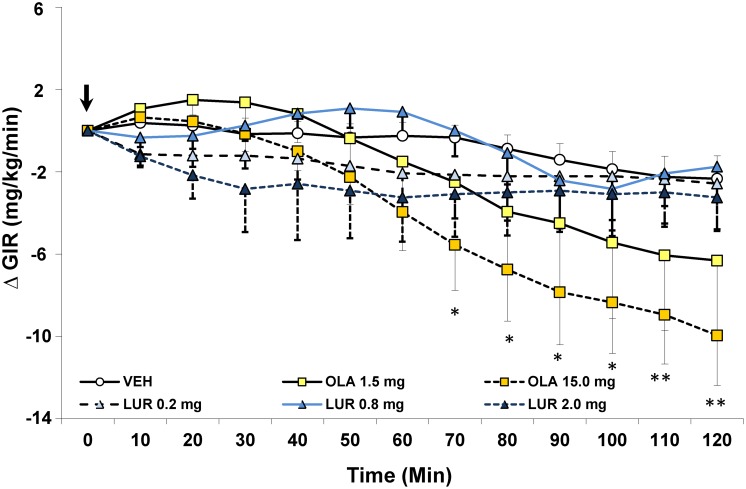
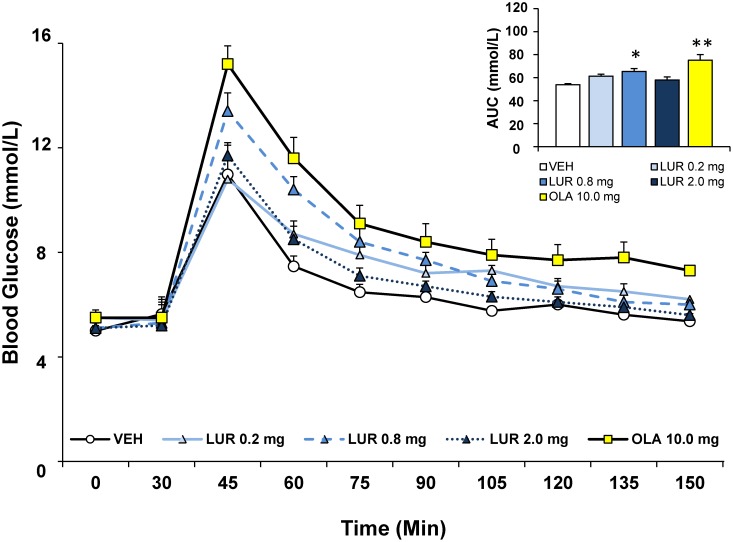
Over the past two decades, there has been a notable rise in the use of antipsychotic drugs, as they are used to treat an increasing number of neuropsychiatric disorders. This rise has been led predominantly by greater use of the second generation antipsychotic (SGA) drugs, which have a low incidence of neurological side-effects. However, many SGAs cause metabolic dysregulation, including glucose intolerance and insulin resistance, thus increasing the risk of cardiometabolic disorders. The metabolic effects of the novel SGA lurasidone, which was approved by the Food and Drug Administration in 2010, remain largely unknown. As rodent models accurately predict the metabolic effects of SGAs in humans, the aim of the present study was to use sophisticated animal models of glucose tolerance and insulin resistance to measure the metabolic effects of lurasidone. In parallel, we compared the SGA olanzapine, which has established metabolic effects. Adult female rats were treated with vehicle, lurasidone (0.2, 0.8 or 2.0 mg/kg, s.c.) or olanzapine (10.0 mg/kg, s.c.) and subjected to the glucose tolerance test (GTT). Separate groups of rats were treated with vehicle, lurasidone (0.2, 0.8 or 2.0 mg/kg, s.c.) or olanzapine (1.5 and 15 mg/kg, s.c.) and tested for insulin resistance with the hyperinsulinemic-euglycemic clamp (HIEC). Compared to vehicle treated animals, lurasidone caused mild glucose intolerance in the GTT with a single dose, but there was no effect on insulin resistance in the GTT, measured by HOMA-IR. The HIEC also confirmed no effect of lurasidone on insulin resistance. In contrast, olanzapine demonstrated dose-dependent and potent glucose intolerance, and insulin resistance in both tests. Thus, in preclinical models, lurasidone demonstrates mild metabolic liability compared to existing SGAs such as olanzapine. However, confirmation of these effects in humans with equivalent tests should be confirmed.
在过去二十年中,抗精神病药物的使用显著增加,因为它们被用于治疗越来越多的神经精神疾病。这种增加主要是由于第二代抗精神病药物(SGA)的使用增加,这类药物神经副作用的发生率较低。然而,许多SGA会导致代谢失调,包括葡萄糖不耐受和胰岛素抵抗,从而增加心脏代谢紊乱的风险。2010年获美国食品药品监督管理局批准的新型SGA鲁拉西酮的代谢作用在很大程度上仍不清楚。由于啮齿动物模型能准确预测SGA在人类中的代谢作用,本研究的目的是使用先进的葡萄糖耐量和胰岛素抵抗动物模型来测定鲁拉西酮的代谢作用。同时,我们比较了已明确具有代谢作用的SGA奥氮平。成年雌性大鼠接受赋形剂、鲁拉西酮(0.2、0.8或2.0mg/kg,皮下注射)或奥氮平(10.0mg/kg,皮下注射)处理,并进行葡萄糖耐量试验(GTT)。将单独的几组大鼠用赋形剂、鲁拉西酮(0.2、0.8或2.0mg/kg,皮下注射)或奥氮平(1.5和15mg/kg,皮下注射)处理,并用高胰岛素-正常血糖钳夹技术(HIEC)检测胰岛素抵抗。与接受赋形剂处理的动物相比,鲁拉西酮单次给药在GTT中引起轻度葡萄糖不耐受,但对通过稳态模型评估胰岛素抵抗(HOMA-IR)测定的GTT中的胰岛素抵抗没有影响。HIEC也证实鲁拉西酮对胰岛素抵抗没有影响。相比之下,奥氮平在两项试验中均表现出剂量依赖性且强效的葡萄糖不耐受和胰岛素抵抗。因此,在临床前模型中,与奥氮平等现有的SGA相比,鲁拉西酮表现出轻度的代谢不良反应。然而,这些作用在人类中通过等效试验的确认仍有待证实。