Brink Hendrik Gideon, Nicol Willie
Microb Cell Fact. 2014 Aug 19;13:111. doi: 10.1186/s12934-014-0111-6.
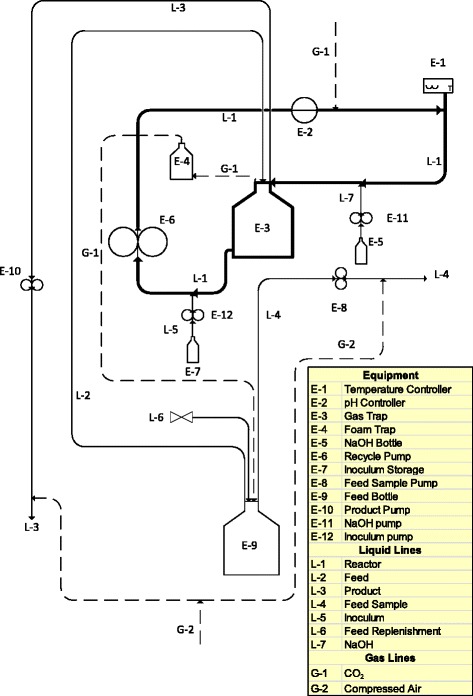
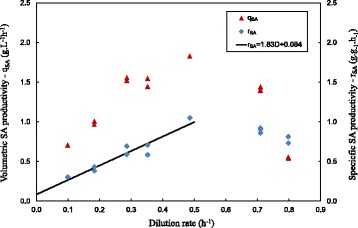
Succinic acid is well established as bio-based platform chemical with production quantities expecting to increase exponentially within the next decade. Actinobacillus succinogenes is by far the most studied wild organism for producing succinic acid and is known for high yield and titre during production on various sugars in batch culture. At low shear conditions continuous fermentation with A. succinogenes results in biofilm formation. In this study, a novel shear controlled fermenter was developed that enabled: 1) chemostat operation where self-immobilisation was opposed by high shear rates and, 2) in-situ removal of biofilm by increasing shear rates and subsequent analysis thereof.
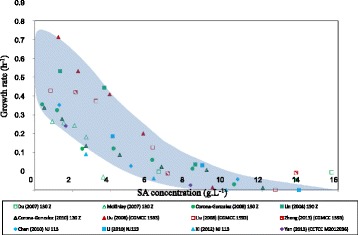
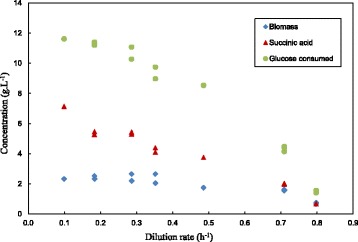
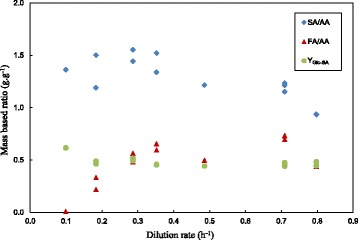
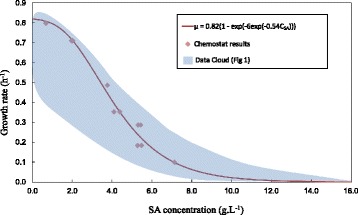
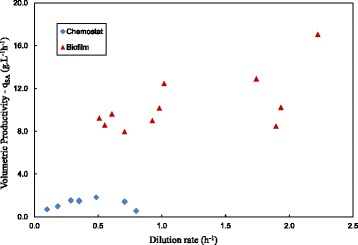
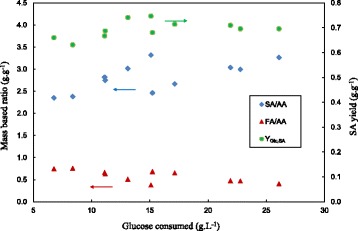
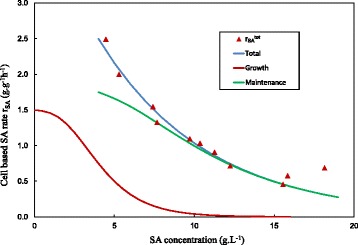
The volumetric productivity of the biofilm fermentations were an order of magnitude more than the chemostat runs. In addition the biofilm runs obtained substantially higher yields. Succinic acid to acetic acid ratios for chemostat runs were 1.28±0.2 g.g(-1), while the ratios for biofilm runs started at 2.4 g.g(-1) and increased up to 3.3 g.g(-1) as glucose consumption increased. This corresponded to an overall yield on glucose of 0.48±0.05 g.g(-1) for chemostat runs, while the yields varied between 0.63 g.g(-1) and 0.74 g.g(-1) for biofilm runs. Specific growth rates (μ) were shown to be severely inhibited by the formation of organic acids, with μ only 12% of μ(max) at a succinic acid titre of 7 g.L(-1). Maintenance production of succinic acid was shown to be dominant for the biofilm runs with cell based production rates (extracellular polymeric substance removed) decreasing as SA titre increases.
The novel fermenter allowed for an in-depth bioreaction analysis of A. succinogenes. Biofilm cells achieve higher SA yields than suspended cells and allow for operation at higher succinic acid titre. Both growth and maintenance rates were shown to drastically decrease with succinic acid titre. The A. succinogenes biofilm process has vast potential, where self-induced high cell densities result in higher succinic acid productivity and yield.
琥珀酸是一种成熟的生物基平台化学品,预计在未来十年内产量将呈指数级增长。产琥珀酸放线杆菌是目前研究最多的用于生产琥珀酸的野生菌株,在分批培养中利用各种糖类生产时,以高产率和高滴度而闻名。在低剪切条件下,产琥珀酸放线杆菌的连续发酵会导致生物膜形成。在本研究中,开发了一种新型的剪切控制发酵罐,其能够实现:1)恒化器操作,其中高剪切速率可抑制细胞的自我固定化;2)通过提高剪切速率原位去除生物膜并对其进行后续分析。
生物膜发酵的体积生产率比恒化器运行高一个数量级。此外,生物膜运行获得的产量显著更高。恒化器运行时琥珀酸与乙酸的比率为1.28±0.2 g·g⁻¹,而生物膜运行的比率起始为2.4 g·g⁻¹,并随着葡萄糖消耗的增加而增加至3.3 g·g⁻¹。这对应于恒化器运行时葡萄糖的总产率为0.48±0.05 g·g⁻¹,而生物膜运行的产率在0.63 g·g⁻¹和0.74 g·g⁻¹之间变化。结果表明,有机酸的形成会严重抑制比生长速率(μ),在琥珀酸滴度为7 g·L⁻¹时,μ仅为μ(max)的12%。对于生物膜运行,琥珀酸的维持性生产占主导,随着琥珀酸滴度的增加,基于细胞的生产率(去除的细胞外聚合物)降低。
新型发酵罐能够对产琥珀酸放线杆菌进行深入的生物反应分析。生物膜细胞比悬浮细胞具有更高的琥珀酸产率,并能够在更高的琥珀酸滴度下运行。结果表明,生长速率和维持速率均会随着琥珀酸滴度的增加而大幅降低。产琥珀酸放线杆菌生物膜工艺具有巨大潜力,其自我诱导的高细胞密度可提高琥珀酸的生产率和产率。