Lee Mary P, Ratner Nancy, Yutzey Katherine E
Division of Molecular Cardiovascular Biology, Cincinnati Children's Hospital Medical Center, Cincinnati, Ohio 45229, USA.
BMC Genomics. 2014 Sep 28;15(1):821. doi: 10.1186/1471-2164-15-821.
The basic helix-loop-helix transcription factor Twist1 has well-documented roles in progenitor populations of the developing embryo, including endocardial cushions (ECC) and limb buds, and also in cancer. Whether Twist1 regulates the same transcriptional targets in different tissue types is largely unknown.
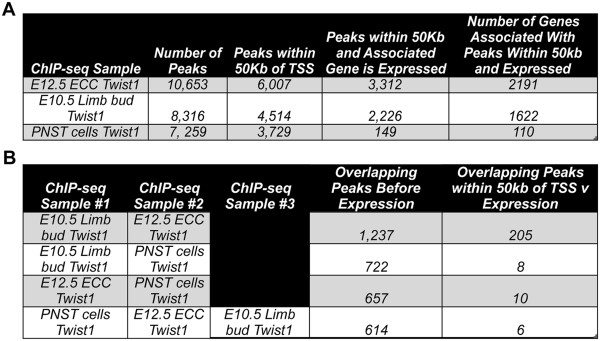
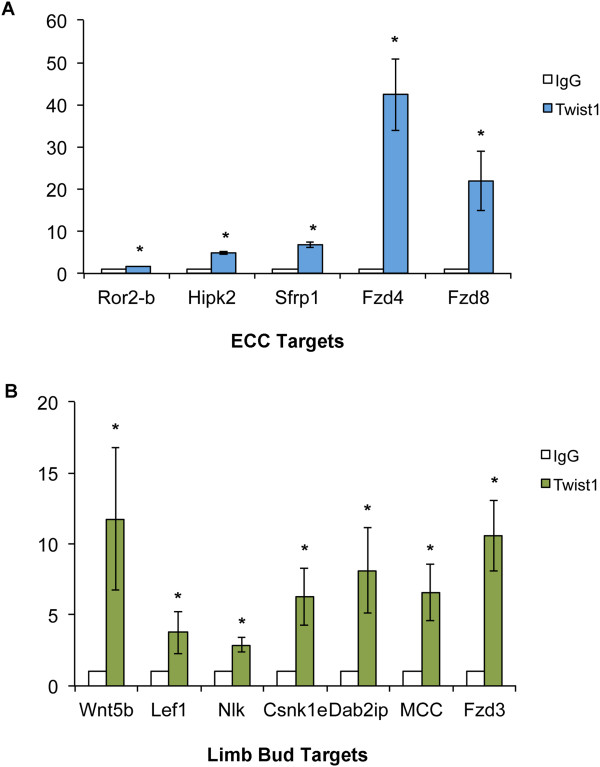
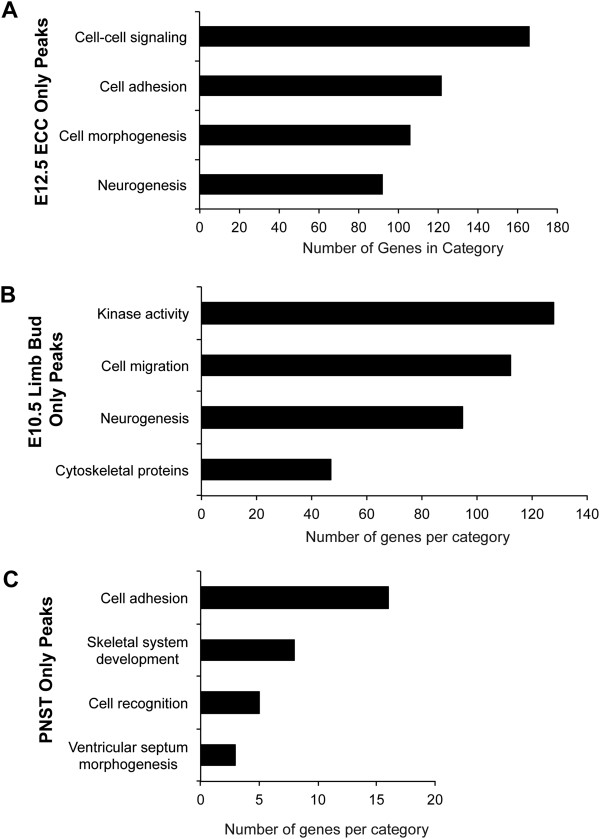
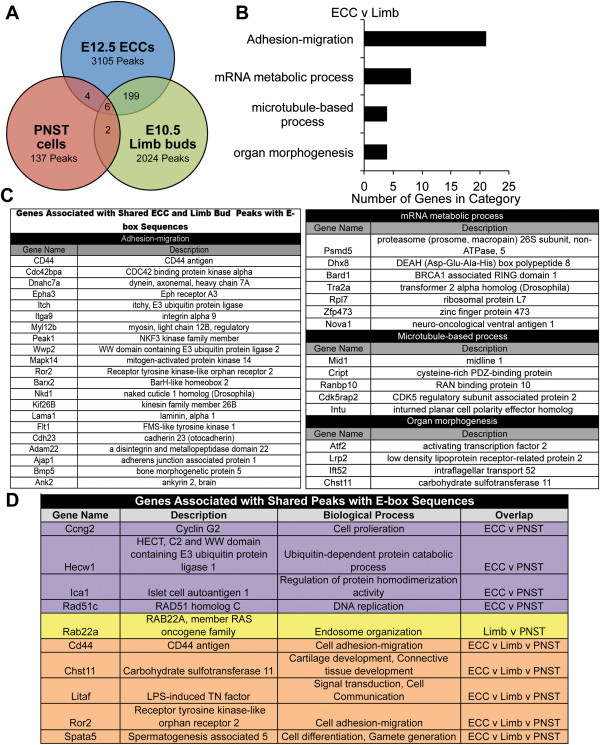
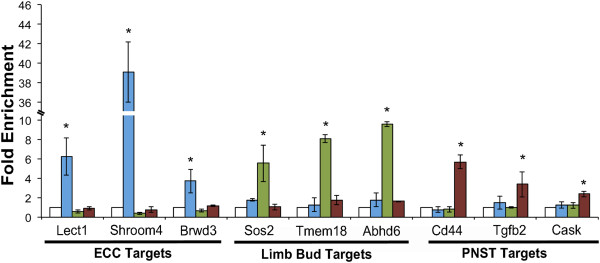
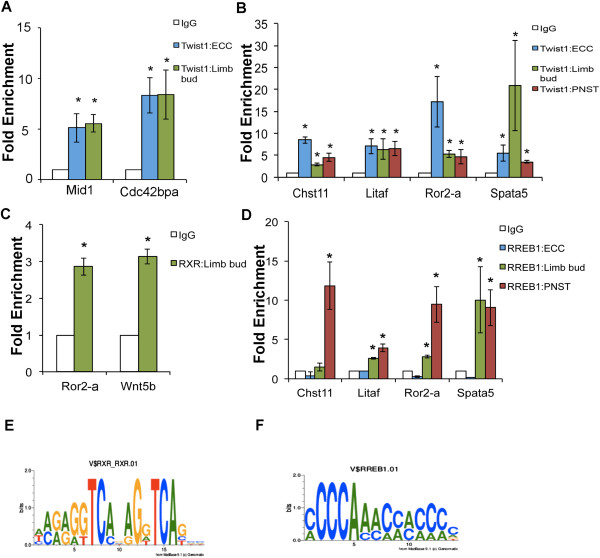
The tissue-specificity of Twist1 genomic occupancy was examined in mouse ECCs, limb buds, and peripheral nerve sheath tumor (PNST) cells using chromatin immunoprecipitation followed by sequencing (Chip-seq) analysis. Consistent with known Twist1 functions during development and in cancer cells, Twist1-DNA binding regions associated with genes related to cell migration and adhesion were detected in all three tissues. However, the vast majority of Twist1 binding regions were specific to individual tissue types. Thus, while Twist1 has similar functions in ECCs, limb buds, and PNST cells, the specific genomic sequences occupied by Twist1 were different depending on cellular context. Subgroups of shared genes, also predominantly related to cell adhesion and migration, were identified in pairwise comparisons of ECC, limb buds and PNST cells. Twist1 genomic occupancy was detected for six binding regions in all tissue types, and Twist1-binding sequences associated with Chst11, Litaf, Ror2, and Spata5 also bound the potential Twist1 cofactor RREB1. Pathway analysis of the genes associated with Twist1 binding suggests that Twist1 may regulate genes associated with the Wnt signaling pathway in ECCs and limb buds.
Together, these data indicate that Twist1 interacts with genes that regulate adhesion and migration in different tissues, potentially through distinct sets of target genes. In addition, there is a small subset of genes occupied by Twist1 in all three tissues that may represent a core group of Twist1 target genes in multiple cell types.
基础螺旋-环-螺旋转录因子Twist1在发育胚胎的祖细胞群体中发挥着重要作用,包括心内膜垫(ECC)和肢芽,在癌症中也有作用。Twist1是否在不同组织类型中调控相同的转录靶点在很大程度上尚不清楚。
利用染色质免疫沉淀测序(Chip-seq)分析,在小鼠ECC、肢芽和周围神经鞘瘤(PNST)细胞中检测了Twist1基因组占据的组织特异性。与Twist1在发育过程中和癌细胞中的已知功能一致,在所有三种组织中均检测到与细胞迁移和黏附相关基因的Twist1-DNA结合区域。然而,绝大多数Twist1结合区域是各组织类型特有的。因此,虽然Twist1在ECC、肢芽和PNST细胞中具有相似功能,但Twist1占据的特定基因组序列因细胞环境而异。在ECC、肢芽和PNST细胞的两两比较中,鉴定出了主要也与细胞黏附和迁移相关的共享基因亚组。在所有组织类型中均检测到六个结合区域的Twist1基因组占据情况,与Chst11、Litaf、Ror2和Spata5相关的Twist1结合序列也与潜在的Twist1辅因子RREB1结合。对与Twist1结合相关基因的通路分析表明,Twist1可能在ECC和肢芽中调控与Wnt信号通路相关的基因。
总之,这些数据表明Twist1可能通过不同的靶基因集与不同组织中调控黏附和迁移的基因相互作用。此外,在所有三种组织中Twist1占据的一小部分基因子集可能代表多种细胞类型中Twist1靶基因的核心组。