
在塞内加尔进行避孕药具的知情推送分发可减少缺货情况并提高计划生育服务质量。
Informed push distribution of contraceptives in Senegal reduces stockouts and improves quality of family planning services.
作者信息
Daff Bocar Mamadou, Seck Cheikh, Belkhayat Hassan, Sutton Perri
机构信息
Ministry of Health and Social Action [Senegal] , Dakar , Senegal.
IntraHealth International, Senegal Urban Reproductive Health Initiative , Dakar , Senegal.
出版信息
Glob Health Sci Pract. 2014 May 13;2(2):245-52. doi: 10.9745/GHSP-D-13-00171. eCollection 2014 May.
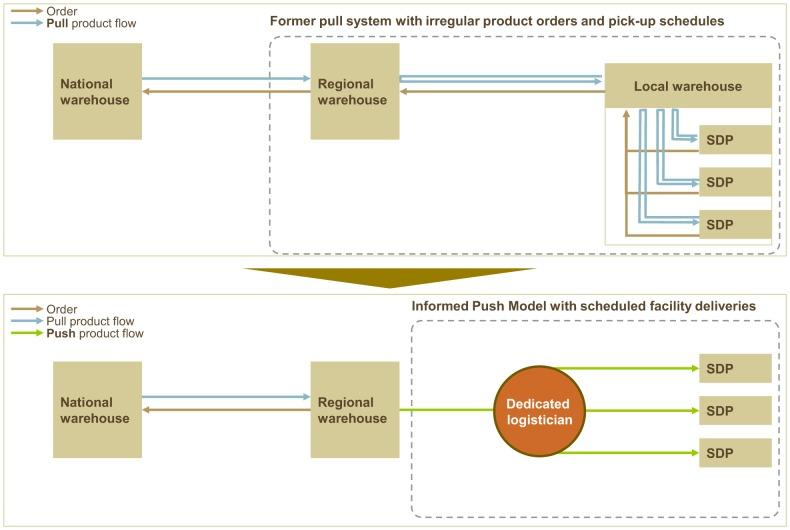
Contraceptive use in Senegal is among the lowest in the world and has barely increased over the past 5 years, from 10% of married women in 2005 to 12% in 2011. Contraceptive stockouts in public facilities, where 85% of women access family planning services, are common. In 2011, we conducted a supply chain study of 33 public-sector facilities in Pikine and Guediawaye districts of the Dakar region to understand the magnitude and root causes of stockouts. The study included stock audits, surveys with 156 consumers, and interviews with facility staff, managers, and other stakeholders. At the facility level, stockouts of injectables and implants occurred, on average, 43% and 83% of the year, respectively. At least 60% of stockouts occurred despite stock availability at the national level. Data from interviews revealed that the current "pull-based" distribution system was complex and inefficient. In order to reduce stockout rates to the commercial-sector standard of 2% or less, the Government of Senegal and the Senegal Urban Reproductive Health Initiative developed the informed push distribution model (IPM) and pilot-tested it in Pikine district between February 2012 and July 2012. IPM brings the source of supply (a delivery truck loaded with supplies) closer to the source of demand (clients in health facilities) and streamlines the steps in between. With a professional logistician managing stock and deliveries, the health facilities no longer need to place and pick up orders. Stockouts of contraceptive pills, injectables, implants, and intrauterine devices (IUDs) were completely eliminated at the 14 public health facilities in Pikine over the 6-month pilot phase. The government expanded IPM to all 140 public facilities in the Dakar region, and 6 months later stockout rates throughout the region dropped to less than 2%. National coverage of the IPM is expected by July 2015.
塞内加尔的避孕药具使用率在世界上处于最低水平,且在过去5年中几乎没有增长,从2005年已婚女性中的10%升至2011年的12%。在提供85%的计划生育服务的公共机构中,避孕药具缺货现象很常见。2011年,我们对达喀尔地区皮基内和古埃迪亚韦区 的33个公共部门机构进行了供应链研究,以了解缺货情况及根源。该研究包括库存审计、对156名消费者的调查以及对机构工作人员、管理人员和其他利益相关者的访谈。在机构层面注射剂 和植入物缺货情况分别平均发生在一年中的43%和83%的时间。尽管国家层面有库存,但至少60%的缺货情况仍会发生。访谈数据显示,当前的“拉动式”配送系统复杂且效率低下。为将缺货率降至商业部门2%或更低的标准,塞内加尔政府和塞内加尔城市生殖健康倡议组织开发了知情推动配送模式(IPM),并于2012年2月至7月在皮基内区进行了试点测试。IPM将供应源(满载物资的送货车)拉近需求源(医疗机构的客户),并简化中间步骤。由专业物流人员管理库存和配送,医疗机构不再需要下单和取货。在6个月的试点阶段,皮基内区的14个公共卫生机构完全消除了避孕药丸、注射剂、植入物和宫内节育器(IUD)的缺货现象。政府将IPM扩展至达喀尔地区的所有140个公共机构,6个月后该地区的缺货率降至2%以下。预计到2015年7月IPM将覆盖全国。



 Zotero 插件