Zhang Xianghong, Jie Shuo, Liu Tang, Zhang Xiangsheng
Department of Orthopedics, the Second Xiangya Hospital, Central South University, 139 Renmin Road, Changsha, Hunan 410011, P,R, China.
BMC Surg. 2014 Oct 3;14:74. doi: 10.1186/1471-2482-14-74.
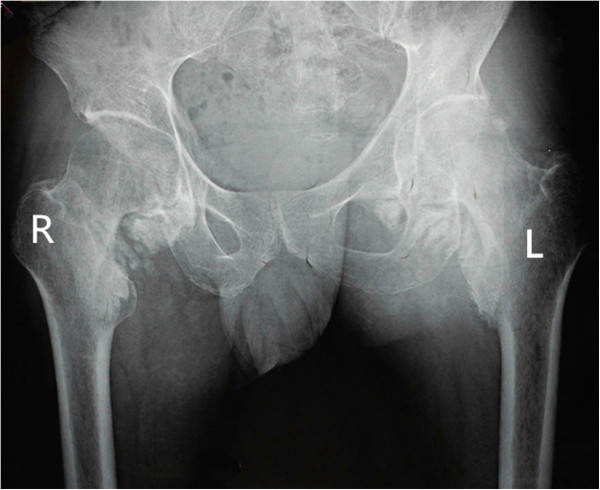
Heterotopic ossification (HO) is a rare and potentially detrimental complication of soft-tissue trauma, amputations, central nervous system injury (traumatic brain injuries, spinal cord lesions, tumors, encephalitis), vasculopathies, arthroplasties and burn injury, characterized by lamellar bone growth in non-osseous tissues such as the muscle and the joint capsule. Heterotopic ossification associated with encephalitis is rare and the occurrence of excessive, symptomatic heterotopic ossification around bilateral hips and bilateral knees is rarely described in the literature.
We present a 47-year-old man with heterotopic ossification in the bilateral hips and bilateral knees that prevented him from walking after being attacked by encephalitis as the case study. He developed severe pain and significantly impaired range of motion of bilateral hips and bilateral knees. Research so far revealed that the management of heterotopic ossification is controversial. After requiring revision surgery resection of heterotopic ossification, reconstruction of the medial collateral ligament and adjunctive pharmacotherapy of 200 mg Celecoxib for 8 weeks after operation, he regained mobility of his joints. On review of X-ray, there was no recurrence of HO and no loosening of rivets which were used in the reconstruction of medial collateral ligament.
Heterotopic ossification in the bilateral hip joints and bilateral knee joints associated with encephalitis have never been reported previously. Daily functions of heterotopic ossification patients can be hampered by pain, inflammation, reduced mobility, the loss of normal posture and other complications. Further studies of presumptive root causes, the early diagnosis, preventability and optimal therapeutic measures for heterotopic ossification following encephalitis are required. Different patient should be managed with different appropriated protocol based on the risk of individual patient and the institutional experience.
异位骨化(HO)是软组织创伤、截肢、中枢神经系统损伤(创伤性脑损伤、脊髓损伤、肿瘤、脑炎)、血管病变、关节成形术和烧伤损伤中一种罕见且可能有害的并发症,其特征是在肌肉和关节囊等非骨性组织中出现板层状骨生长。与脑炎相关的异位骨化很少见,文献中很少描述双侧髋部和双侧膝关节周围出现过度的、有症状的异位骨化情况。
我们报告一例47岁男性,作为病例研究,其在患脑炎后双侧髋部和双侧膝关节出现异位骨化,导致无法行走。他双侧髋部和双侧膝关节出现严重疼痛,活动范围明显受限。目前的研究表明,异位骨化的治疗存在争议。在进行异位骨化翻修手术切除、内侧副韧带重建以及术后使用200毫克塞来昔布辅助药物治疗8周后,他恢复了关节活动能力。复查X线显示,异位骨化未复发,内侧副韧带重建所用铆钉未松动。
双侧髋关节和双侧膝关节与脑炎相关的异位骨化此前从未有过报道。异位骨化患者的日常功能可能会受到疼痛、炎症、活动能力下降、正常姿势丧失及其他并发症的影响。需要进一步研究脑炎后异位骨化的可能病因、早期诊断、可预防性及最佳治疗措施。应根据个体患者的风险和机构经验,采用不同的合适方案对不同患者进行管理。