Wan Zhong-Yuan, Song Fang, Sun Zhen, Chen Yu-Fei, Zhang Wei-Lin, Samartzis Dino, Ma Chi-Jiao, Che Lu, Liu Xu, Ali M-Azam, Wang Hai-Qiang, Luo Zhuo-Jing
Arthritis Res Ther. 2014 Oct 4;16(5):465. doi: 10.1186/s13075-014-0465-5.
In addition to the well-known short noncoding RNAs such as microRNAs (miRNAs), increasing evidence suggests that long noncoding RNAs (lncRNAs) act as key regulators in a wide aspect of biologic processes. Dysregulated expression of lncRNAs has been demonstrated being implicated in a variety of human diseases. However, little is known regarding the role of lncRNAs with regards to intervertebral disc degeneration (IDD). In the present study we aimed to determine whether lncRNAs are differentially expressed in IDD.
An lncRNA-mRNA microarray analysis of human nucleus pulposus (NP) was employed. Bioinformatics prediction was also applied to delineate the functional roles of the differentially expressed lncRNAs. Several lncRNAs and mRNAs were chosen for quantitative real-time PCR (qRT-PCR) validation.
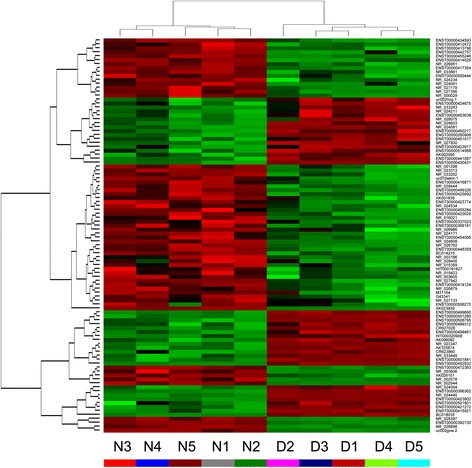
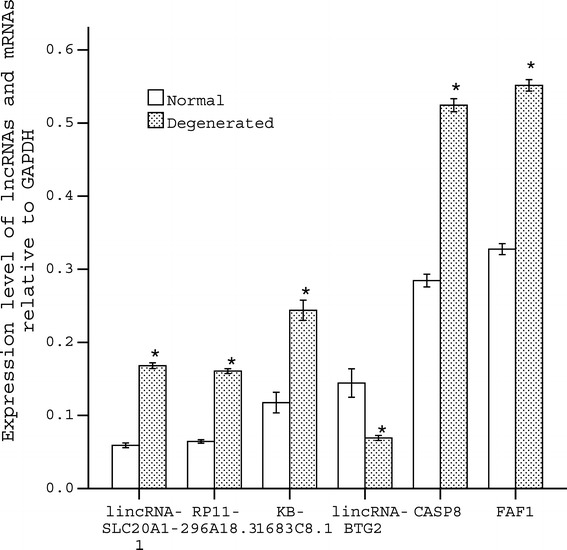
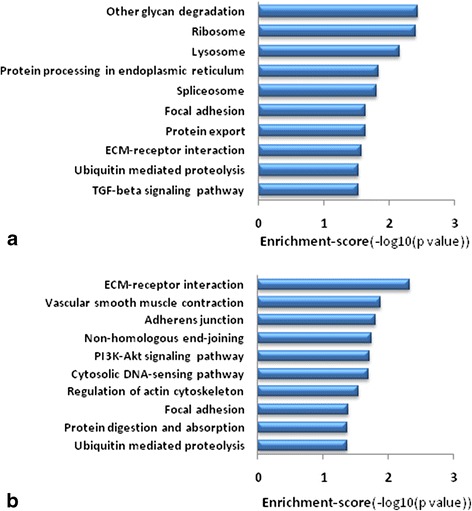
Microarray data profiling indicated that 116 lncRNAs (67 up and 49 down) and 260 mRNAs were highly differentially expressed with an absolute fold change greater than ten. Moreover, 1,052 lncRNAs and 1,314 mRNAs were differentially expressed in the same direction in at least four of the five degenerative samples with fold change greater than two. Kyoto Encyclopedia of Genes and Genomes (KEGG) pathway analysis for the differentially expressed mRNAs indicated a number of pathways, such as extracellular matrix (ECM)-receptor interaction. A coding-noncoding gene co-expression (CNC) network was constructed for the ten most significantly changed lncRNAs. Annotation terms of the coexpressed mRNAs were related to several known degenerative alterations, such as chondrocyte differentiation. Moreover, lncRNAs belonging to a particular subgroup were identified. Functional annotation for the corresponding nearby coding genes showed that these lncRNAs were mainly associated with cell migration and phosphorylation. Interestingly, we found that Fas-associated protein factor-1 (FAF1), which potentiates the Fas-mediated apoptosis and its nearby enhancer-like lncRNA RP11-296A18.3, were highly expressed in the degenerative discs. Subsequent qRT-PCR results confirmed the changes.
This is the first study to demonstrate that aberrantly expressed lncRNAs play a role in the development of IDD. Our study noted that up-regulated RP11-296A18.3 highly likely induced the over-expression of FAF1, which eventually promoted the aberrant apoptosis of disc cells. Such findings further broaden the understanding of the etiology of IDD.
除了众所周知的短链非编码RNA,如微小RNA(miRNA)外,越来越多的证据表明长链非编码RNA(lncRNA)在生物过程的广泛方面起着关键调节作用。lncRNA的表达失调已被证明与多种人类疾病有关。然而,关于lncRNA在椎间盘退变(IDD)中的作用知之甚少。在本研究中,我们旨在确定lncRNA在IDD中是否存在差异表达。
采用人髓核(NP)的lncRNA-mRNA微阵列分析。还应用生物信息学预测来描述差异表达的lncRNA的功能作用。选择了几种lncRNA和mRNA进行定量实时PCR(qRT-PCR)验证。
微阵列数据剖析表明,116种lncRNA(67种上调和49种下调)和260种mRNA高度差异表达,绝对倍数变化大于10。此外,在五个退变样本中的至少四个中,1052种lncRNA和1314种mRNA以相同方向差异表达,倍数变化大于2。对差异表达的mRNA进行京都基因与基因组百科全书(KEGG)通路分析,表明有许多通路,如细胞外基质(ECM)-受体相互作用。为十个变化最显著的lncRNA构建了编码-非编码基因共表达(CNC)网络。共表达mRNA的注释术语与一些已知的退变改变有关,如软骨细胞分化。此外,还鉴定出属于特定亚组的lncRNA。对相应附近编码基因的功能注释表明,这些lncRNA主要与细胞迁移和磷酸化有关。有趣的是,我们发现增强Fas介导的凋亡的Fas相关蛋白因子-1(FAF1)及其附近的增强子样lncRNA RP11-296A18.3在退变椎间盘中高表达。随后的qRT-PCR结果证实了这些变化。
这是第一项证明异常表达的lncRNA在IDD发展中起作用的研究。我们的研究指出,上调的RP11-296A18.3很可能诱导FAF1的过度表达,最终促进椎间盘细胞的异常凋亡现象。这些发现进一步拓宽了对IDD病因学的理解。