Demir Hande, Donner Iikki, Kivipelto Leena, Kuismin Outi, Schalin-Jäntti Camilla, De Menis Ernesto, Karhu Auli
Department of Medical Genetics, Genome-Scale Biology Research Program, Institute of Biomedicine, Biomedicum Helsinki, University of Helsinki, Helsinki, Finland.
Department of Neurosurgery, Helsinki University Central Hospital, Helsinki, Finland.
PLoS One. 2014 Oct 7;9(10):e109897. doi: 10.1371/journal.pone.0109897. eCollection 2014.
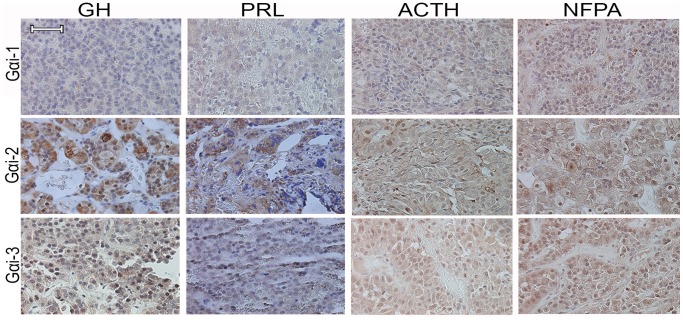
Pituitary adenomas are neoplasms of the anterior pituitary lobe and account for 15-20% of all intracranial tumors. Although most pituitary tumors are benign they can cause severe symptoms related to tumor size as well as hypopituitarism and/or hypersecretion of one or more pituitary hormones. Most pituitary adenomas are sporadic, but it has been estimated that 5% of patients have a familial background. Germline mutations of the tumor suppressor gene aryl hydrocarbon receptor-interacting protein (AIP) predispose to hereditary pituitary neoplasia. Recently, it has been demonstrated that AIP mutations predispose to pituitary tumorigenesis through defective inhibitory GTP binding protein (Gαi) signaling. This finding prompted us to examine whether germline loss-of-function mutations in inhibitory guanine nucleotide (GTP) binding protein alpha (GNAI) loci are involved in genetic predisposition of pituitary tumors. To our knowledge, this is the first time GNAI genes are sequenced in order to examine the occurrence of inactivating germline mutations. Thus far, only somatic gain-of-function hot-spot mutations have been studied in these loci. Here, we have analyzed the coding regions of GNAI1, GNAI2, and GNAI3 in a set of young sporadic somatotropinoma patients (n = 32; mean age of diagnosis 32 years) and familial index cases (n = 14), thus in patients with a disease phenotype similar to that observed in AIP mutation carriers. In addition, expression of Gαi proteins was studied in human growth hormone (GH), prolactin (PRL), adrenocorticotropic hormone (ACTH)-secreting and non-functional pituitary tumors. No pathogenic germline mutations affecting the Gαi proteins were detected. The result suggests that loss-of-function mutations of GNAI loci are rare or nonexistent in familial pituitary adenomas.
垂体腺瘤是垂体前叶的肿瘤,占所有颅内肿瘤的15% - 20%。尽管大多数垂体肿瘤是良性的,但它们可导致与肿瘤大小相关的严重症状,以及垂体功能减退和/或一种或多种垂体激素的分泌过多。大多数垂体腺瘤是散发性的,但据估计5%的患者有家族背景。肿瘤抑制基因芳烃受体相互作用蛋白(AIP)的种系突变易患遗传性垂体肿瘤。最近,已证明AIP突变通过缺陷性抑制性GTP结合蛋白(Gαi)信号传导易患垂体肿瘤发生。这一发现促使我们研究抑制性鸟嘌呤核苷酸(GTP)结合蛋白α(GNAI)基因座的种系功能丧失突变是否参与垂体肿瘤的遗传易感性。据我们所知,这是首次对GNAI基因进行测序以检查种系失活突变的发生情况。迄今为止,在这些基因座中仅研究了体细胞功能获得性热点突变。在这里,我们分析了一组年轻的散发性生长激素瘤患者(n = 32;平均诊断年龄32岁)和家族性索引病例(n = 14)中GNAI1、GNAI2和GNAI3的编码区,这些患者具有与AIP突变携带者中观察到的相似疾病表型。此外,还研究了Gαi蛋白在人类生长激素(GH)、催乳素(PRL)、促肾上腺皮质激素(ACTH)分泌性和无功能性垂体肿瘤中的表达。未检测到影响Gαi蛋白的致病性种系突变。结果表明,GNAI基因座的功能丧失突变在家族性垂体腺瘤中很少见或不存在。