Taylor Amy E, Fluharty Meg E, Bjørngaard Johan H, Gabrielsen Maiken Elvestad, Skorpen Frank, Marioni Riccardo E, Campbell Archie, Engmann Jorgen, Mirza Saira Saeed, Loukola Anu, Laatikainen Tiina, Partonen Timo, Kaakinen Marika, Ducci Francesca, Cavadino Alana, Husemoen Lise Lotte N, Ahluwalia Tarunveer Singh, Jacobsen Rikke Kart, Skaaby Tea, Ebstrup Jeanette Frost, Mortensen Erik Lykke, Minica Camelia C, Vink Jacqueline M, Willemsen Gonneke, Marques-Vidal Pedro, Dale Caroline E, Amuzu Antoinette, Lennon Lucy T, Lahti Jari, Palotie Aarno, Räikkönen Katri, Wong Andrew, Paternoster Lavinia, Wong Angelita Pui-Yee, Horwood L John, Murphy Michael, Johnstone Elaine C, Kennedy Martin A, Pausova Zdenka, Paus Tomáš, Ben-Shlomo Yoav, Nohr Ellen A, Kuh Diana, Kivimaki Mika, Eriksson Johan G, Morris Richard W, Casas Juan P, Preisig Martin, Boomsma Dorret I, Linneberg Allan, Power Chris, Hyppönen Elina, Veijola Juha, Jarvelin Marjo-Riitta, Korhonen Tellervo, Tiemeier Henning, Kumari Meena, Porteous David J, Hayward Caroline, Romundstad Pål R, Smith George Davey, Munafò Marcus R
MRC Integrative Epidemiology Unit (IEU) at the University of Bristol, UK.
UK Centre for Tobacco and Alcohol Studies, School of Experimental Psychology, University of Bristol, Bristol, UK.
BMJ Open. 2014 Oct 7;4(10):e006141. doi: 10.1136/bmjopen-2014-006141.
To investigate whether associations of smoking with depression and anxiety are likely to be causal, using a Mendelian randomisation approach.
Mendelian randomisation meta-analyses using a genetic variant (rs16969968/rs1051730) as a proxy for smoking heaviness, and observational meta-analyses of the associations of smoking status and smoking heaviness with depression, anxiety and psychological distress.
Current, former and never smokers of European ancestry aged ≥16 years from 25 studies in the Consortium for Causal Analysis Research in Tobacco and Alcohol (CARTA).
Binary definitions of depression, anxiety and psychological distress assessed by clinical interview, symptom scales or self-reported recall of clinician diagnosis.
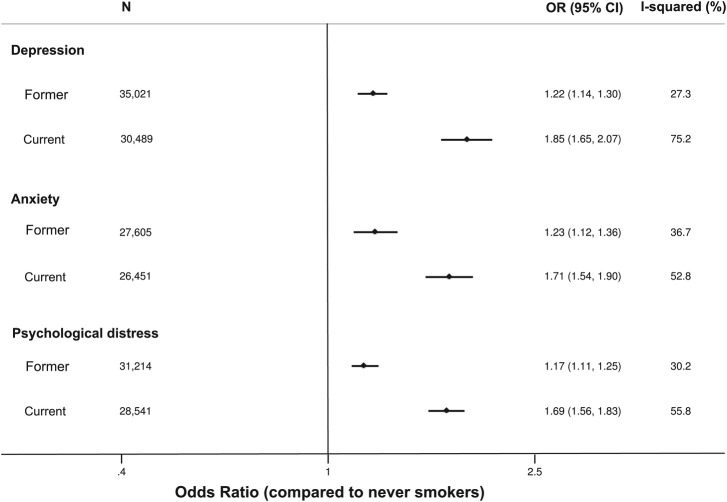
The analytic sample included up to 58 176 never smokers, 37 428 former smokers and 32 028 current smokers (total N=127 632). In observational analyses, current smokers had 1.85 times greater odds of depression (95% CI 1.65 to 2.07), 1.71 times greater odds of anxiety (95% CI 1.54 to 1.90) and 1.69 times greater odds of psychological distress (95% CI 1.56 to 1.83) than never smokers. Former smokers also had greater odds of depression, anxiety and psychological distress than never smokers. There was evidence for positive associations of smoking heaviness with depression, anxiety and psychological distress (ORs per cigarette per day: 1.03 (95% CI 1.02 to 1.04), 1.03 (95% CI 1.02 to 1.04) and 1.02 (95% CI 1.02 to 1.03) respectively). In Mendelian randomisation analyses, there was no strong evidence that the minor allele of rs16969968/rs1051730 was associated with depression (OR=1.00, 95% CI 0.95 to 1.05), anxiety (OR=1.02, 95% CI 0.97 to 1.07) or psychological distress (OR=1.02, 95% CI 0.98 to 1.06) in current smokers. Results were similar for former smokers.
Findings from Mendelian randomisation analyses do not support a causal role of smoking heaviness in the development of depression and anxiety.
采用孟德尔随机化方法研究吸烟与抑郁及焦虑之间的关联是否可能具有因果关系。
使用一种基因变异(rs16969968/rs1051730)作为吸烟量的替代指标进行孟德尔随机化荟萃分析,以及对吸烟状况和吸烟量与抑郁、焦虑及心理困扰之间的关联进行观察性荟萃分析。
来自烟酒因果分析研究联盟(CARTA)的25项研究中年龄≥16岁的欧洲血统现吸烟者、既往吸烟者和从不吸烟者。
通过临床访谈、症状量表或对临床医生诊断的自我报告回忆来评估抑郁、焦虑和心理困扰的二元定义。
分析样本包括多达58176名从不吸烟者、37428名既往吸烟者和32028名现吸烟者(总计N = 127632)。在观察性分析中,现吸烟者患抑郁症的几率比从不吸烟者高1.85倍(95%置信区间1.65至2.07),患焦虑症的几率高1.71倍(95%置信区间1.54至1.90),患心理困扰的几率高1.69倍(95%置信区间1.56至1.83)。既往吸烟者患抑郁、焦虑和心理困扰的几率也比从不吸烟者高。有证据表明吸烟量与抑郁、焦虑和心理困扰呈正相关(每天每支烟的比值比:分别为1.03(95%置信区间1.02至1.04)、1.03(95%置信区间1.02至1.04)和1.02(95%置信区间1.02至1.03))。在孟德尔随机化分析中,没有强有力的证据表明rs16969968/rs1051730的次要等位基因与现吸烟者的抑郁(比值比 = 1.00,95%置信区间0.95至1.05)、焦虑(比值比 = 1.02,95%置信区间0.97至1.07)或心理困扰(比值比 = 1.02,95%置信区间0.98至1.06)有关。既往吸烟者的结果相似。
孟德尔随机化分析的结果不支持吸烟量在抑郁和焦虑发生中具有因果作用。