Keefover-Ring Ken, Ahnlund Maria, Abreu Ilka Nacif, Jansson Stefan, Moritz Thomas, Albrectsen Benedicte Riber
Department of Plant Physiology, Umeå Plant Science Centre, Umeå University, Umeå, Sweden; Department of Entomology, University of Wisconsin-Madison, Madison, Wisconsin, United States of America.
Department of Forest Genetics and Plant Physiology, Swedish University of Agricultural Sciences, Umeå Plant Science Centre, Umeå, Sweden.
PLoS One. 2014 Oct 9;9(10):e107189. doi: 10.1371/journal.pone.0107189. eCollection 2014.
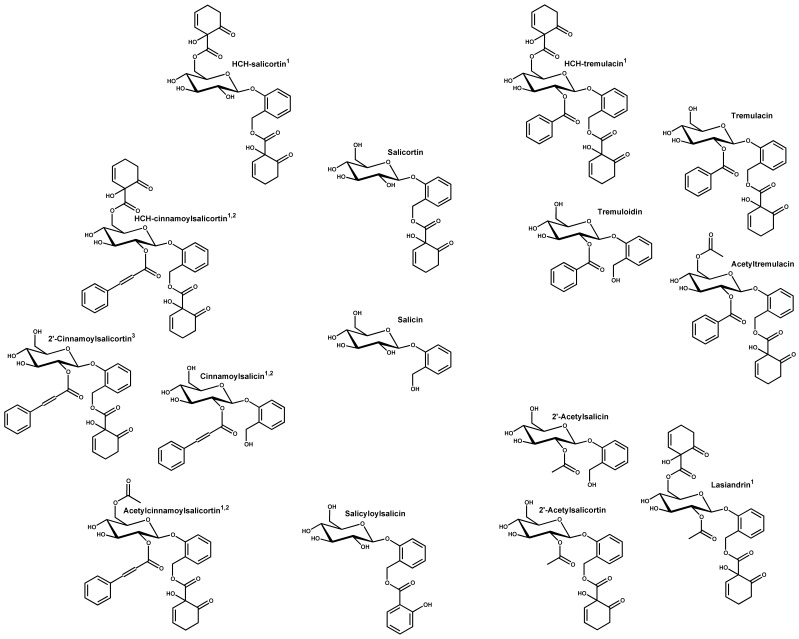
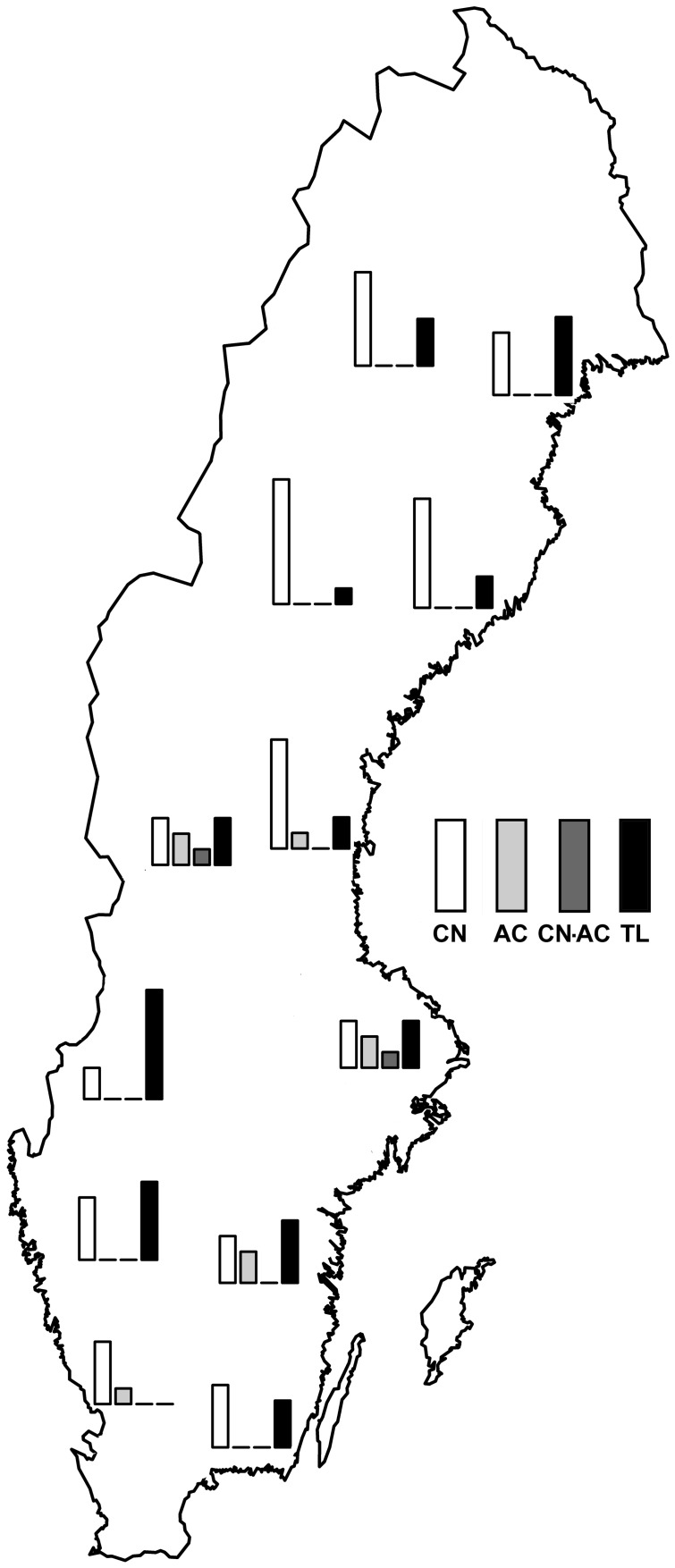
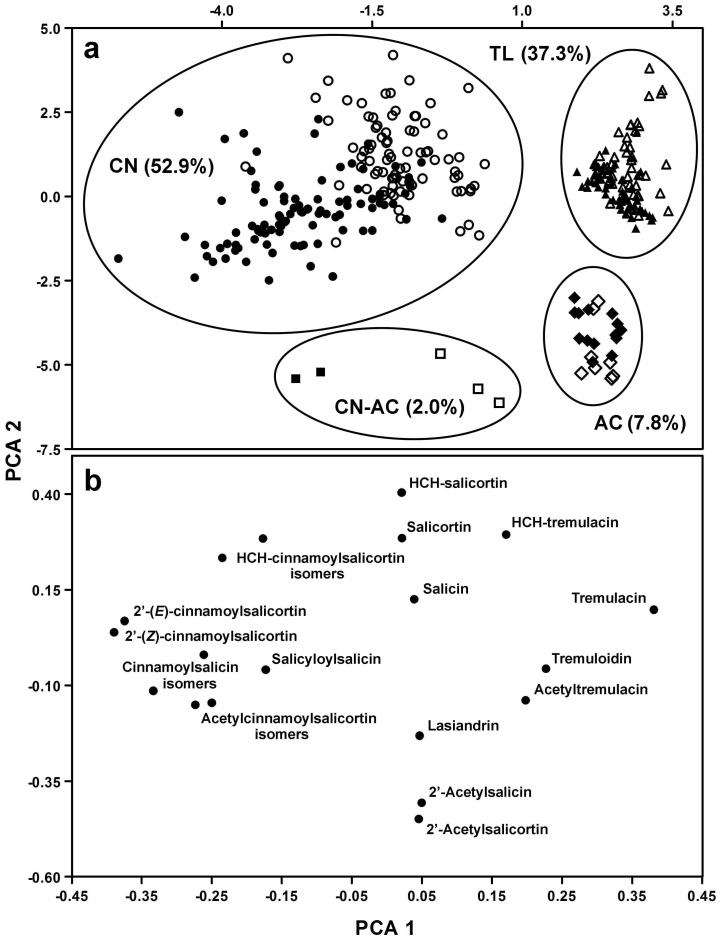
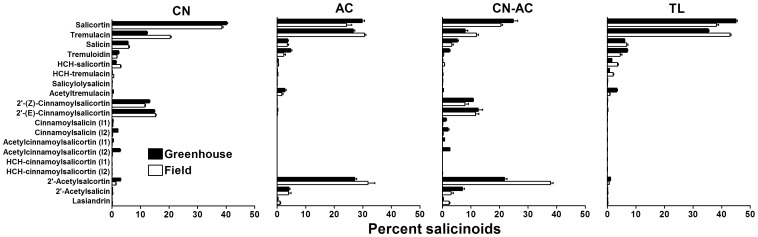
Salicinoids are well-known defense compounds in salicaceous trees and careful screening at the population level is warranted to fully understand their diversity and function. European aspen, Populus tremula, is a foundation species in Eurasia and highly polymorphic in Sweden. We exhaustively surveyed 102 replicated genotypes from the Swedish Aspen collection (SwAsp) for foliar salicinoids using UHPLC-ESI-TOF/MS and identified nine novel compounds, bringing the total to 19 for this species. Salicinoid structure followed a modular architecture of a salicin skeleton with added side groups, alone or in combination. Two main moieties, 2'-cinnamoyl and 2'-acetyl, grouped the SwAsp population into four distinct chemotypes, and the relative allocation of salicinoids was remarkably constant between different environments, implying a highly channeled biosynthesis of these compounds. Slightly more than half of the SwAsp genotypes belonged to the cinnamoyl chemotype. A fraction synthesized the acetyl moiety alone (∼7%) or in combination with cinnamoyl (∼2%), and close to forty percent lacked either of the two characteristic moieties, and thus resemble P. tremuloides in their salicinoid profile. The two most abundant chemotypes were evenly distributed throughout Sweden, unlike geographical patterns reported for SwAsp phenology traits, plant defense genes, and herbivore community associations. Here we present the salicinoid characterization of the SwAsp collection as a resource for future studies of aspen chemical ecology, salicinoid biosynthesis, and genetics.
水杨素类化合物是杨柳科树木中著名的防御性化合物,有必要在种群水平上进行仔细筛选,以全面了解它们的多样性和功能。欧洲山杨(Populus tremula)是欧亚大陆的基础物种,在瑞典具有高度多态性。我们使用超高效液相色谱-电喷雾电离-飞行时间质谱(UHPLC-ESI-TOF/MS)对瑞典山杨种质库(SwAsp)中的102个重复基因型的叶片水杨素类化合物进行了详尽的调查,鉴定出9种新化合物,使该物种的此类化合物总数达到19种。水杨素类化合物的结构遵循水杨素骨架加上侧基的模块化结构,侧基单独或组合存在。两个主要部分,2'-肉桂酰基和2'-乙酰基,将SwAsp种群分为四种不同的化学型,并且在不同环境下水杨素类化合物的相对分配非常恒定,这意味着这些化合物的生物合成具有高度的定向性。略超过一半的SwAsp基因型属于肉桂酰基化学型。一小部分仅合成乙酰基部分(约7%)或与肉桂酰基结合合成(约2%),近40%的基因型缺乏这两个特征部分中的任何一个,因此在水杨素类化合物谱方面与颤杨(P. tremuloides)相似。与报道的SwAsp物候特征、植物防御基因和食草动物群落关联的地理模式不同,两种最丰富的化学型在瑞典各地均匀分布。在这里,我们展示了SwAsp种质库的水杨素类化合物特征,作为未来研究山杨化学生态学、水杨素类化合物生物合成和遗传学的资源。