Larsen Charles E, Alford Dennis R, Trautwein Michael R, Jalloh Yanoh K, Tarnacki Jennifer L, Kunnenkeri Sushruta K, Fici Dolores A, Yunis Edmond J, Awdeh Zuheir L, Alper Chester A
Program in Cellular and Molecular Medicine, Boston Children's Hospital, Boston, Massachusetts, United States of America; Department of Medicine, Harvard Medical School, Boston, Massachusetts, United States of America.
Program in Cellular and Molecular Medicine, Boston Children's Hospital, Boston, Massachusetts, United States of America.
PLoS Genet. 2014 Oct 9;10(10):e1004637. doi: 10.1371/journal.pgen.1004637. eCollection 2014 Oct.
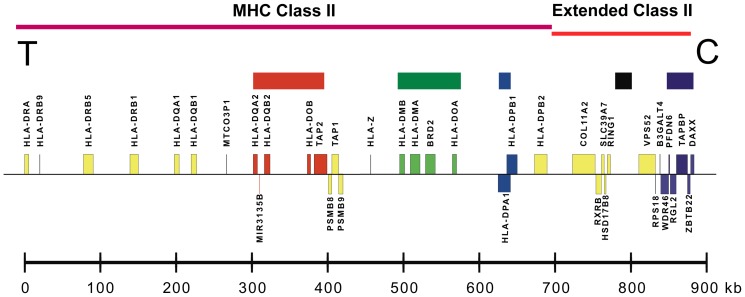
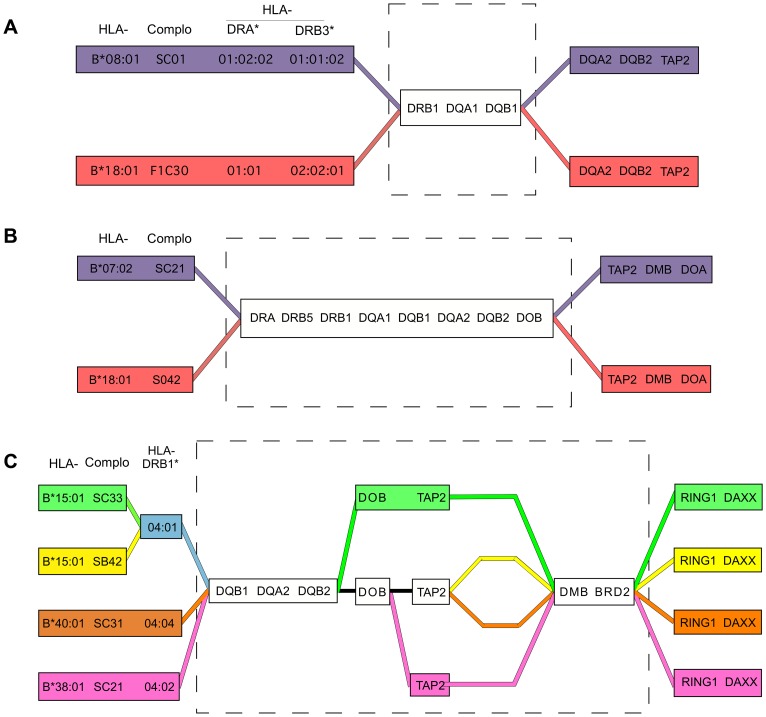
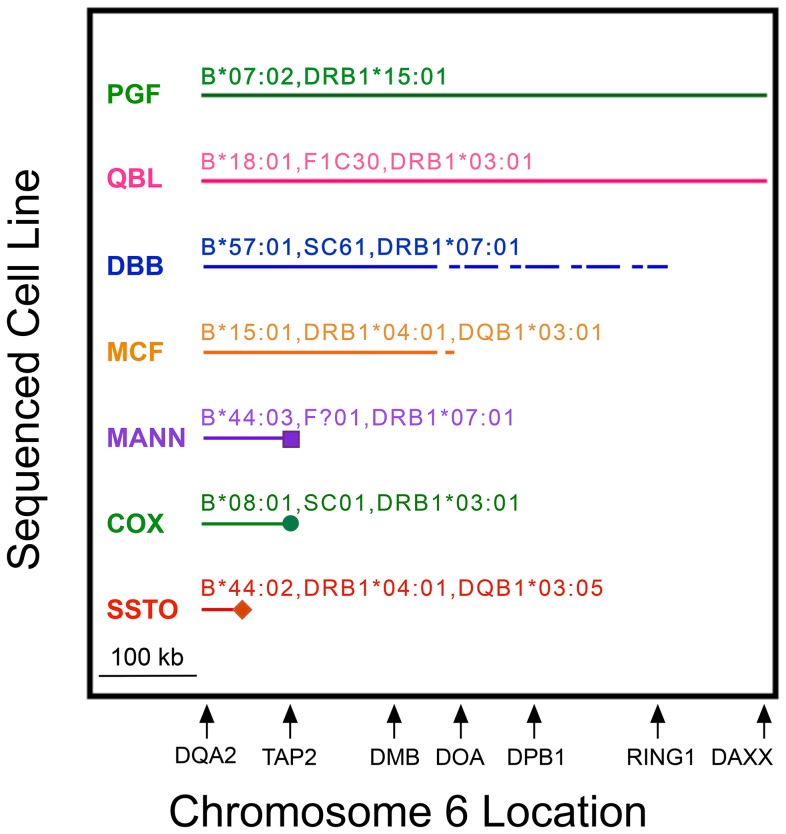
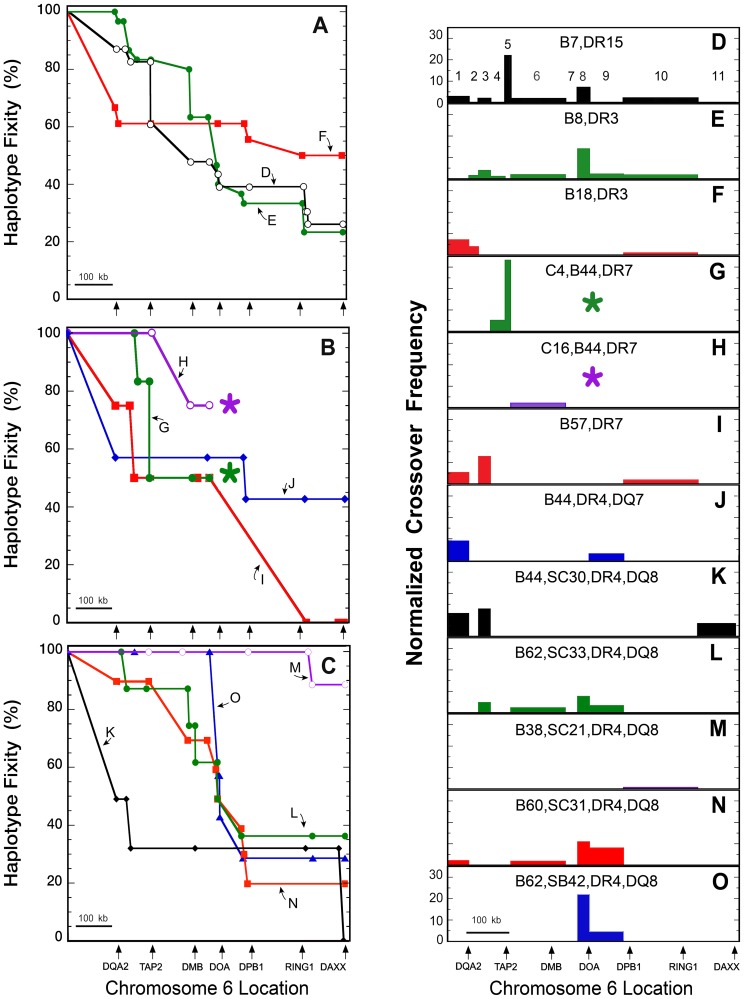
We resequenced and phased 27 kb of DNA within 580 kb of the MHC class II region in 158 population chromosomes, most of which were conserved extended haplotypes (CEHs) of European descent or contained their centromeric fragments. We determined the single nucleotide polymorphism and deletion-insertion polymorphism alleles of the dominant sequences from HLA-DQA2 to DAXX for these CEHs. Nine of 13 CEHs remained sufficiently intact to possess a dominant sequence extending at least to DAXX, 230 kb centromeric to HLA-DPB1. We identified the regions centromeric to HLA-DQB1 within which single instances of eight "common" European MHC haplotypes previously sequenced by the MHC Haplotype Project (MHP) were representative of those dominant CEH sequences. Only two MHP haplotypes had a dominant CEH sequence throughout the centromeric and extended class II region and one MHP haplotype did not represent a known European CEH anywhere in the region. We identified the centromeric recombination transition points of other MHP sequences from CEH representation to non-representation. Several CEH pairs or groups shared sequence identity in small blocks but had significantly different (although still conserved for each separate CEH) sequences in surrounding regions. These patterns partly explain strong calculated linkage disequilibrium over only short (tens to hundreds of kilobases) distances in the context of a finite number of observed megabase-length CEHs comprising half a population's haplotypes. Our results provide a clearer picture of European CEH class II allelic structure and population haplotype architecture, improved regional CEH markers, and raise questions concerning regional recombination hotspots.
我们对158条群体染色体上MHC II类区域580 kb范围内的27 kb DNA进行了重测序和定相,其中大部分是欧洲血统的保守延伸单倍型(CEH)或包含其着丝粒片段。我们确定了这些CEH从HLA - DQA2到DAXX的显性序列的单核苷酸多态性和缺失 - 插入多态性等位基因。13个CEH中有9个保持足够完整,拥有至少延伸到DAXX的显性序列,DAXX位于HLA - DPB1着丝粒方向230 kb处。我们确定了HLA - DQB1着丝粒方向的区域,在该区域内,MHC单倍型项目(MHP)先前测序的8种“常见”欧洲MHC单倍型的单个实例代表了那些显性CEH序列。只有两种MHP单倍型在整个着丝粒和延伸的II类区域具有显性CEH序列,一种MHP单倍型在该区域的任何地方都不代表已知的欧洲CEH。我们确定了其他MHP序列从CEH代表性到非代表性的着丝粒重组转变点。几个CEH对或组在小片段中共享序列同一性,但在周围区域具有显著不同(尽管每个单独的CEH仍然保守)的序列。这些模式部分解释了在有限数量的观察到的兆碱基长度的CEH(占群体单倍型的一半)的背景下,仅在短(几十到几百千碱基)距离上计算出的强连锁不平衡。我们的结果提供了更清晰的欧洲CEH II类等位基因结构和群体单倍型结构图景,改进了区域CEH标记,并提出了有关区域重组热点的问题。