Department of Medical Oncology & Cancer Biology, Dana-Farber Cancer Institute, 450 Brookline Avenue, Boston, MA 02215, USA.
Pharmacogenomics. 2014 Aug;15(11):1507-18. doi: 10.2217/pgs.14.108.
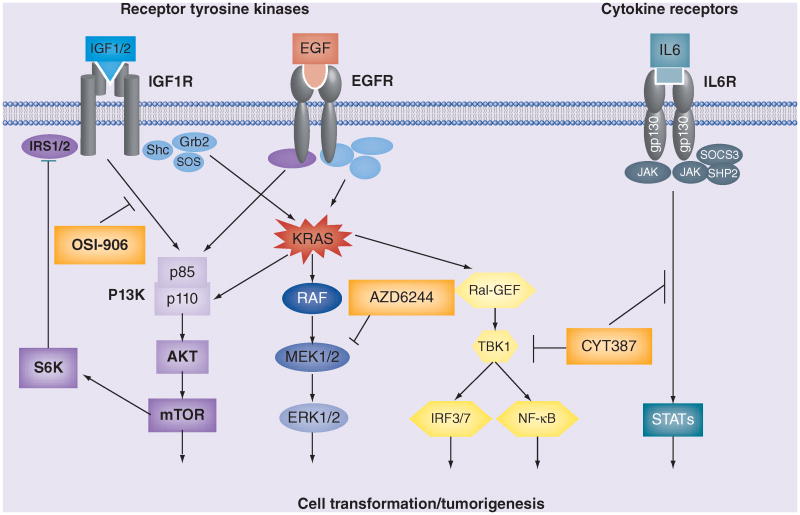
Oncogenic KRAS activation is responsible for the most common genetic subtype of lung cancer. Although many of the major downstream signaling pathways that KRAS engages have been defined, these discoveries have yet to translate into effective targeted therapy. Much of the current focus has been directed at inhibiting the activation of RAF/MAPK and PI3K/AKT signaling, but clinical trials combining multiple different agents that target these pathways have failed to show significant activity. In this article, we will discuss the evidence for RAF and PI3K as key downstream RAS effectors, as well as the RAL guanine exchange factor, which is equally essential for transformation. Furthermore, we will delineate alternative pathways, including cytokine activation and autophagy, which are co-opted by oncogenic RAS signaling and also represent attractive targets for therapy. Finally, we will present strategies for combining inhibitors of these downstream KRAS signaling pathways in a rational fashion, as multitargeted therapy will be required to achieve a cure.
致癌性 KRAS 激活是最常见的肺癌遗传亚型的原因。尽管已经确定了 KRAS 涉及的许多主要下游信号通路,但这些发现尚未转化为有效的靶向治疗。目前的研究重点主要集中在抑制 RAF/MAPK 和 PI3K/AKT 信号的激活上,但联合使用多种靶向这些通路的药物的临床试验并未显示出显著的活性。在本文中,我们将讨论 RAF 和 PI3K 作为关键的下游 RAS 效应物的证据,以及 RAL 鸟嘌呤交换因子,它对于转化同样至关重要。此外,我们将阐述其他途径,包括细胞因子激活和自噬,这些途径被致癌性 RAS 信号转导所采用,也代表着有吸引力的治疗靶点。最后,我们将提出以合理的方式联合这些下游 KRAS 信号通路抑制剂的策略,因为需要多靶向治疗才能实现治愈。