Pagliuca Felicia W, Millman Jeffrey R, Gürtler Mads, Segel Michael, Van Dervort Alana, Ryu Jennifer Hyoje, Peterson Quinn P, Greiner Dale, Melton Douglas A
Department of Stem Cell and Regenerative Biology, Harvard Stem Cell Institute, Harvard University, 7 Divinity Avenue, Cambridge, MA 02138, USA.
Diabetes Center of Excellence, University of Massachusetts Medical School, 368 Plantation Street, AS7-2051, Worcester, MA 01605, USA.
Cell. 2014 Oct 9;159(2):428-39. doi: 10.1016/j.cell.2014.09.040.
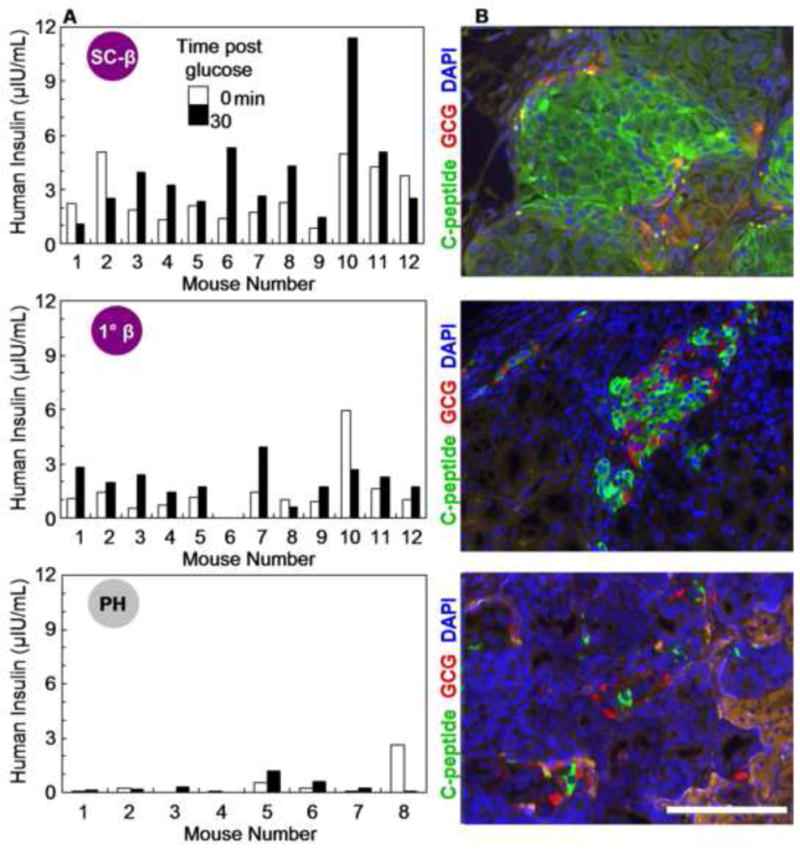
The generation of insulin-producing pancreatic β cells from stem cells in vitro would provide an unprecedented cell source for drug discovery and cell transplantation therapy in diabetes. However, insulin-producing cells previously generated from human pluripotent stem cells (hPSC) lack many functional characteristics of bona fide β cells. Here, we report a scalable differentiation protocol that can generate hundreds of millions of glucose-responsive β cells from hPSC in vitro. These stem-cell-derived β cells (SC-β) express markers found in mature β cells, flux Ca(2+) in response to glucose, package insulin into secretory granules, and secrete quantities of insulin comparable to adult β cells in response to multiple sequential glucose challenges in vitro. Furthermore, these cells secrete human insulin into the serum of mice shortly after transplantation in a glucose-regulated manner, and transplantation of these cells ameliorates hyperglycemia in diabetic mice.
体外从干细胞生成产生胰岛素的胰腺β细胞,将为糖尿病药物研发和细胞移植治疗提供前所未有的细胞来源。然而,先前从人多能干细胞(hPSC)生成的胰岛素产生细胞缺乏真正β细胞的许多功能特性。在此,我们报告一种可扩展的分化方案,该方案能在体外从hPSC生成数亿个对葡萄糖有反应的β细胞。这些源自干细胞的β细胞(SC-β)表达成熟β细胞中发现的标志物,对葡萄糖作出反应时Ca(2+) 内流,将胰岛素包装到分泌颗粒中,并且在体外对多次连续葡萄糖刺激作出反应时分泌的胰岛素量与成年β细胞相当。此外,这些细胞在移植后不久以葡萄糖调节的方式将人胰岛素分泌到小鼠血清中,并且移植这些细胞可改善糖尿病小鼠的高血糖症。