Department of Neurosurgery and Brain Repair, University of South Florida, Tampa, FL, USA.
Neural Regen Res. 2014 Aug 1;9(15):1430-3. doi: 10.4103/1673-5374.139458.
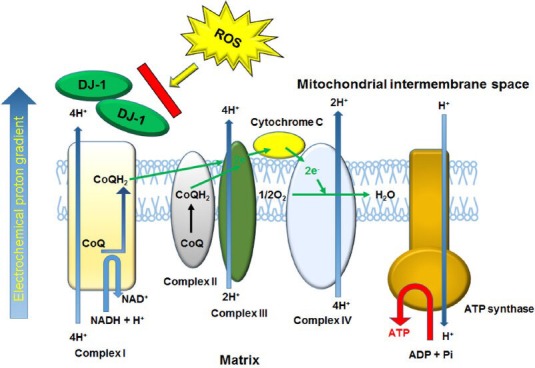
Oxidative stress is closely associated with secondary cell death in many disorders of the central nervous system including stroke, Parkinson's disease, Alzheimer's disease. Among many aberrant oxidative stress-associated proteins, DJ-1 has been associated with the oxidative stress cell death cascade primarily in Parkinson's disease. Although principally expressed in the cytoplasm and nucleus, DJ-1 can be secreted into the serum under pathological condition. Recently, a close pathological association between DJ-1 and oxidative stress in stroke has been implicated. To this end, we and others have demonstrated the important role of mitochondria in neuroprotection for stroke by demonstrating that the translocation of DJ-1 in the mitochondria could potentially mitigate mitochondrial injury. Here, we discuss our recent findings testing the hypothesis that DJ-1 not only functions as a form of intracellular protection from oxidative stress, but that it also utilizes paracrine and/or autocrine cues in order to accomplish extracellular signaling between neighboring neuronal cells, resulting in neuroprotection. This article highlights recent evidence supporting the status of DJ-1 as key anti-oxidative stress therapeutic target for stroke.
氧化应激与中枢神经系统许多疾病(包括中风、帕金森病、阿尔茨海默病)中的继发性细胞死亡密切相关。在许多异常的氧化应激相关蛋白中,DJ-1 主要与帕金森病中的氧化应激细胞死亡级联反应有关。尽管 DJ-1 主要在细胞质和细胞核中表达,但在病理条件下它可以分泌到血清中。最近,DJ-1 与中风中的氧化应激之间存在密切的病理关联。为此,我们和其他人通过证明 DJ-1 在 线粒体中的易位可能潜在减轻线粒体损伤,证明了线粒体在中风神经保护中的重要作用。在这里,我们讨论了我们最近的发现,这些发现检验了这样一个假设,即 DJ-1 不仅作为一种抵抗氧化应激的细胞内保护形式发挥作用,而且还利用旁分泌和/或自分泌信号来完成相邻神经元细胞之间的细胞外信号传递,从而实现神经保护。本文强调了支持 DJ-1 作为中风抗氧化应激治疗靶点的最新证据。